

Kiwi Ears Aether Earphones Review
At the end of December, Kiwi Ears wrote me an email with an assertive partnership proposal. They were offering different things, I was being picky, but they didn’t have all the models available to send to reviewers. We settled on Aether as a middle ground that suited both me and them.
Therefore, today we’ll talk about Aether. Kiwi Ears, thank you so much for sending me this model!
The manufacturer wants $170 for these single-driver planar earphones on their official website, while Russian marketplaces set the initial price of Aether at some $136.
All but the sound
The earphones come in a medium-sized cardboard box.

Here’s what’s inside:
- the earphones themselves;
- three sets of eartips, with three pairs of them in each;
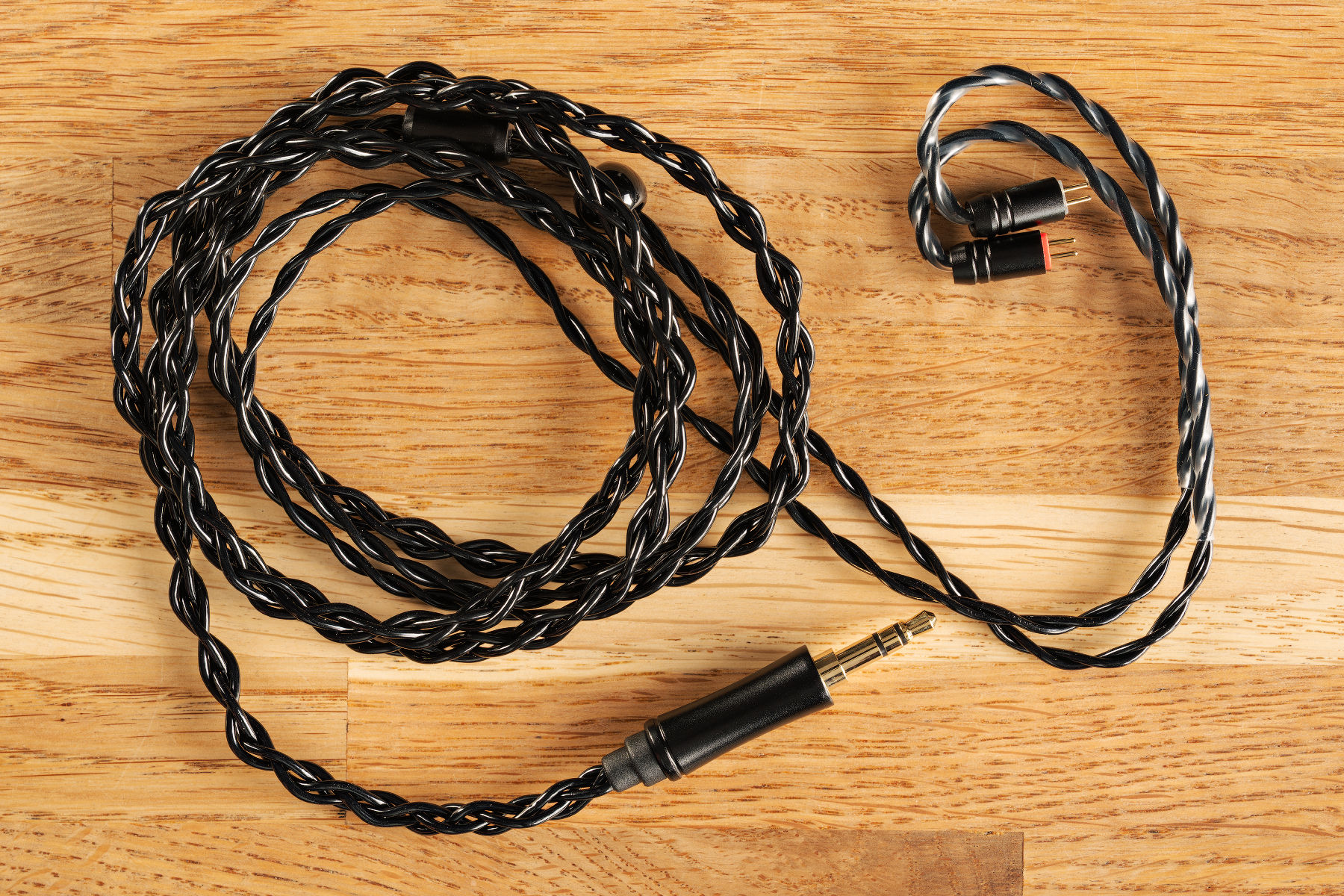
- a cable;
- a case;
- some papers.
No additional accessories, such as key chains, like Truthear’s, or acrylic stands like Roseselsa’s, are included.
The case is extremely simple, so I didn’t even take any pictures of it.
As for the eartips, the black ones have an average density, the white ones are softer, and the red and gray ones are equipped with elastic cores, but soft flanges. In terms of the shape of the flanges and the diameters of the sound ducts, all original eartips are identical.

The cable is just a cable with a non-replaceable connector. The cable is decent, and it works.
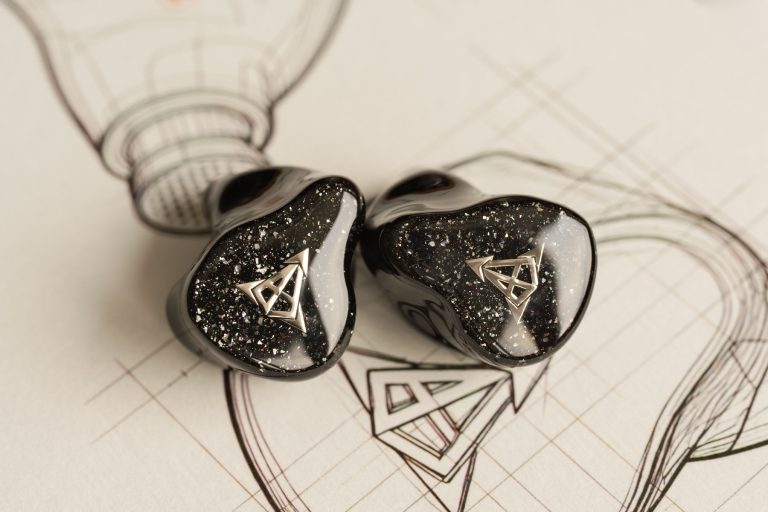
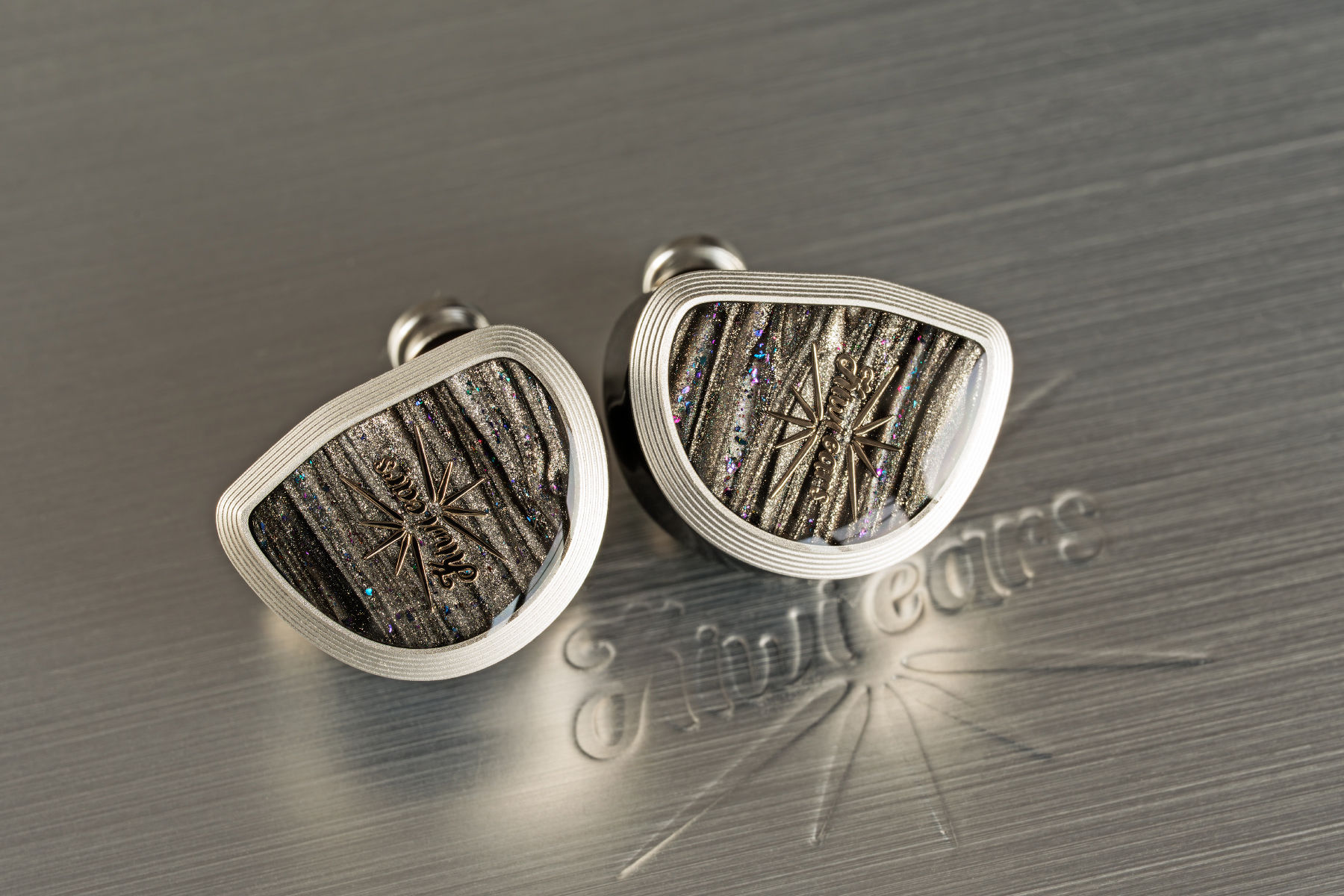
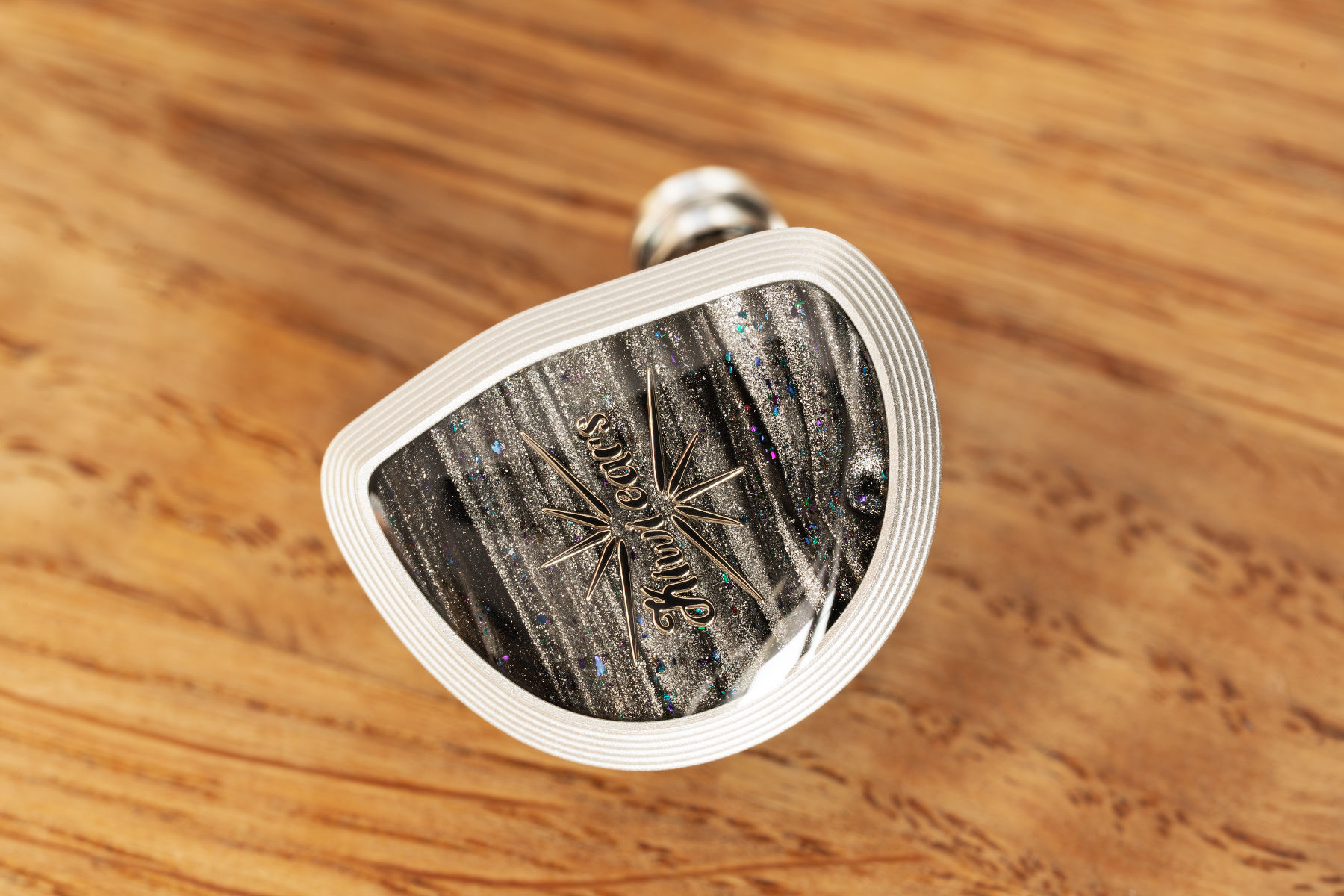
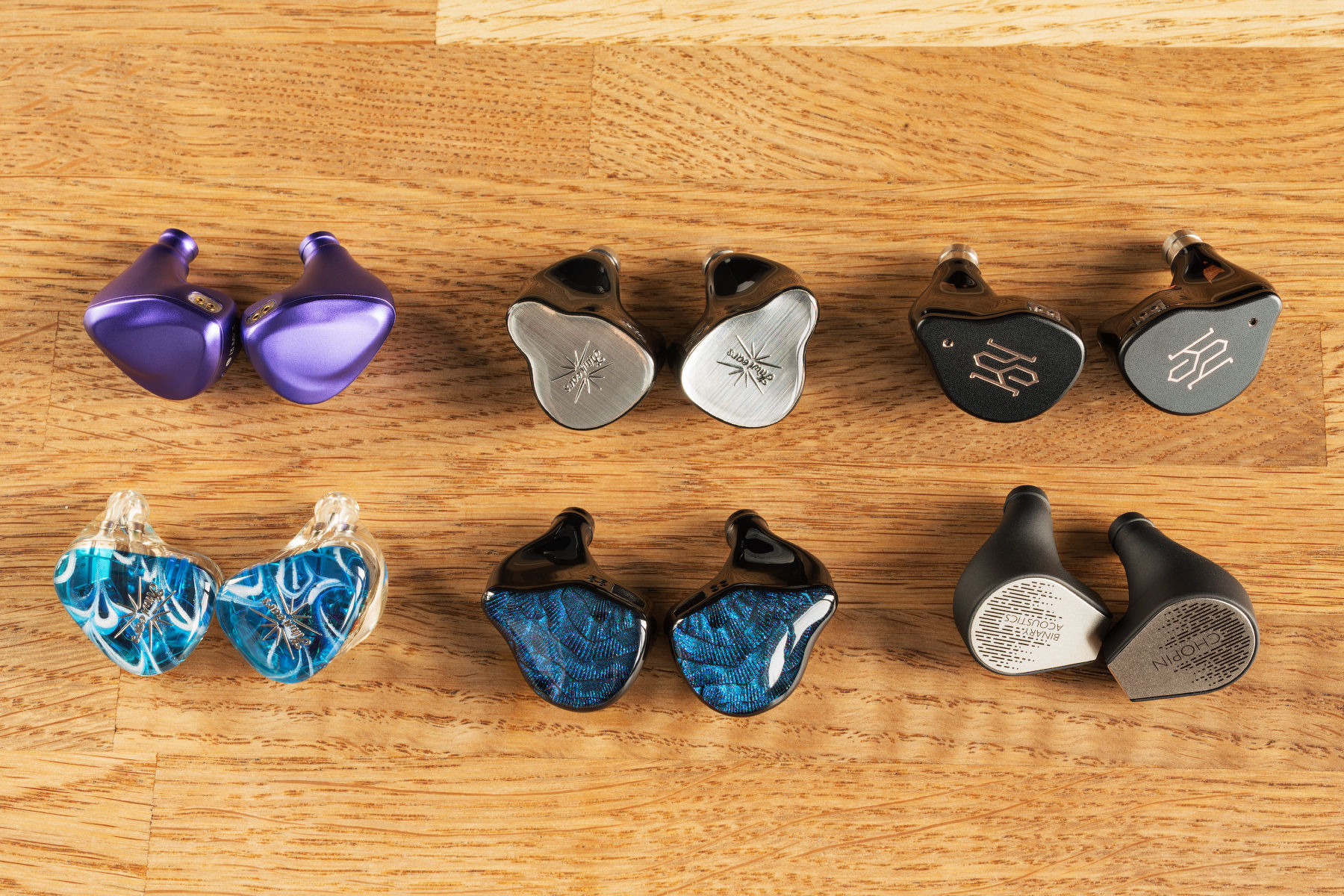
Next come the earphones themselves. The manufacturer’s golden logo can be seen under transparent faceplates against a background of silver layered glitter. There are purple and blue color accents, made with separate shiny particles, while the outer plates are metal-framed, and the polymer resin earphone shells are hollow and translucent in bright light.
The earphones look low-key, but worthy of their price, I’d say.
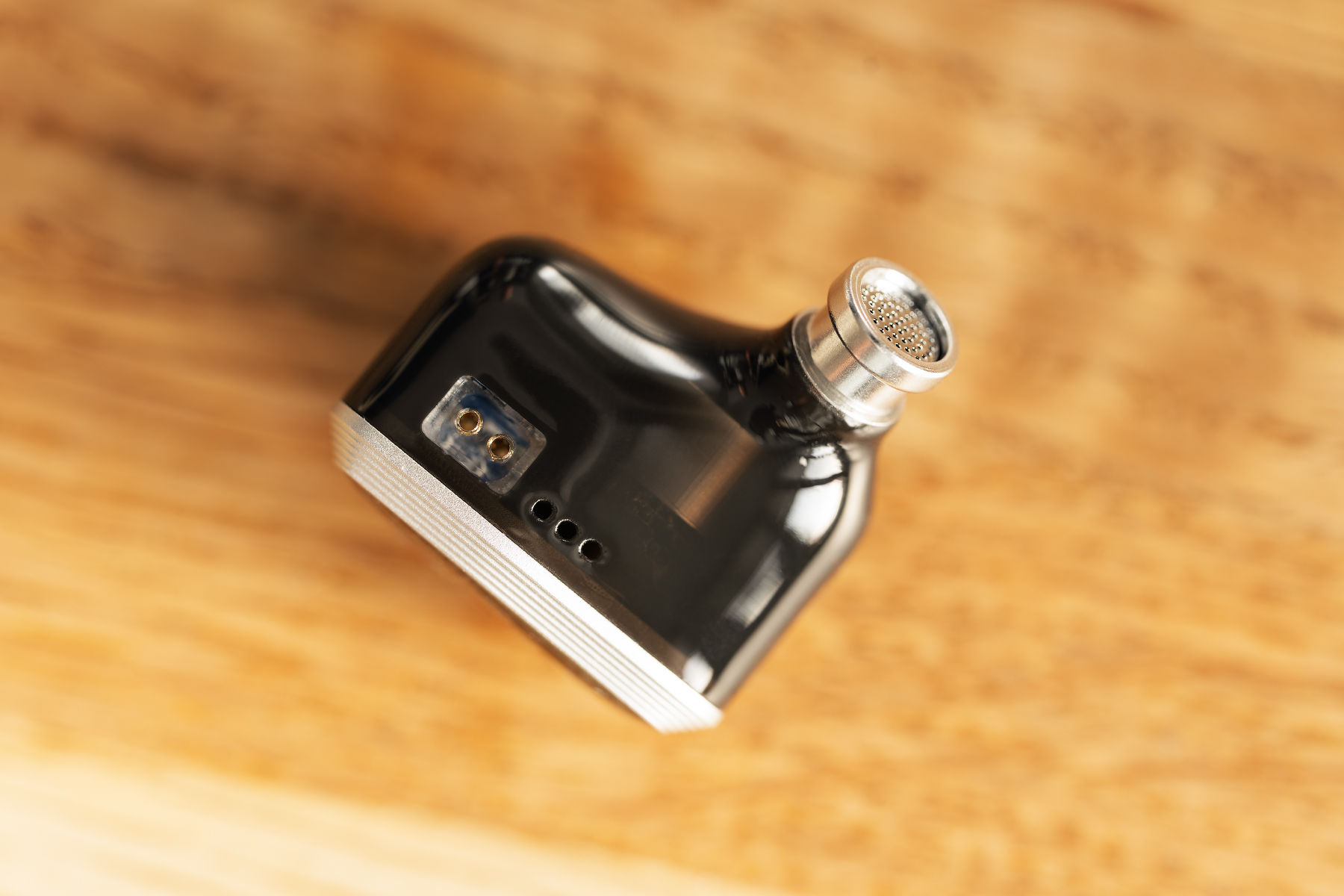
The compensation holes are located in the immediate vicinity of the connectors.
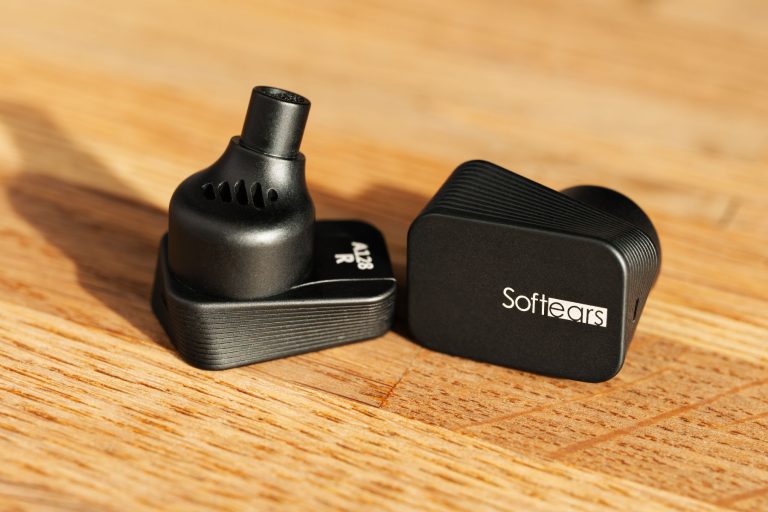
The shells are quite voluminous, but this is due to their considerable thickness. For reference, look at Truthear NOVA on the left and Binary Acoustic Chopin on the right in the picture below.
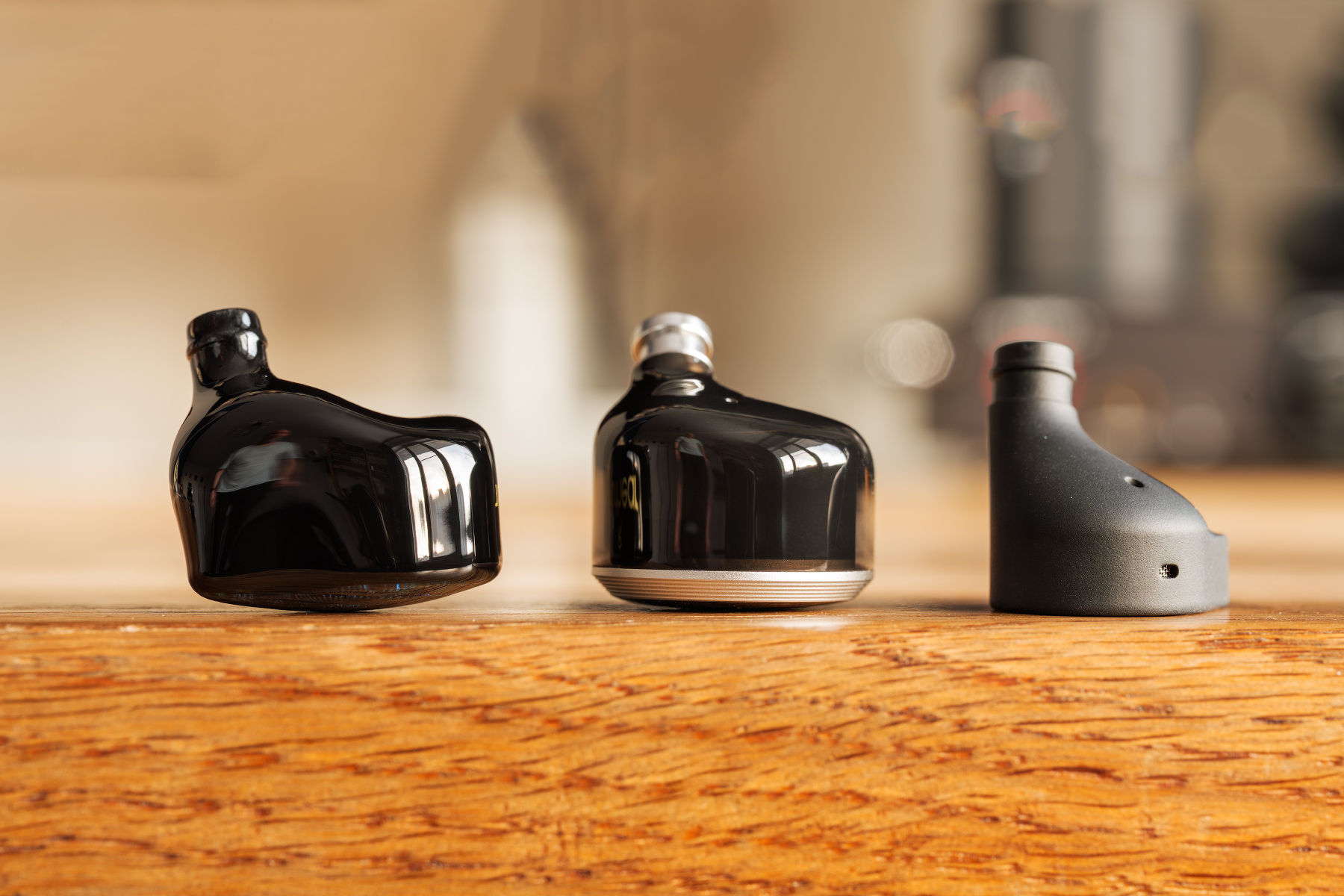
That is, the earphones do protrude from the auricles, but it doesn’t cause any problems in terms of ergonomics — the shells turned out to be very comfortable.
The metal pieces of the sound ducts are 3.7 mm long, 6.5 mm thick in their wide parts, and 5.4 mm thick in their narrow ones.
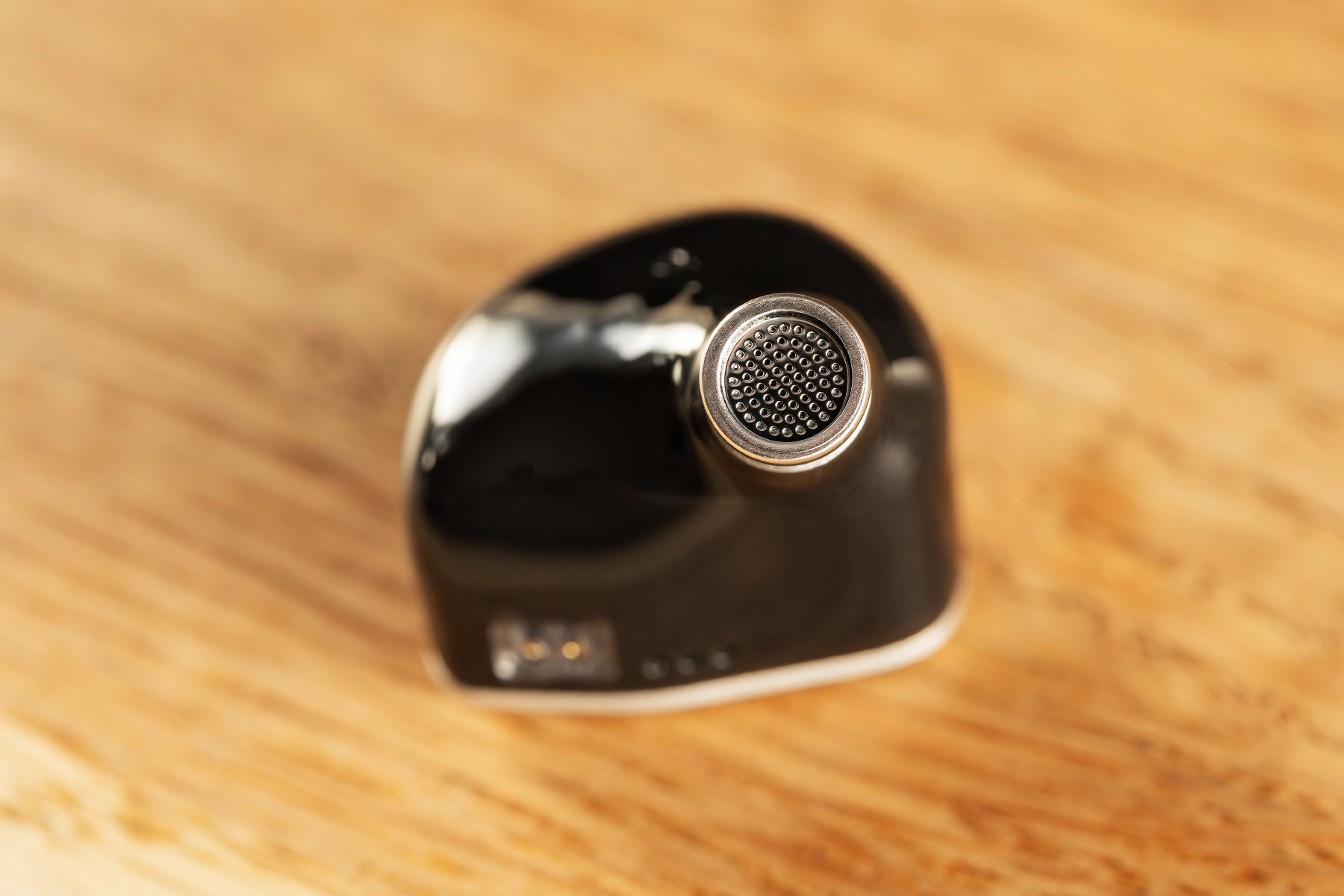
The electrical parameters of the model declared by the manufacturer are 14 Ω of self-impedance (at 1 kHz) and 105 SPL/MW of sensitivity (at 1 kHz).
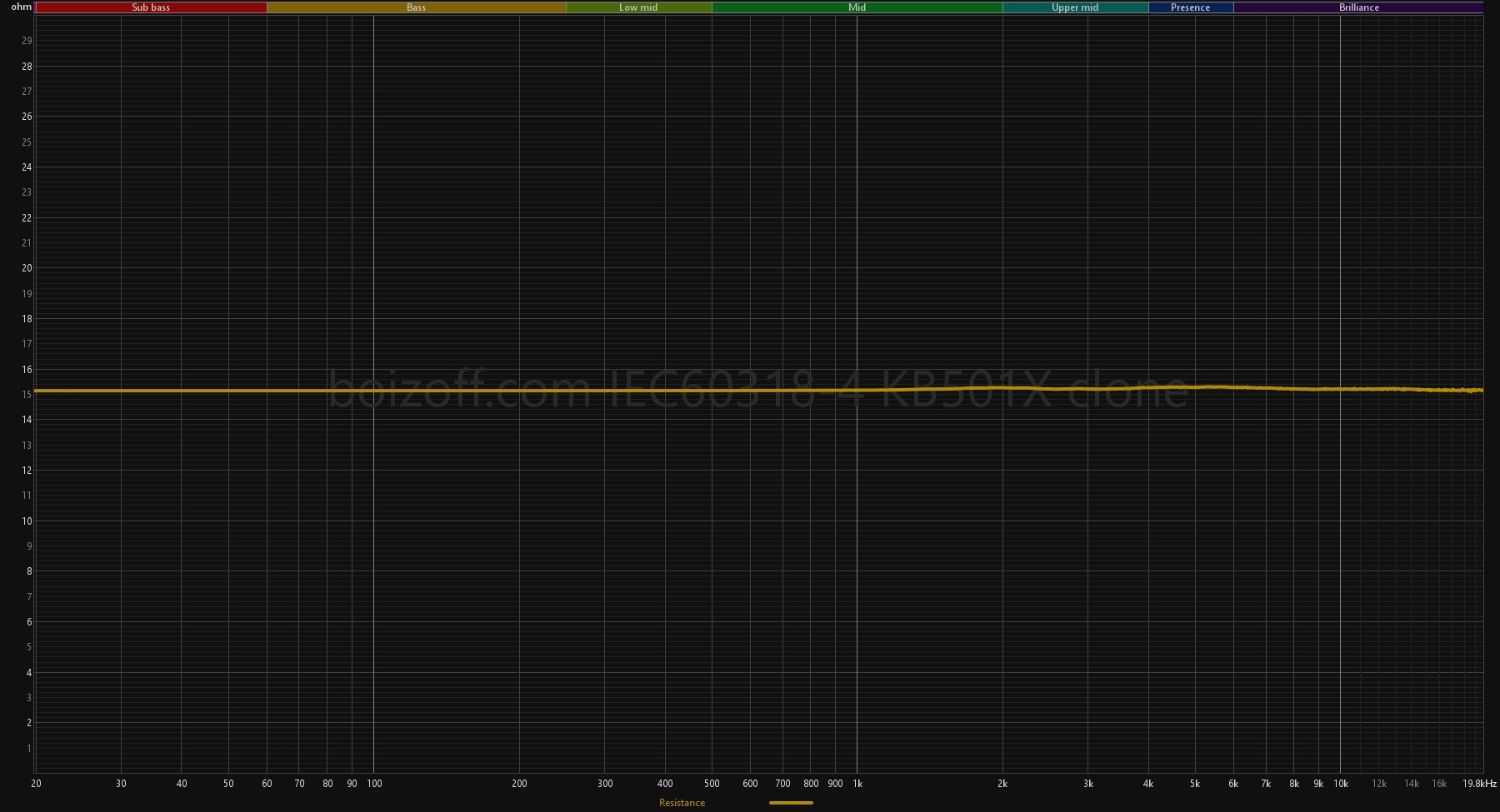
I managed to measure a bit more than 15 Ω of impedance, and this value doesn’t change over the entire audible frequency range, which is typical for planar drivers.
The sound
Standard links:
- the description of my rig is here;
- the audiogram of my hearing is here;
- articles on measurement theory and the whole shebang are here.
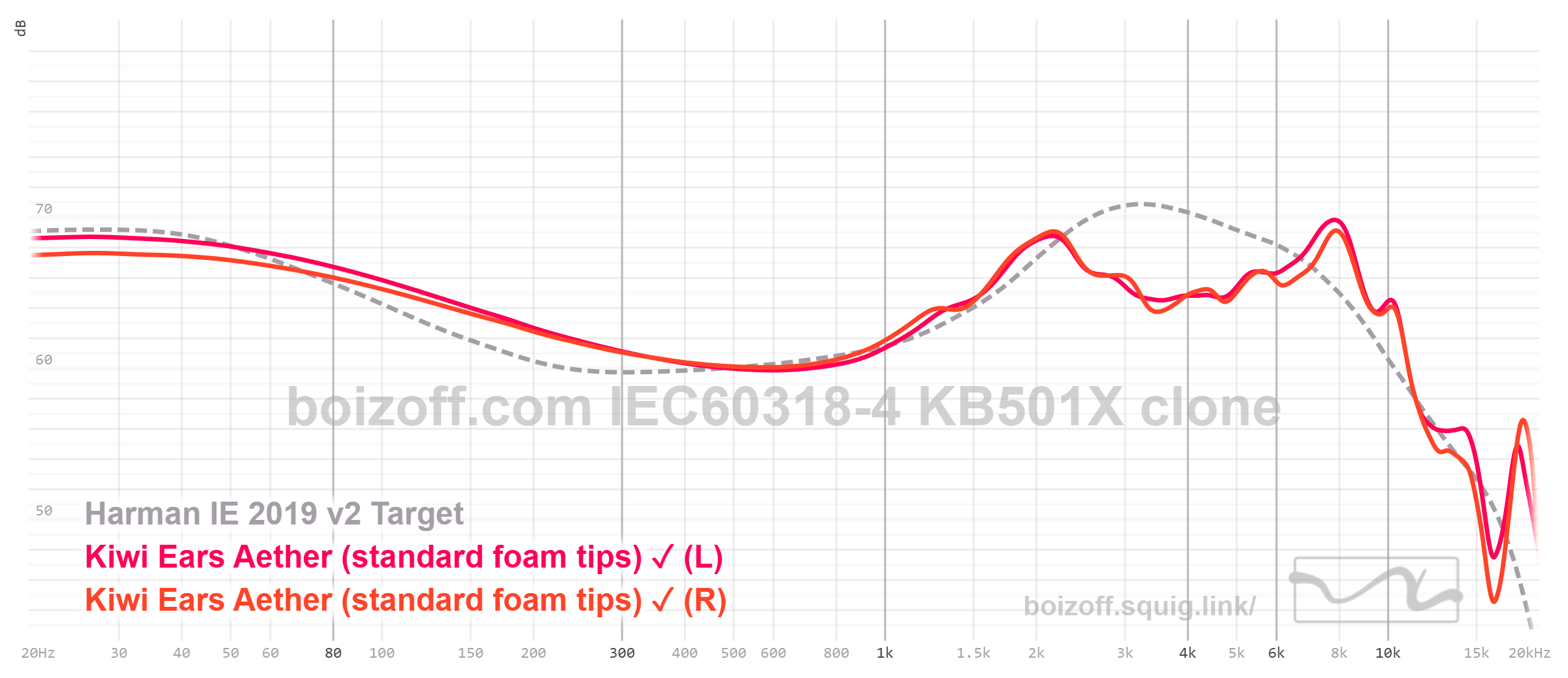
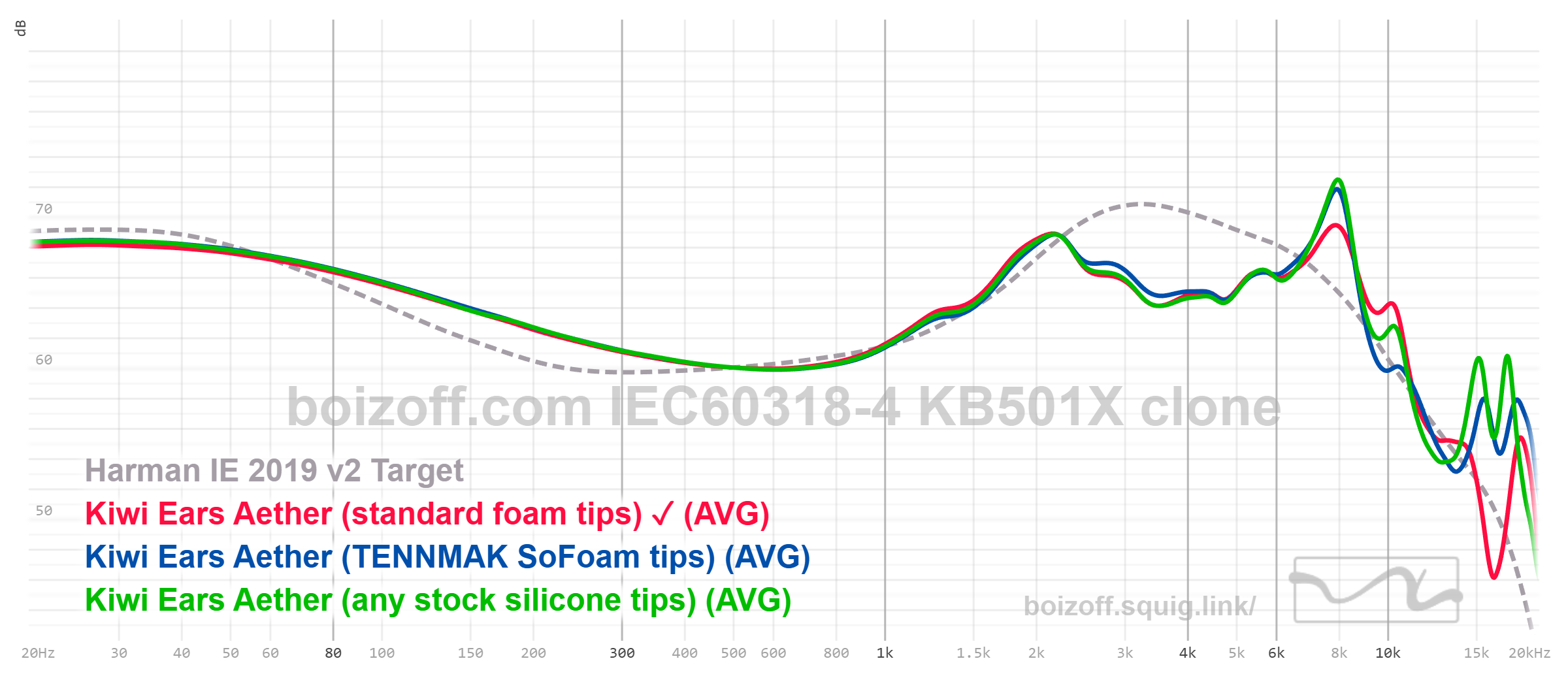
Frequency response of Kiwi Ears Aether:
Different types of eartips have different effects on the upper frequency range:
In my personal case, the second resonance is shifted to the left, to 7,150 Hz, and I perceive the frequency response of Aether something like this:
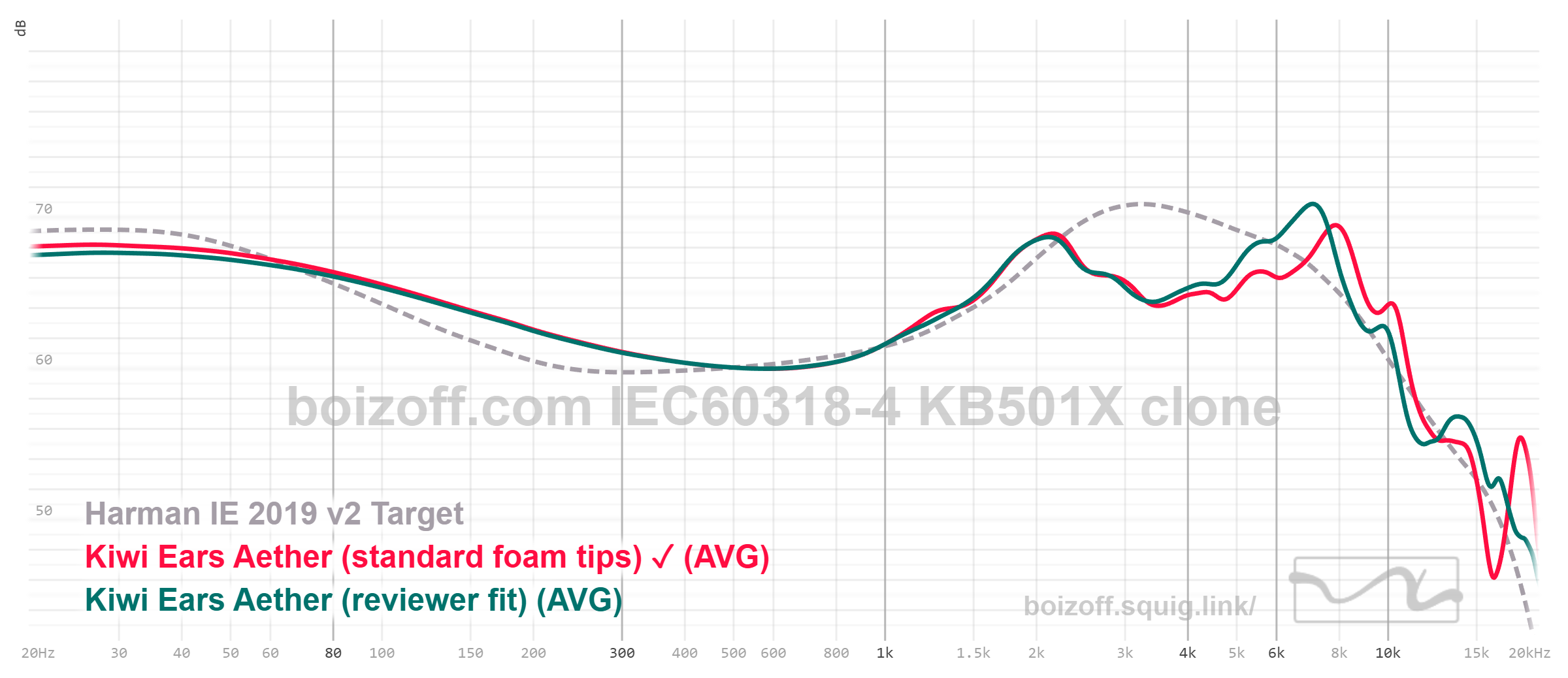
We can see the following on the graph:
- there is a significant addition to the bass, which will clearly mask part of the midrange;
- the first resonance, 3 kHz, is 5 dB below the volume;
- the volume of the ‘presence’ area at about 4-5 kHz is reduced by 5 dB in comparison to the Harman curve, that is, almost twice;
- then there is a slight emphasis at 8 kHz, in the area of the second resonance;
- the uppermost frequencies after 10 kHz will be likely played up a little, but their delivery will actually depend on the fit and the selected eartips.
This tuning is frankly not everyone’s cup of tea.
The manufacturer states that this model has a ‘studio-tuned sound signature’, as well as ‘recreates the immersive experience of open-back headphones’. As for being ‘studio-tuned’, this sound signature and what it’s like can be argued at length about, but a definite typical feature of all studio headphones is the pronounced ‘top’ of the midrange. That is, the 3-6 kHz range, even if not accentuated, certainly doesn’t fall 5 dB down because it’s necessary to aim at the diffuse field curve at this point of the frequency range. We can argue about its turn, slope, etc., but the frequency response graph should be inverted-U-shaped, not just U-shaped. As for the ‘immersive experience of open-back headphones’, I’d say that these words are an inappropriate generalization. For example, let’s take Fosi i5 (I’ve recently tested them thanks to one of my readers!) and Moondrop PARA. Only a deaf person would say that they have a similar ‘experience’, for real.
And may the manufacturer forgive me, I’m not trying to nitpick! I just checked with the official website in order to find some words that would help me understand the reasons for choosing this particular sound.
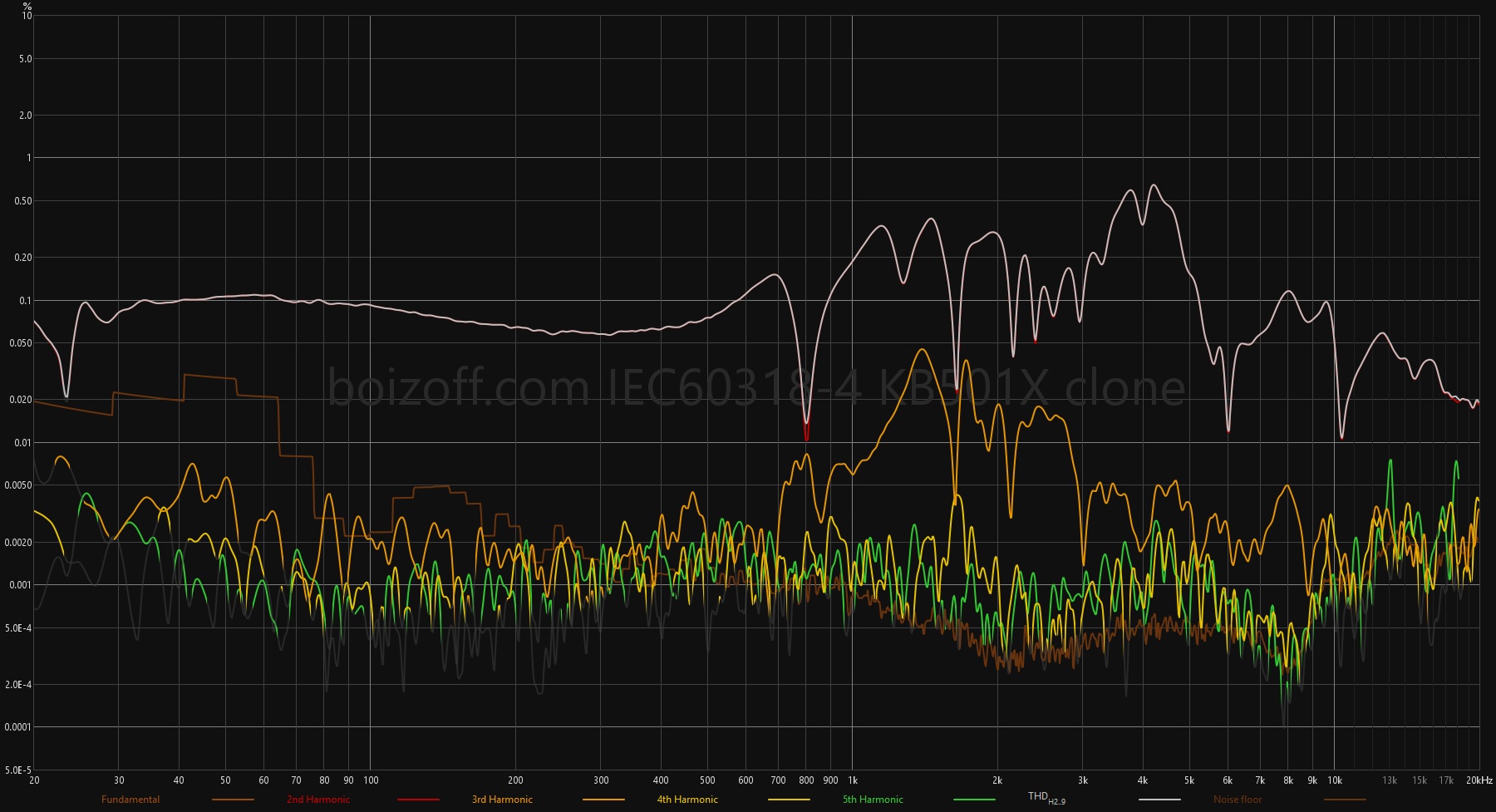
Nonlinear distortion at 94 dB with the ‘Use harmonic frequency as ref’ option turned off and on:
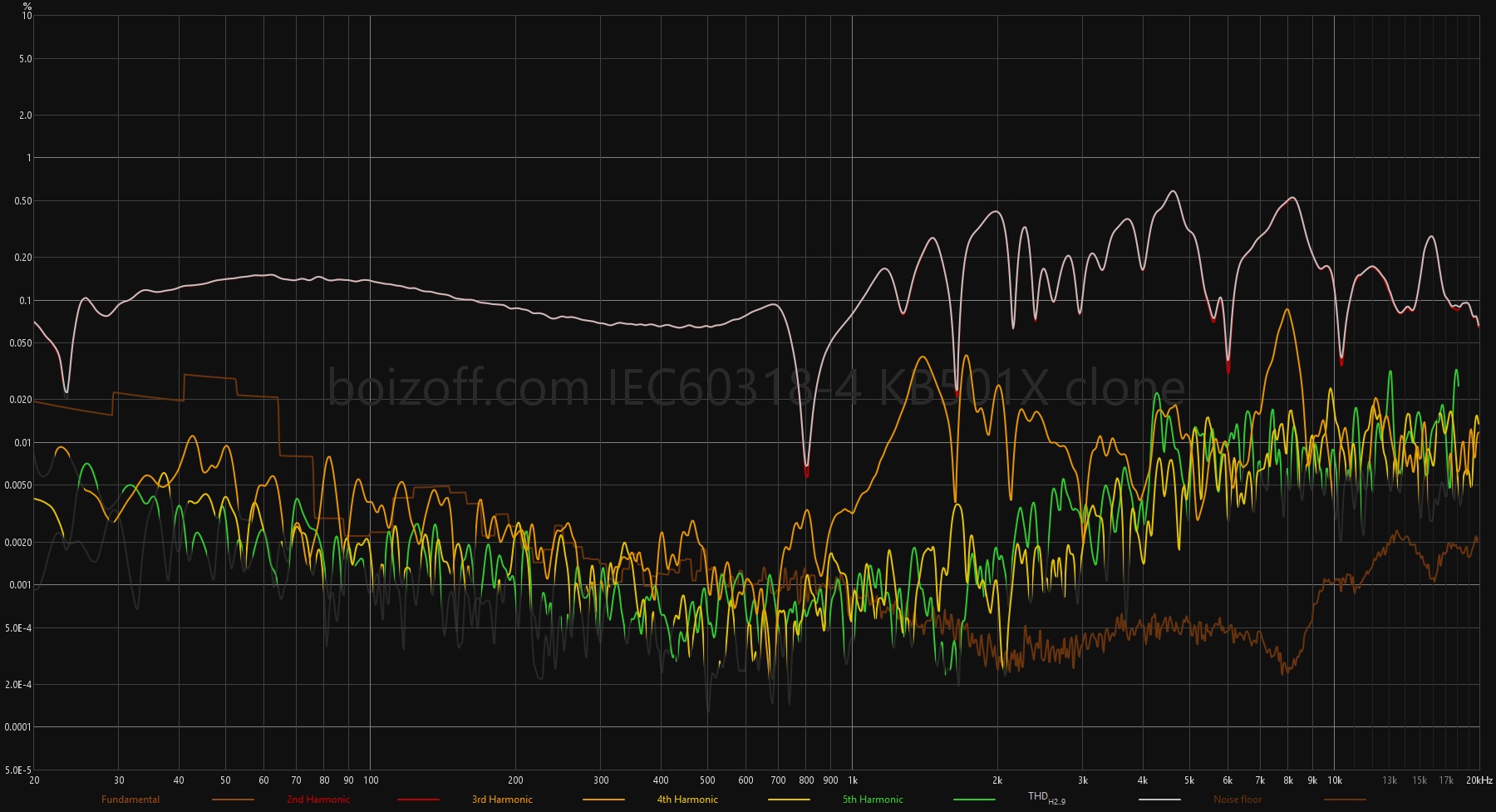
Nonlinear distortion at 104 dB with the ‘Use harmonic frequency as ref’ option turned off and on:
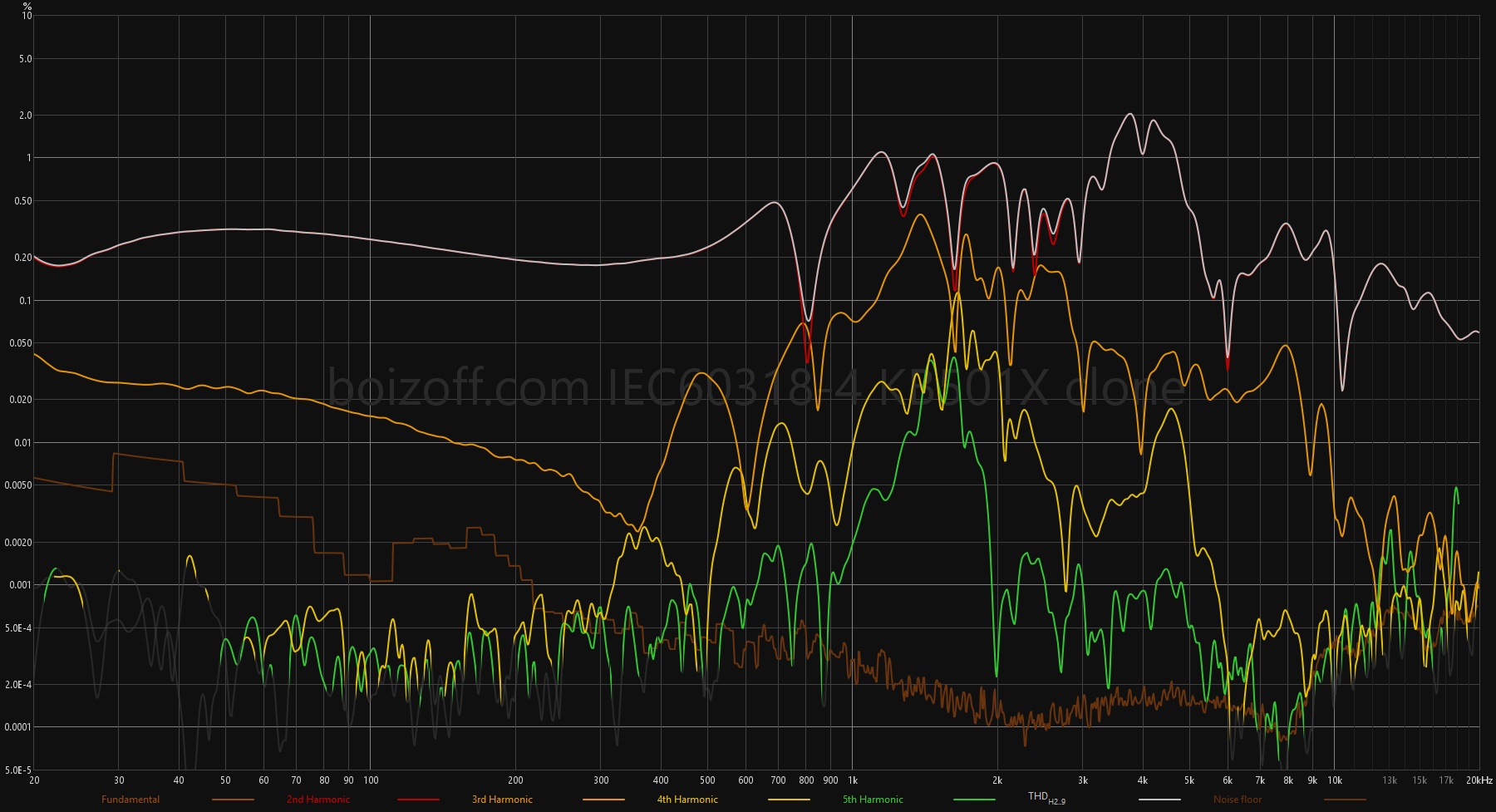
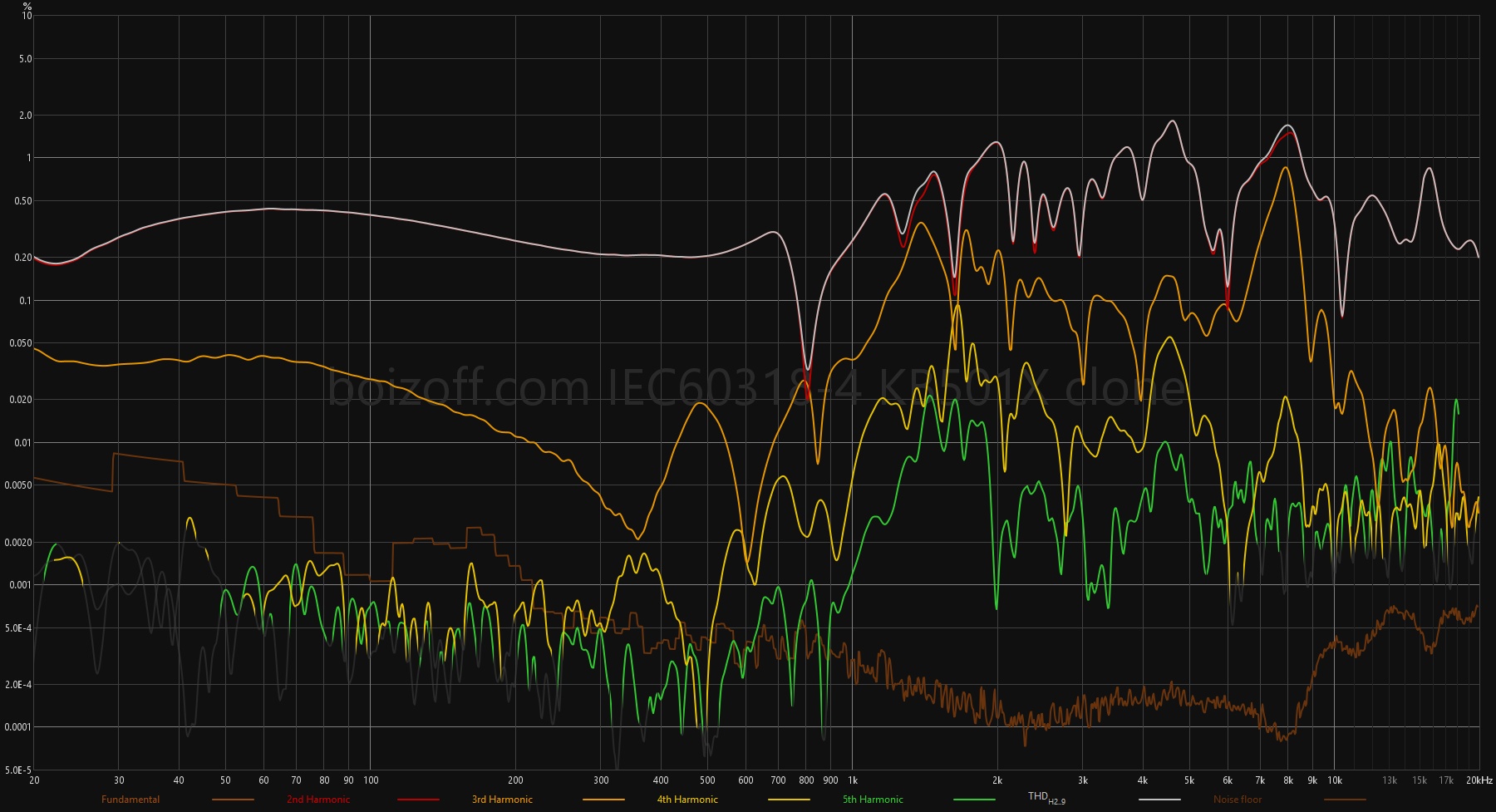
Formally, at a volume of 94 dB at 1 kHz, the distortion is 0.19%, and at a volume of 104 dB it is 0.6%. However, the maximum level at 104 dB of volume is 2% over the entire range, which is a bit too much.
I’ll also note that the maximum distortion can be seen in the range of 3-6 kHz, where we can see a significant decrease in the frequency response. And I’m not going to overanalyze that this decline could have been intentionally implemented by the manufacturer in order to reduce the level of distortion in this area because there is no way I can confirm this causality and the intention itself. I’ll just point out this coincidence.
Minimum phase response, group delay, and spectrogram in the ‘Burst decay’ mode:
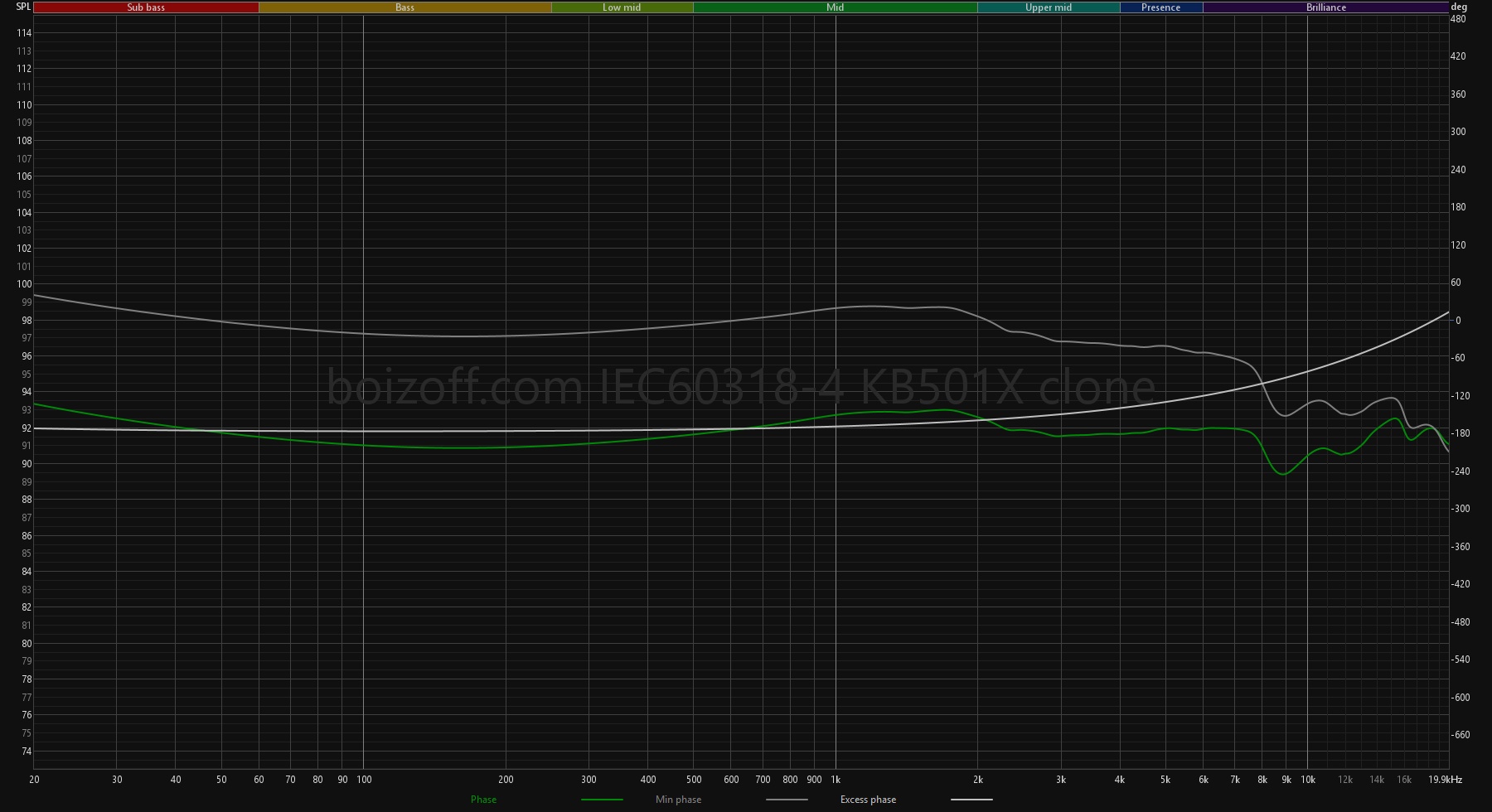
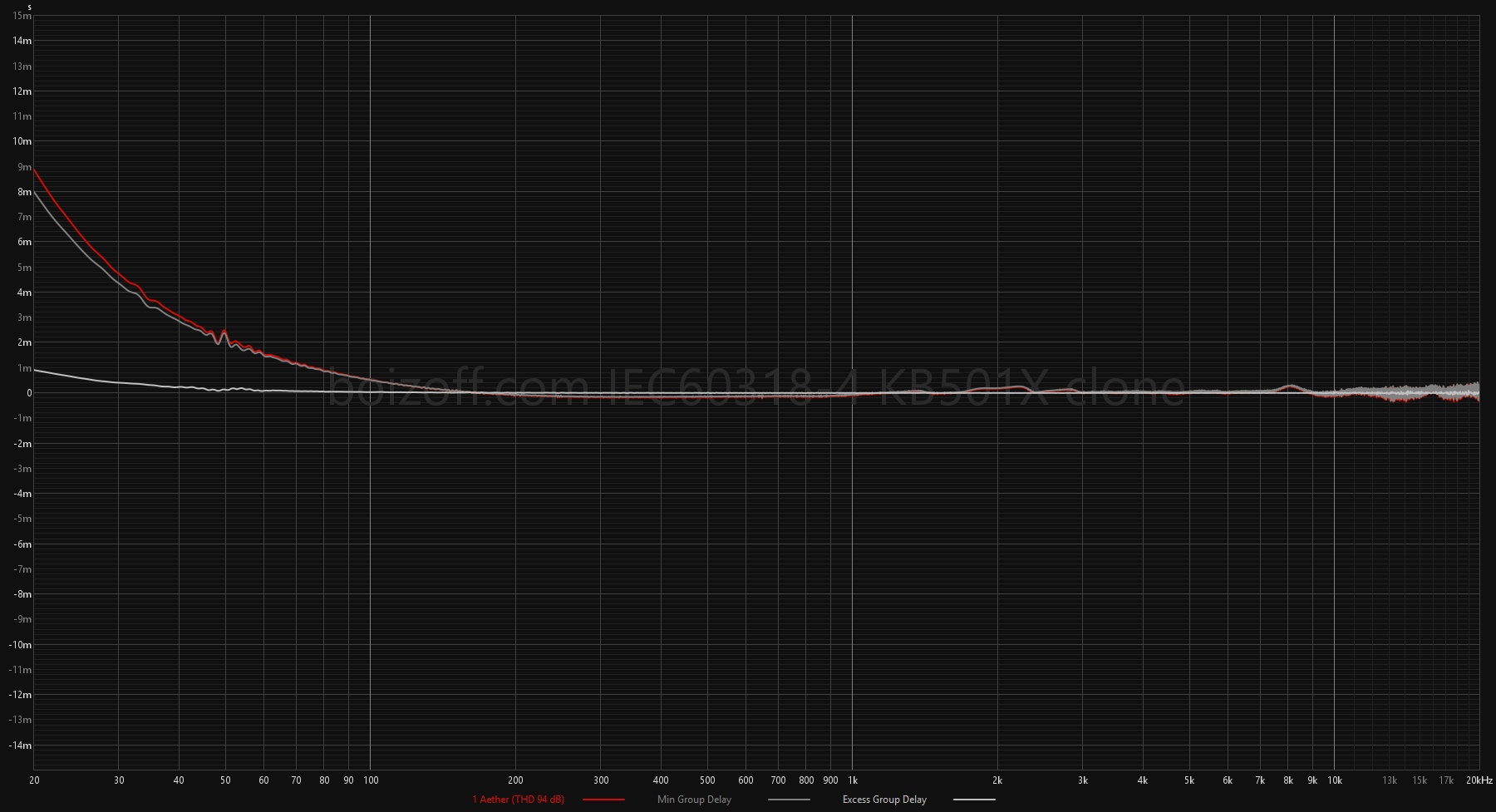
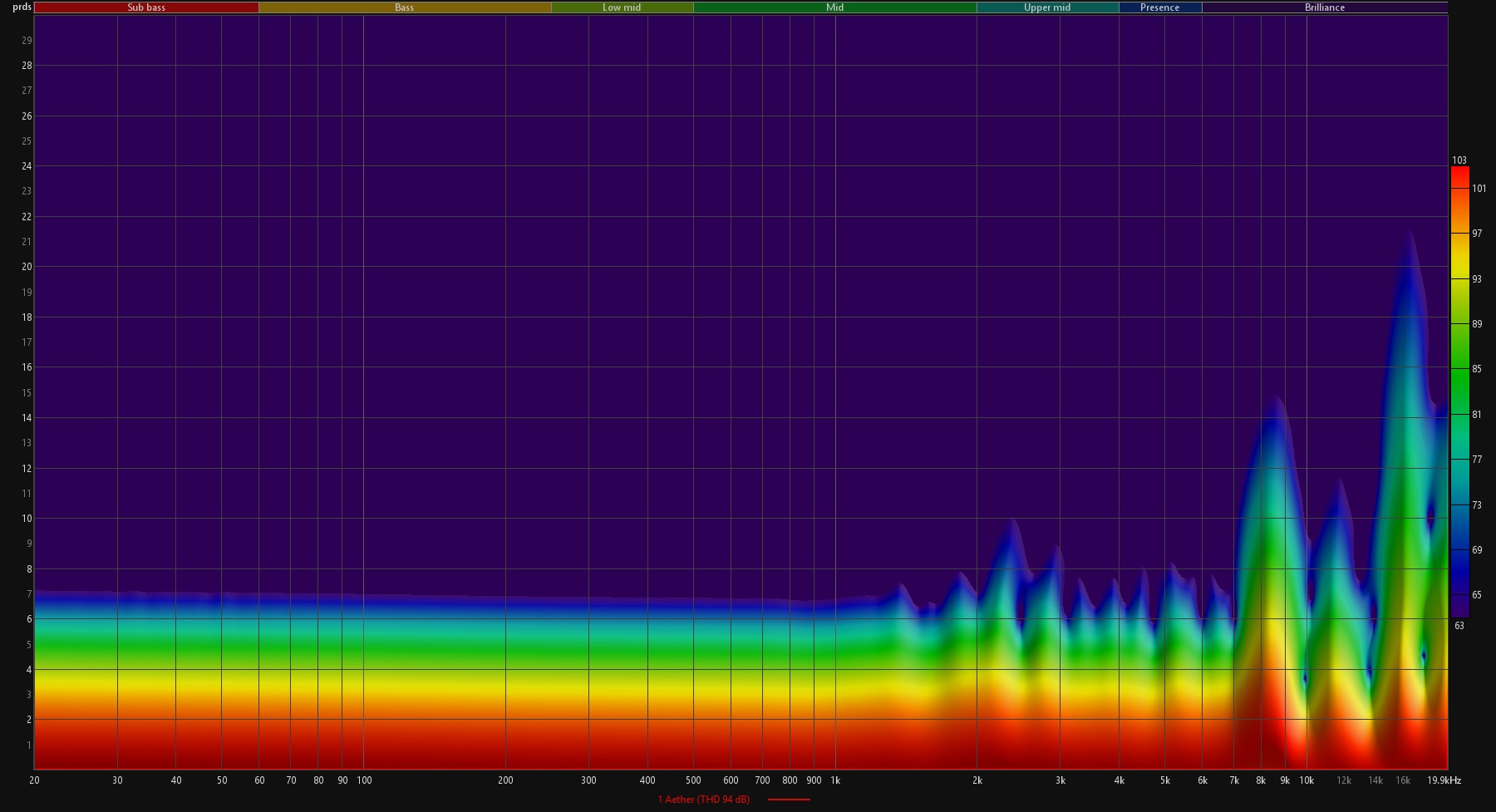
There are no surprises here.
Now let’s talk about the subjective perception of the Aether sound.
I usually listen to headphones at high volume. The Aether sound is balanced to the point where you don’t want to raise the volume above the average – it already seems at 70-80 dB that you can hear everything that the earphones can ‘extract’ from the track. And at this very average volume, the main feature of the Aether’s sound is… that it’s ‘hassle-free’. There is no whipping bottom here, since it also requires a respective volume of 4-6 kHz (it affects the perception of an ‘attack’, the beginning of a blow), but there’s none. The bottom plays deep, but sometimes quite boomy and ‘watery’. The ultra-high frequency range after 10 kHz is ‘extended’, that is, it clearly lies above the Harman curve, but this dominance is insignificant. In other sections of the audible frequency response range, Aether more or less correspond to the Harman curve.
What’s in the aggregate?
It happens to be a ‘toothless’ sound.
The bass is booming, the upper frequencies rustle nicely, there is a subjective feeling of ‘detail’, but the Aether sound doesn’t seem to be going to attract your attention. It’s out there, always far away, and it’s always delivered as if someone has stretched a thick cotton blanket between the listener and the sound source. Nothing in this sound is expressed explicitly, nothing turns heads.
The dialectical advantage here is that you can listen to Aether all day without stopping, well, because after a while you stop paying attention to what they’re playing there, regardless of whether it’s hell of a deathcore, orchestral academic music, or, bless your heart, hip-hop.
All of the above, let me repeat, is legitimate for listening to this model at medium volume. An attempt to raise the volume to 90-96 dB logically leads to the second resonance, that is, the area around 7-8 kHz, starting to dominate the sound delivery. The Aether sound simply becomes too sonorous, gaining neither quantity nor quality in terms of the width of the sound stage, the power of the subbass and any other characteristics.
Comparisons
Based on the well-known rating, we’ll compare Aether with the following models within the same price category:
- TRI I3 MK3;
- Kiwi Ears KE4;
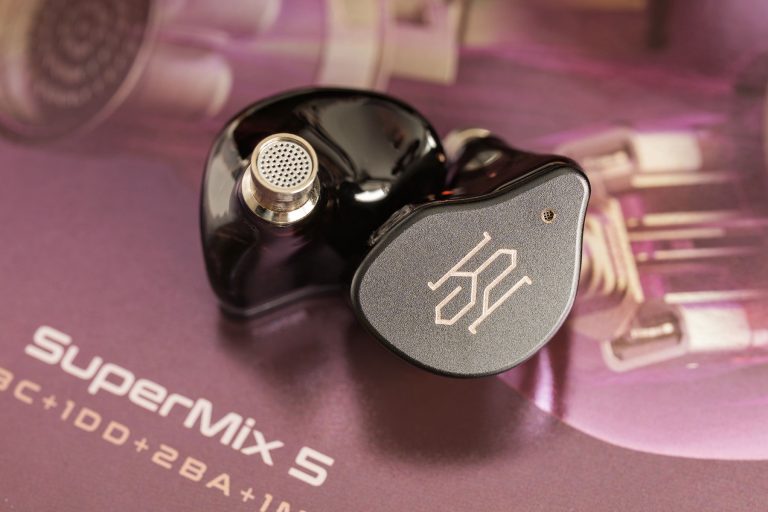
- Simgot SuperMix 5;
- Kiwi Ears Orchestra Lite;
- Truthear NOVA;
- Binary Acoustic × Gizaudio Chopin.
Frequency response of Aether compared to I3:
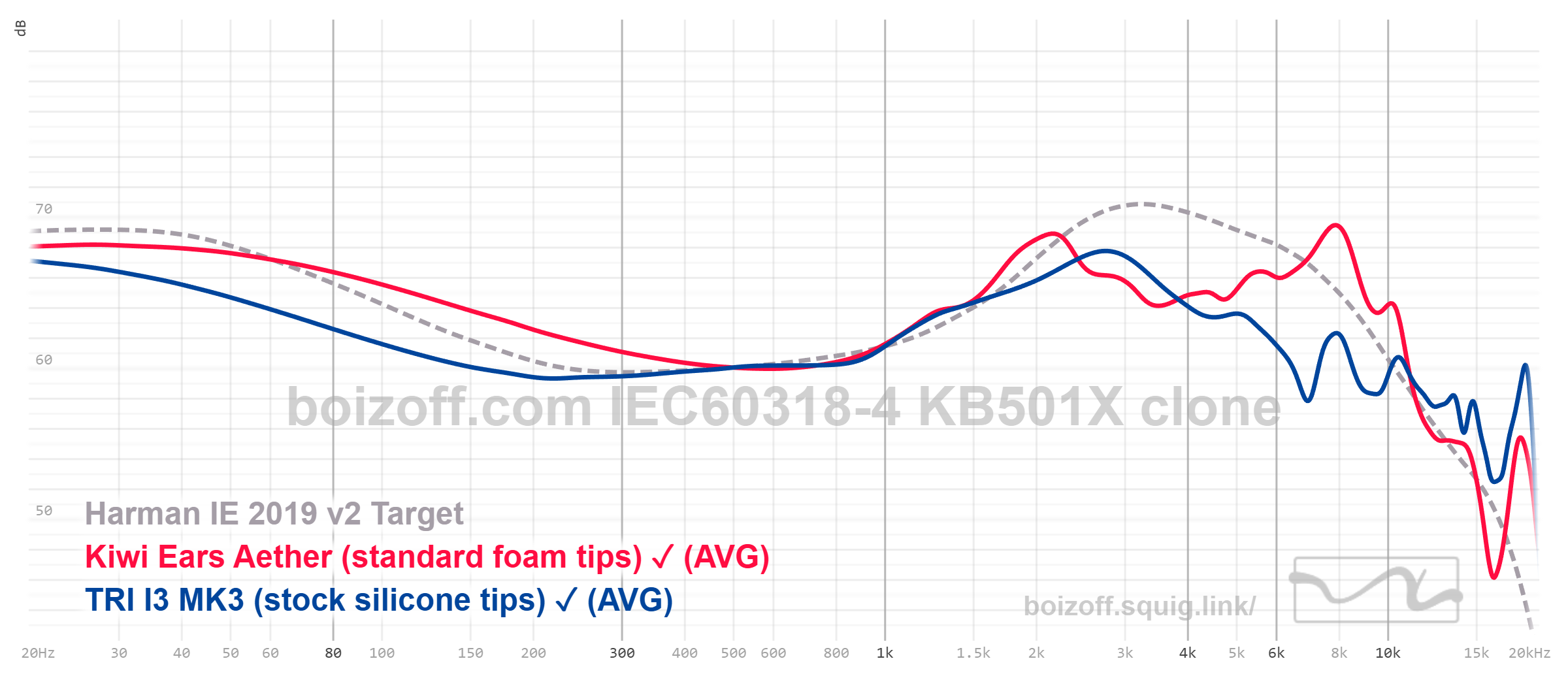
Compared to Aether, the I3’s sound is more natural; the bass is reduced, the subbass is more striking, and the treble is much more extended, although not tiring. Aether sound more weighty, but less expressive.
Frequency response of Aether compared to KE4:
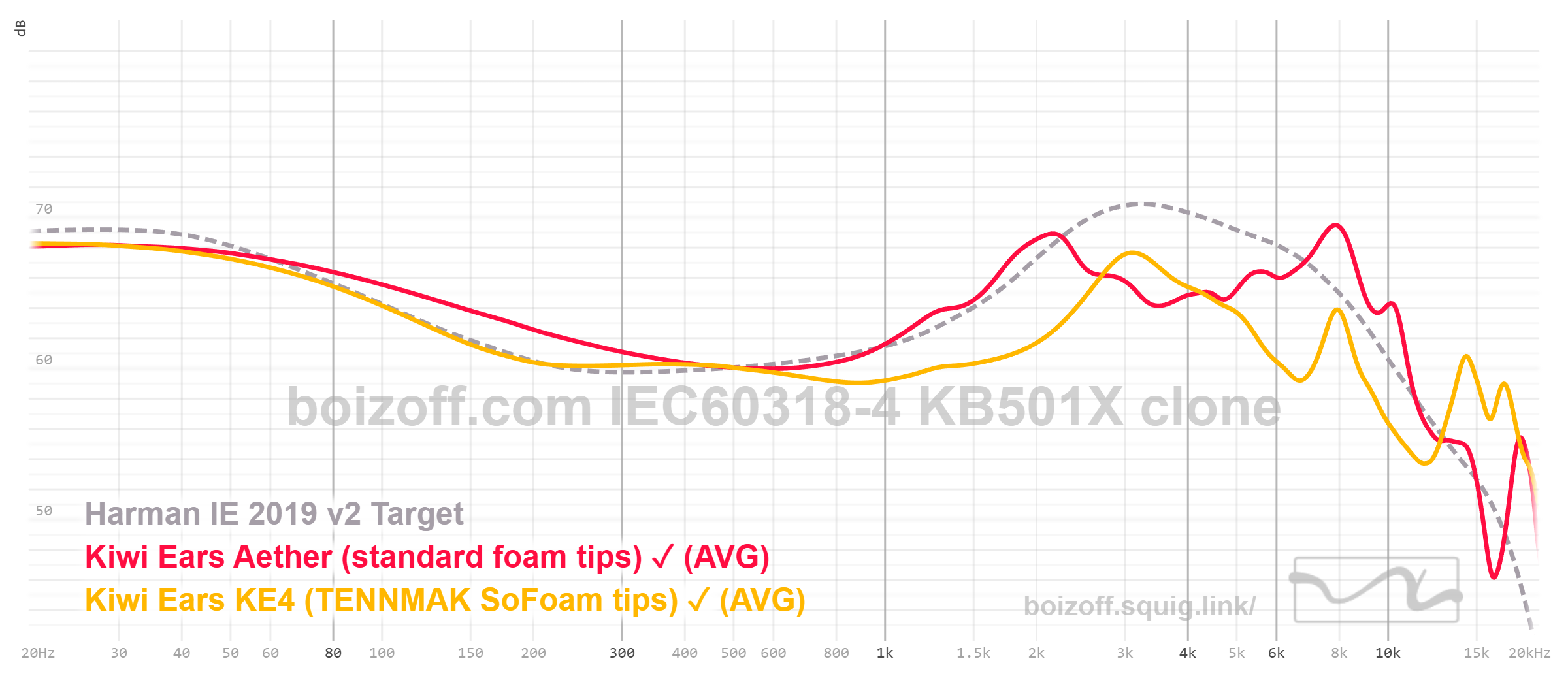
KE4 are much ‘warmer’, ‘fuller’, but their sound seems more balanced and natural at the same time. The KE4 sound is comfortable, allowing for prolonged listening, but also reliable in terms of frequency balance. Aether provide more airiness and volume.
Frequency response of Aether compared to SuperMix 5:
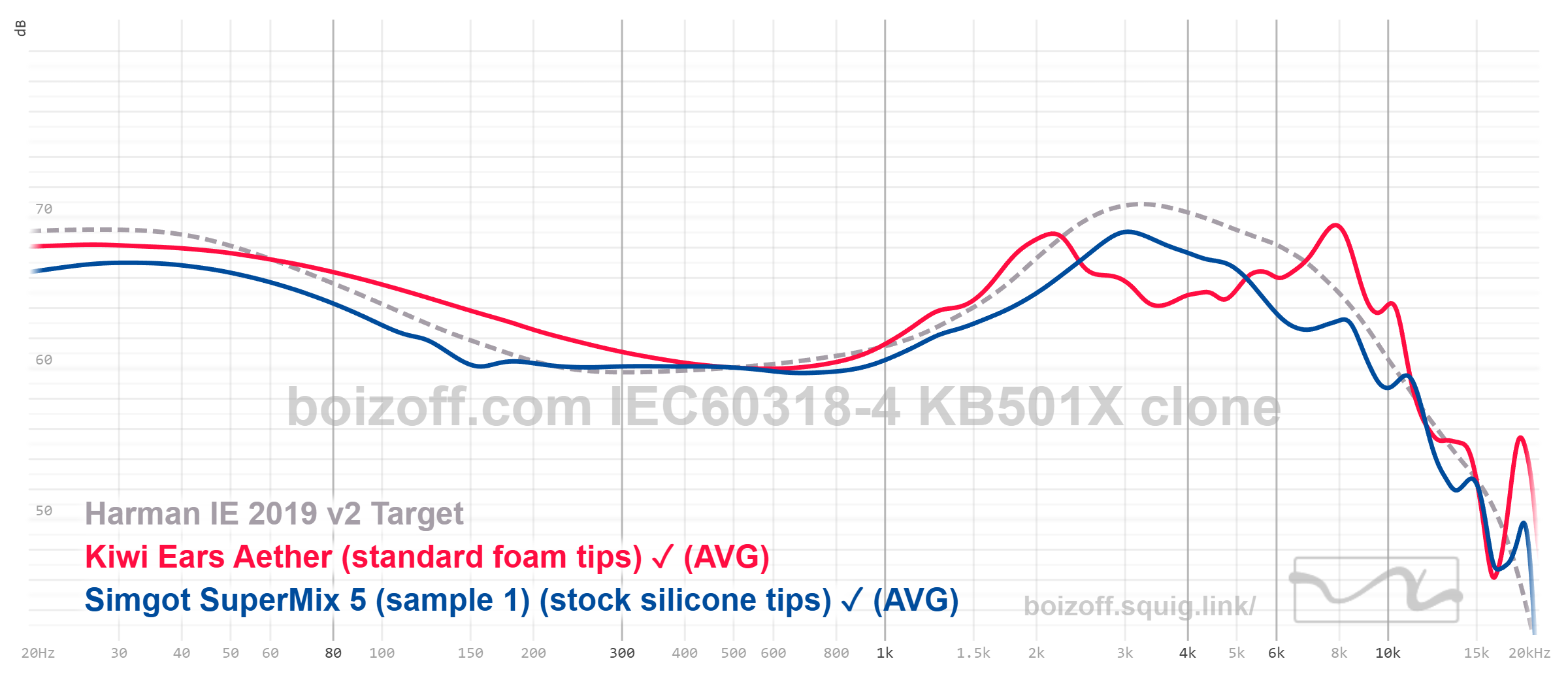
I’m gonna write a separate article about SuperMix 5 because they deserve it. Incredibly, SuperMix 5 manage to deliver musical material in an exciting, yet comfortable and authentic way at any volume, while the bone conduction driver provides this additional dimension of sound, which is difficult to describe verbally, but it significantly affects the listening experience. Aether provide a ‘softer’, more ‘gentle’ sound, which, on the other hand, is less expressive.
Frequency response of Aether compared to Orchestra Lite:
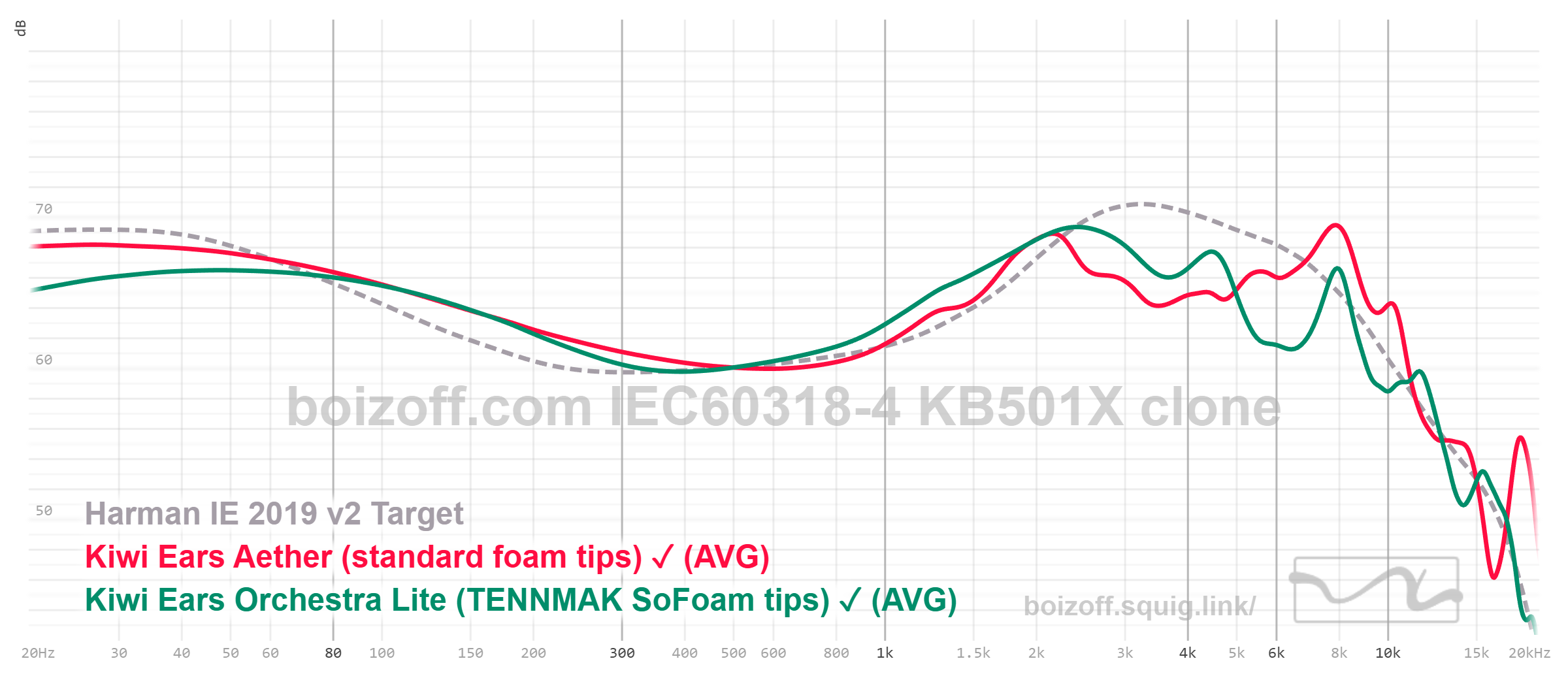
Orchestra Lite deliver incredibly expressive and lively midrange frequencies, this is their strong hold, the reason for the existence of this rather unique model. At the lower end of the frequency range, the Orchestra Lite’s sound relies not on subbass, but on bass. Aether sound broader, more weighty, but less aggressive and engaging.
Frequency response of Aether compared to NOVA:
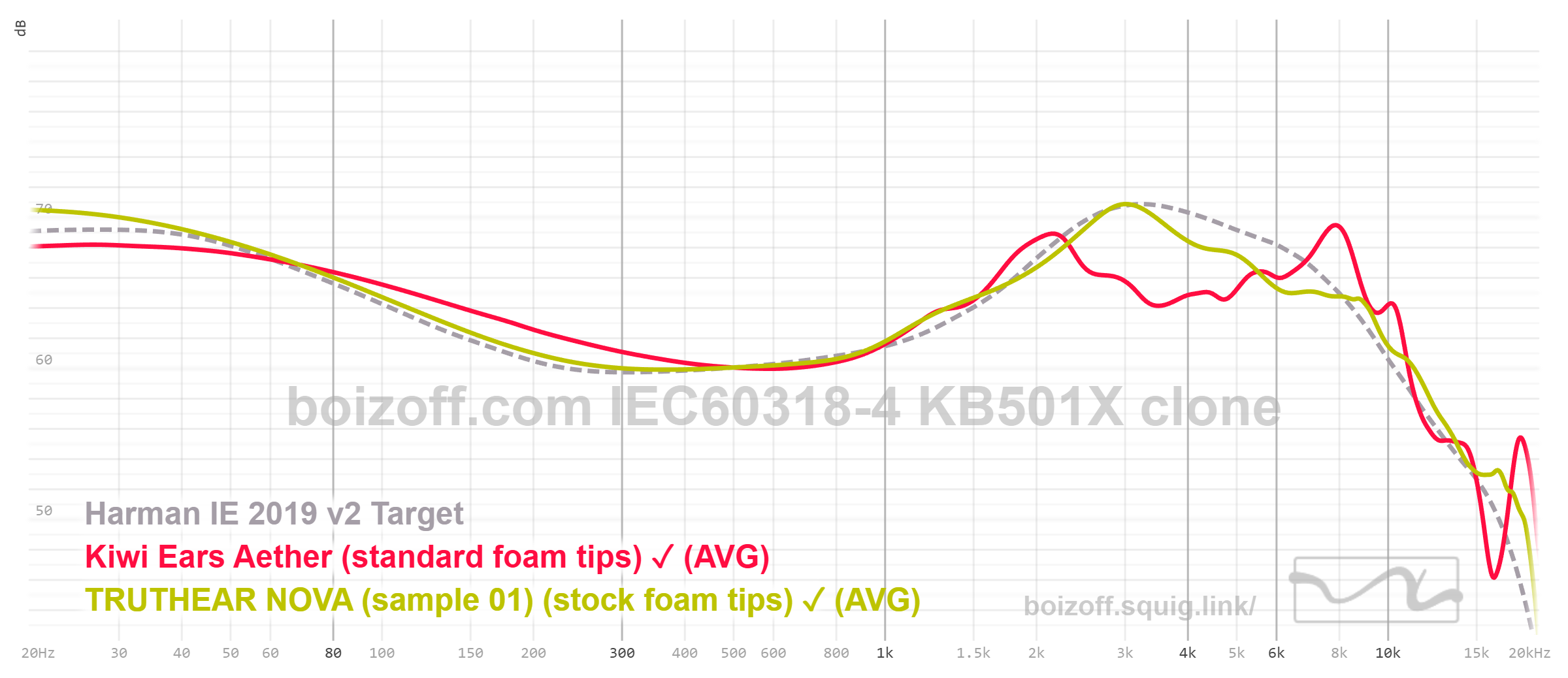
The Harman-balanced NOVA provide a good separation of the subbass from the bass, an articulated middle, and neat upper frequencies without peaks (if you luck out with the sample, yes). I have nothing to say about the repeatability of tuning in different Aether samples, but this model cannot boast of any other qualities from the above. I’d probably point out the ‘softness’ of the sound as the only comparative advantage of Aether.
Frequency response of Aether compared to Chopin:
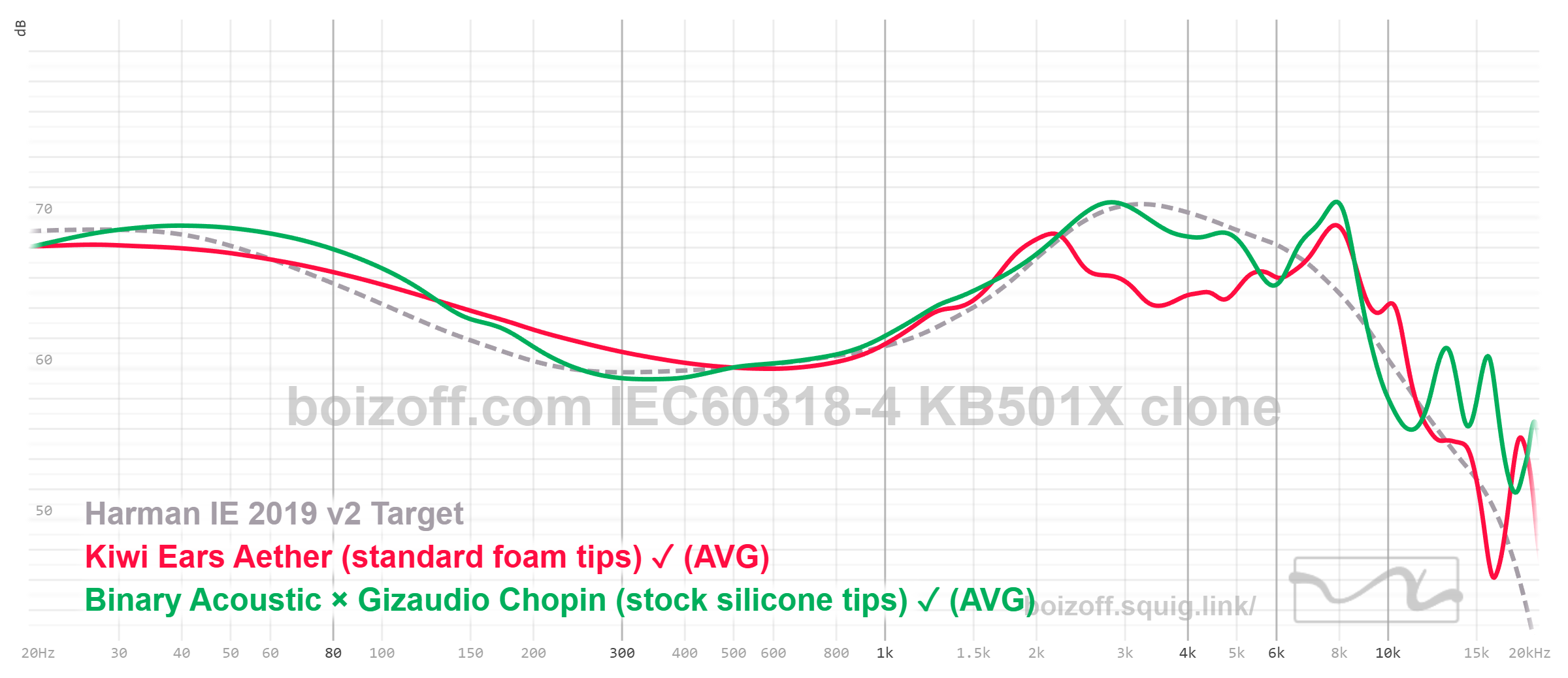
Chopin is the perfect antagonist of Aether. While Aether are ideal for non-engaging background listening, then Chopin literally insist that they be listened to, leaving aside everything else. They attract maximum attention of the listener with their whipping powerful bass, aggressive upper middle, and sparkling ‘tops’.
Summary
I have absolutely no doubt that Kiwi Ears can make good headphones – five of their models are on my list of the best, jeez! I also have no questions about the technological uniqueness of the 15.3 mm planar driver (I asked the manufacturer and got an answer that this is the size of the diaphragm), the largest driver ever developed for IEM.
Based on the totality of my impressions, I would describe Aether as earphones that are afraid to disturb the listener with their sound. And, taking into account the above-mentioned features of frequency response tuning and distortion measurement data, the situation looks like the company made a new driver, but released a model based on it before they could resolve all the technical issues. And if we talk about the context, about peer headphones within this price range, then it becomes clear that there are so many really beautiful and also diversely sounding models available for this money that opting for Aether becomes absolutely questionable.
Still, who can I recommend Aether to? Definitely to those who are looking for a model for very long listening sessions; to those who need earphones that would not strain their ears in any way and would not attract attention at all.
To buy or not to buy: only after listening. Really. Long. Listening.