


Softears Twilight Earphones Review
Today I’m going to tell you about the earphones that you’ll most probably never buy. You won’t buy them not even because they cost $930 — we can survive that, but because these are in-ears for $930, which only have one single dynamic driver. Getting someone to pay that kind of money for the earphones with such a simple, if not ‘poor’ hardware base is very, very difficult.
Paradoxically, they sound good in general and even unique in some specific aspects. And let’s admit that $930 is really affordable and moderate compared to $2,500 that Softears wanted for the predecessor of this model, Turii Ti, in 2022.
Looking at it that way, buying Twilight is saving!
So, here are Softears Twilight, mono-driver dynamic in-ears for $930 (in Russia, they cost some $870 on sale right now).
Dima, thank you so much for the opportunity to listen to, measure and write about these earphones!
All but the sound
The earphones come in a non-nonsense-looking black box, on the surface of which fingerprints appear as if by themselves.
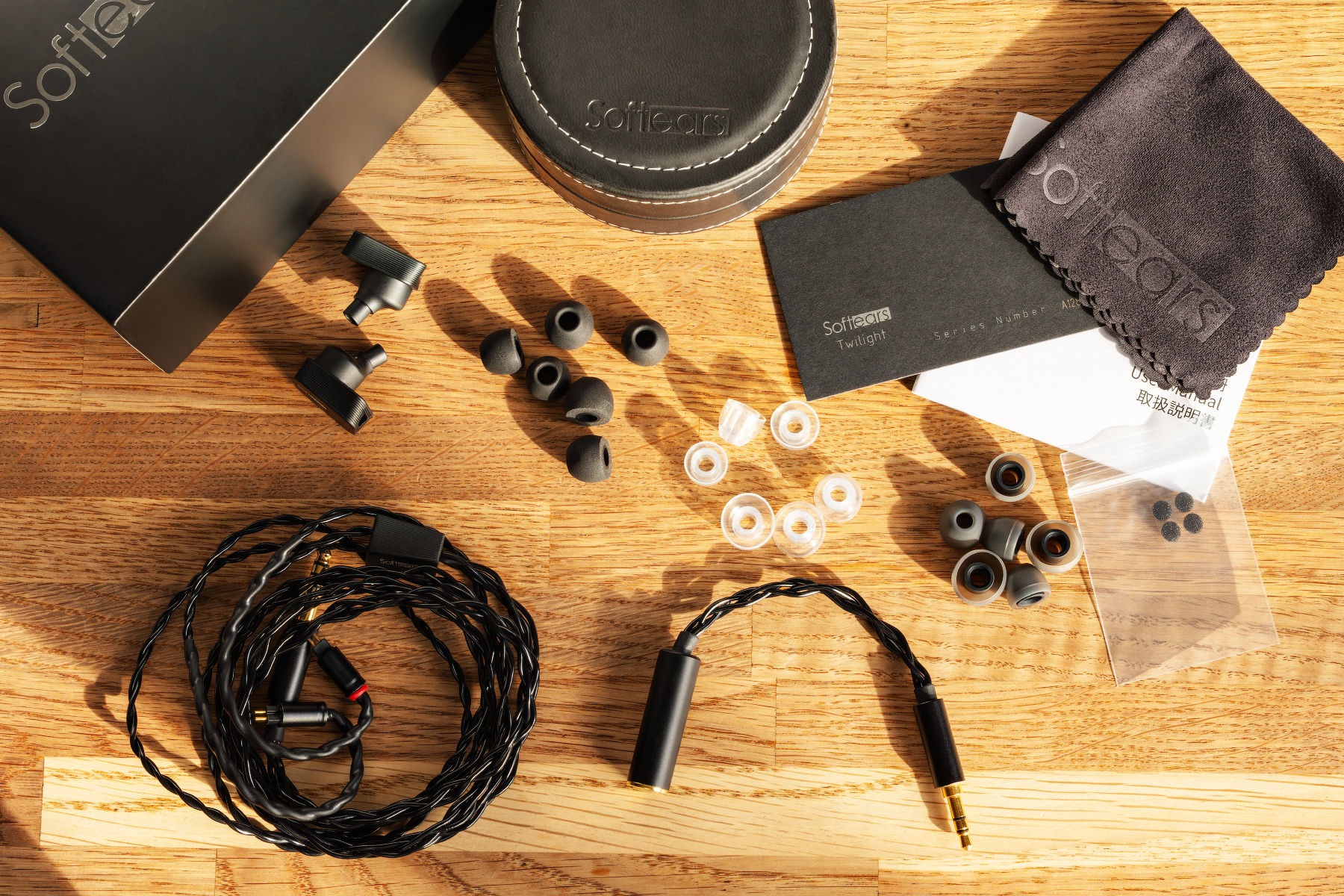
The manufacturer supplied the earphones with the following:
- a cable with a 4.4mm connector;
- a 4.4 → 3.5mm adapter;
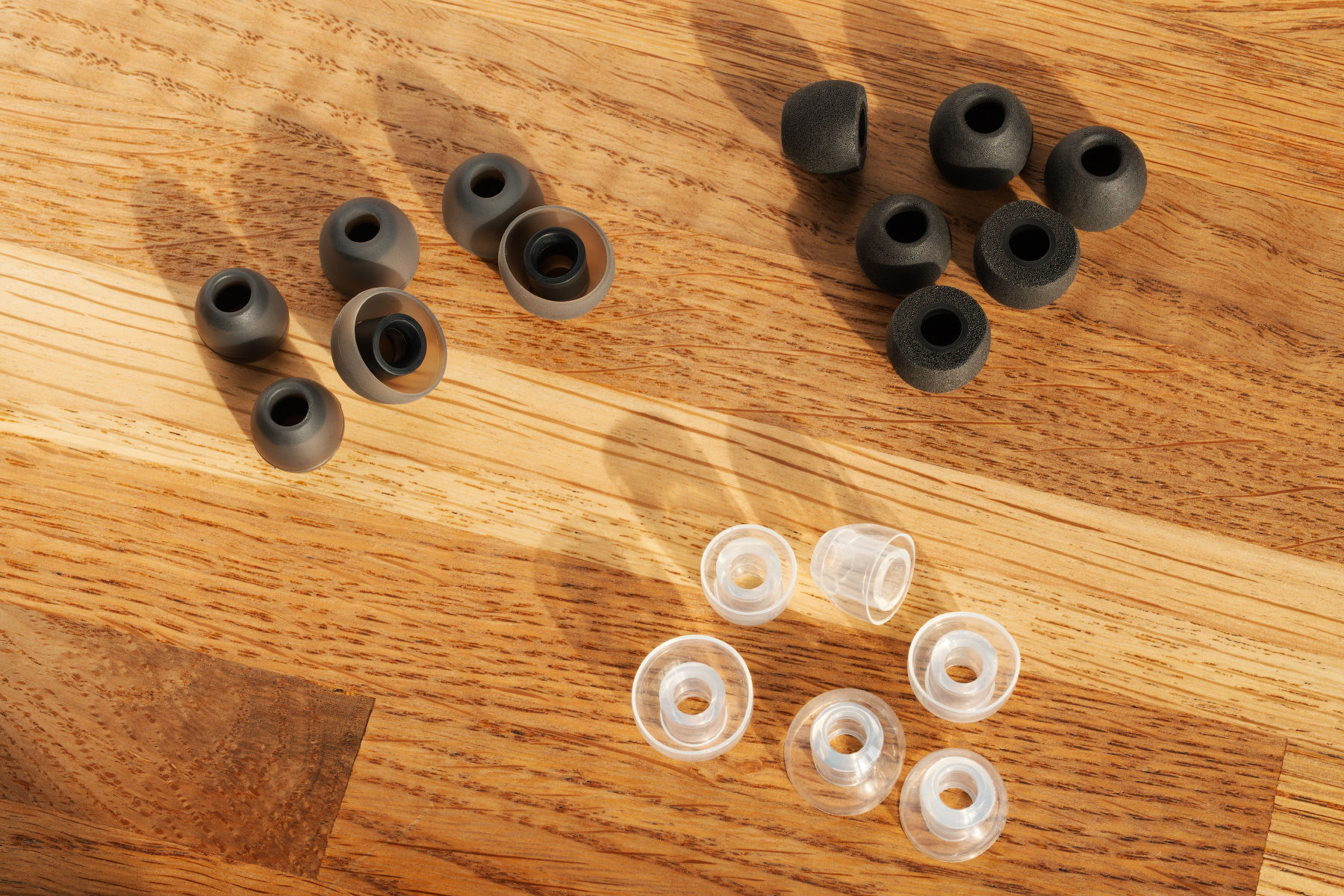
- three sets of eartips, with three pairs of them in each;
- extra replaceable filters;
- a case;
- a cloth;
- a cleaning brush;
- some papers.
How about a badge? A keychain? A sticker? A stand? A micro DAC?
None of them!
I didn’t even take pictures of the case because it’s common as dirt in terms of its inner arrangement, and it’s unusually simply made for the earphones that cost $930. And I’m gonna come back to the price of the earphones time and again because the price of $930 is kind of binding and sets high expectations in many aspects. So, the case is not even made of faux leather, but covered with vinyl with a ‘leather’ print.
The cable has a 4.4 mm connector, which means it’s balanced. The connector is non-replaceable, but you can use a standard 3.5 mm adapter.
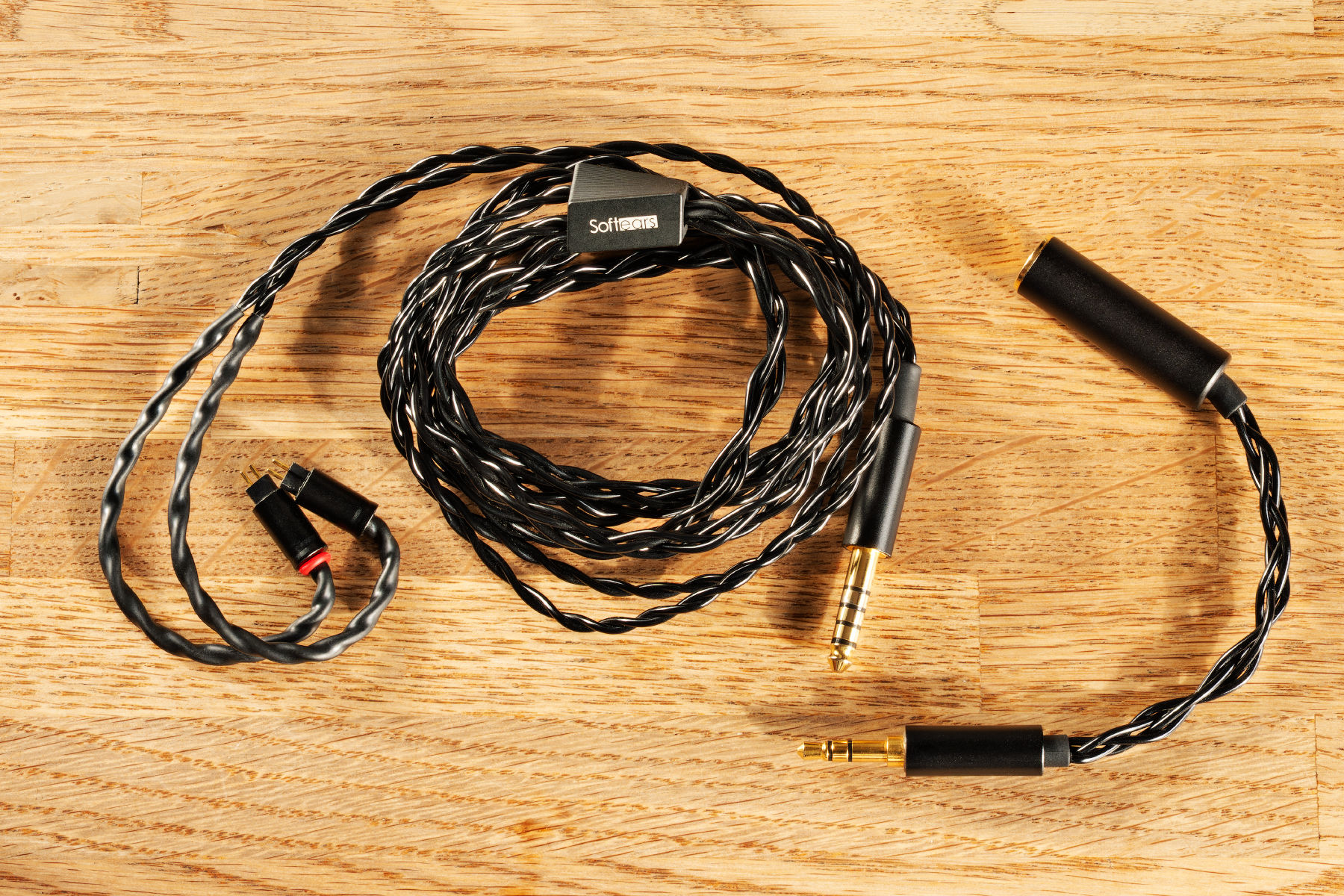
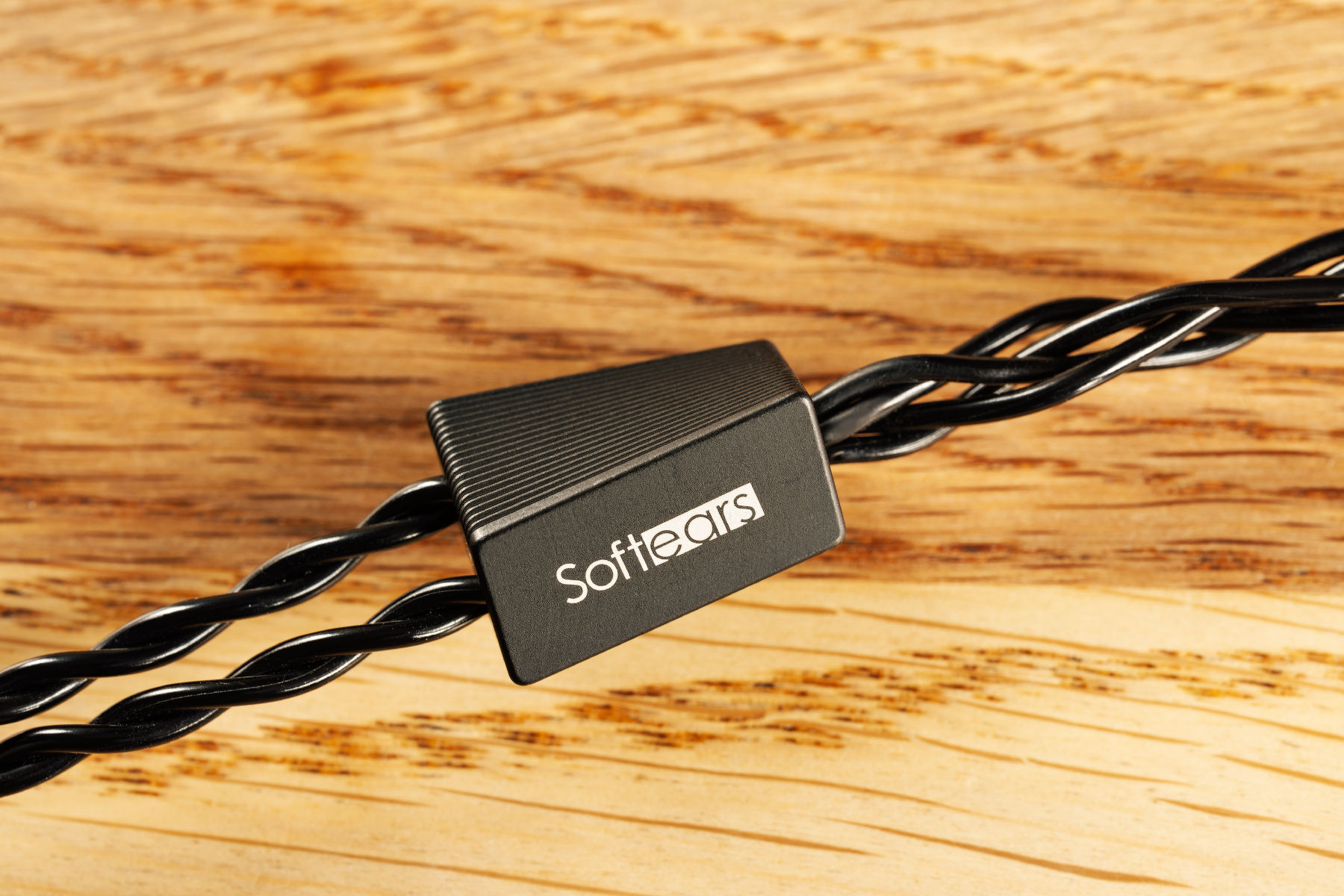
The cable flexibility is normal, it’s convenient to use, but its decorative value is frankly lowered. The manufacturer doesn’t note any ‘magical’ properties of the cable on its website. The cable is distinguished only by its branded metal splitter, which is in harmony in shape and color with the earphones themselves.
The eartips are presented in three sets of different types: gray ones are silicone, transparent ones are made of TPE (thermoplastic elastomer), and black ones are foam.
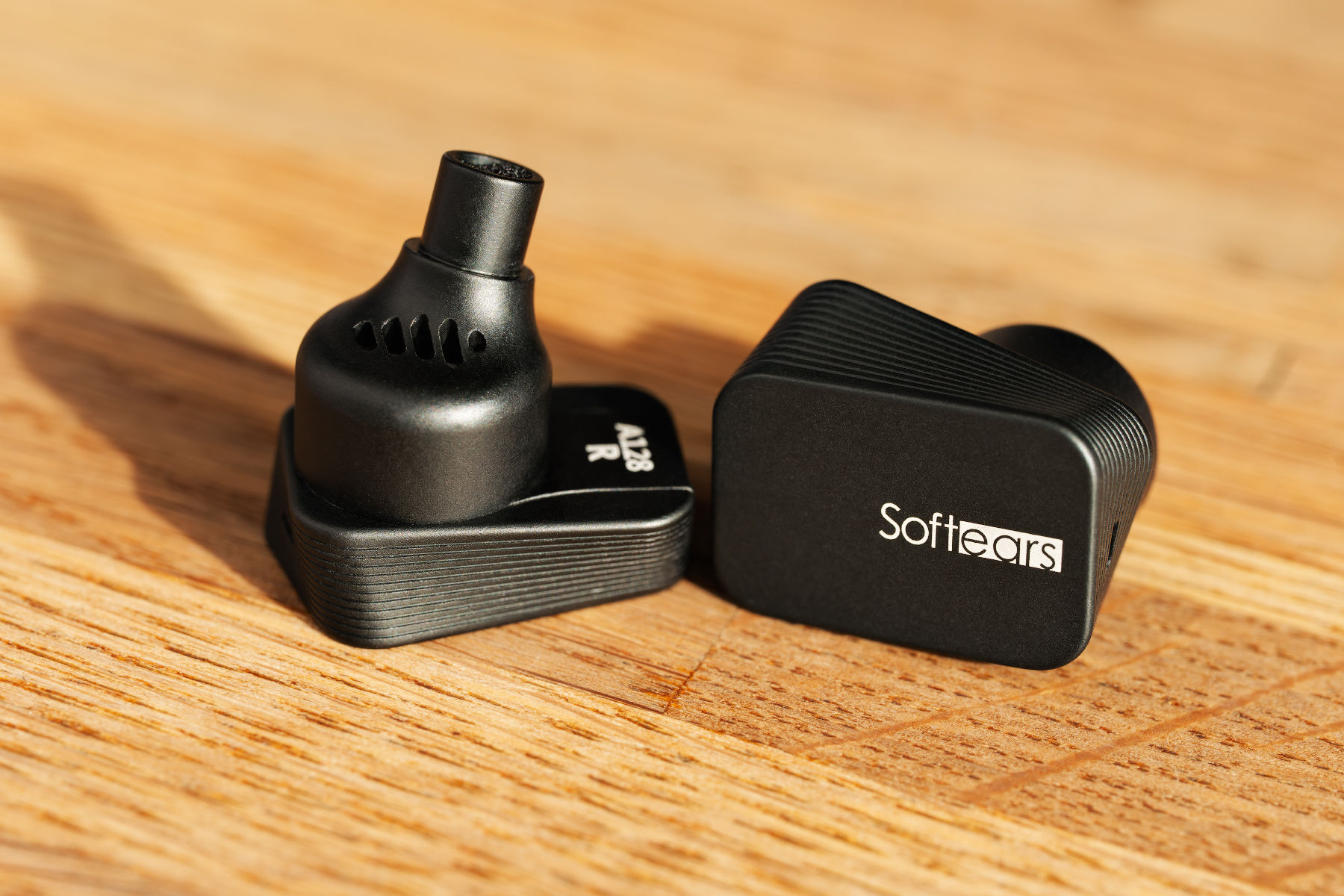
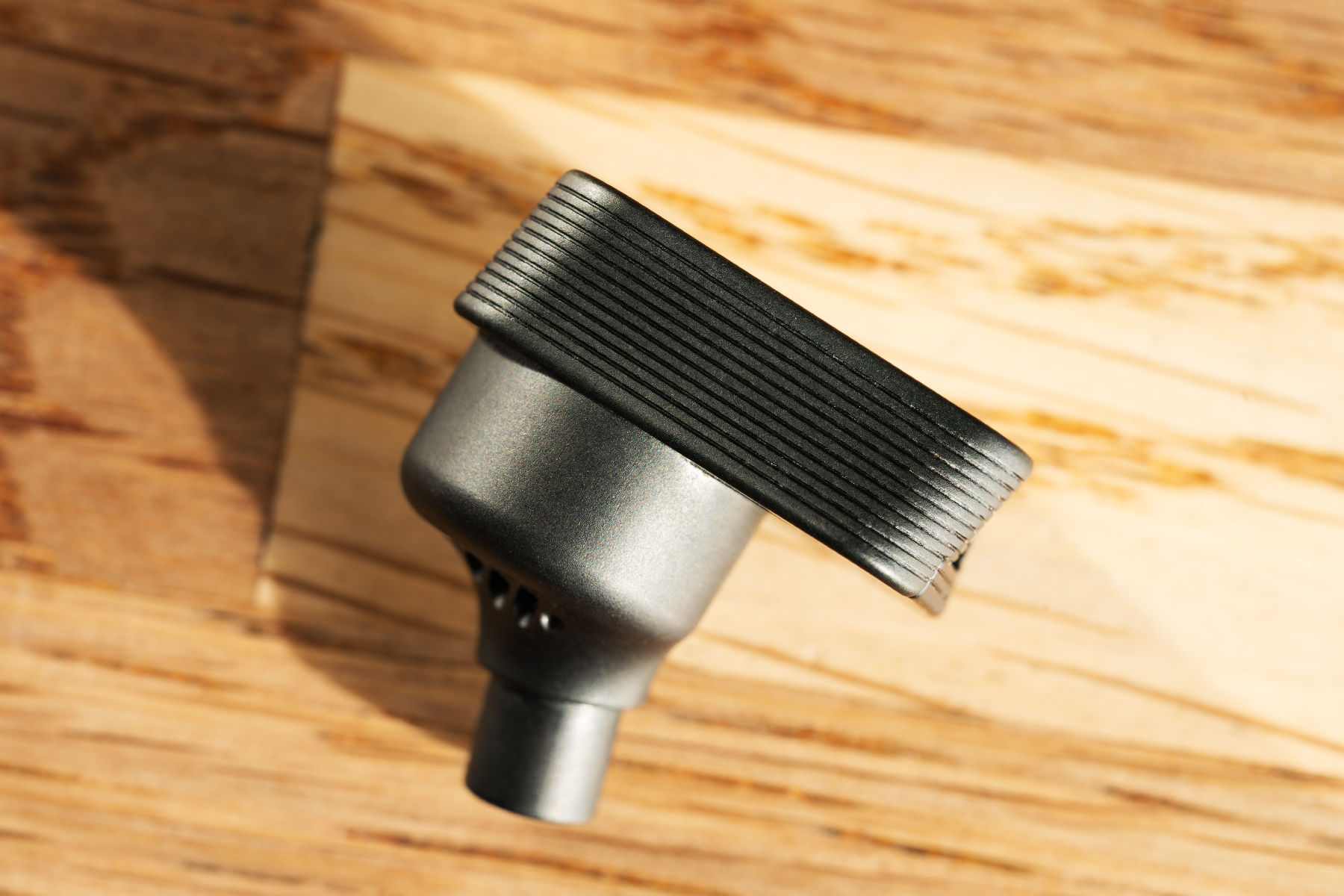
Let’s go to the very earphones. Their shape may seem deliberately simple: the main part of the shells is made in the form of a slightly twisted parallelepiped close-coupled with a cylinder. Only aluminum, only black color, so the earphones look extremely strict. The main part of the shell is encircled by thin (0.1 mm) grooves.
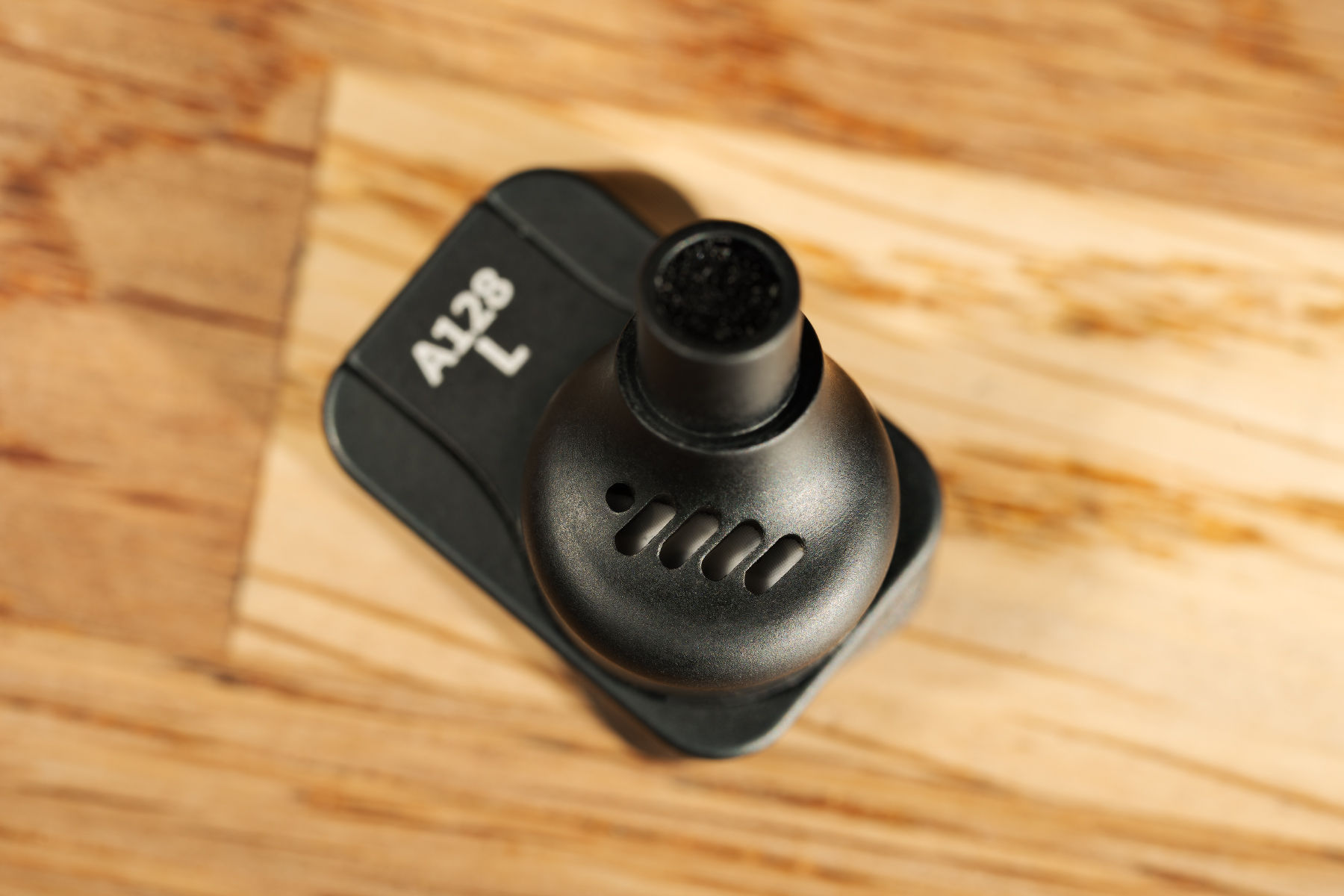
Neat wide compensation holes are made on the front of the cylindrical chamber, which has a single dynamic driver with a diameter of 10 mm. A white acoustic filter can be seen through them.
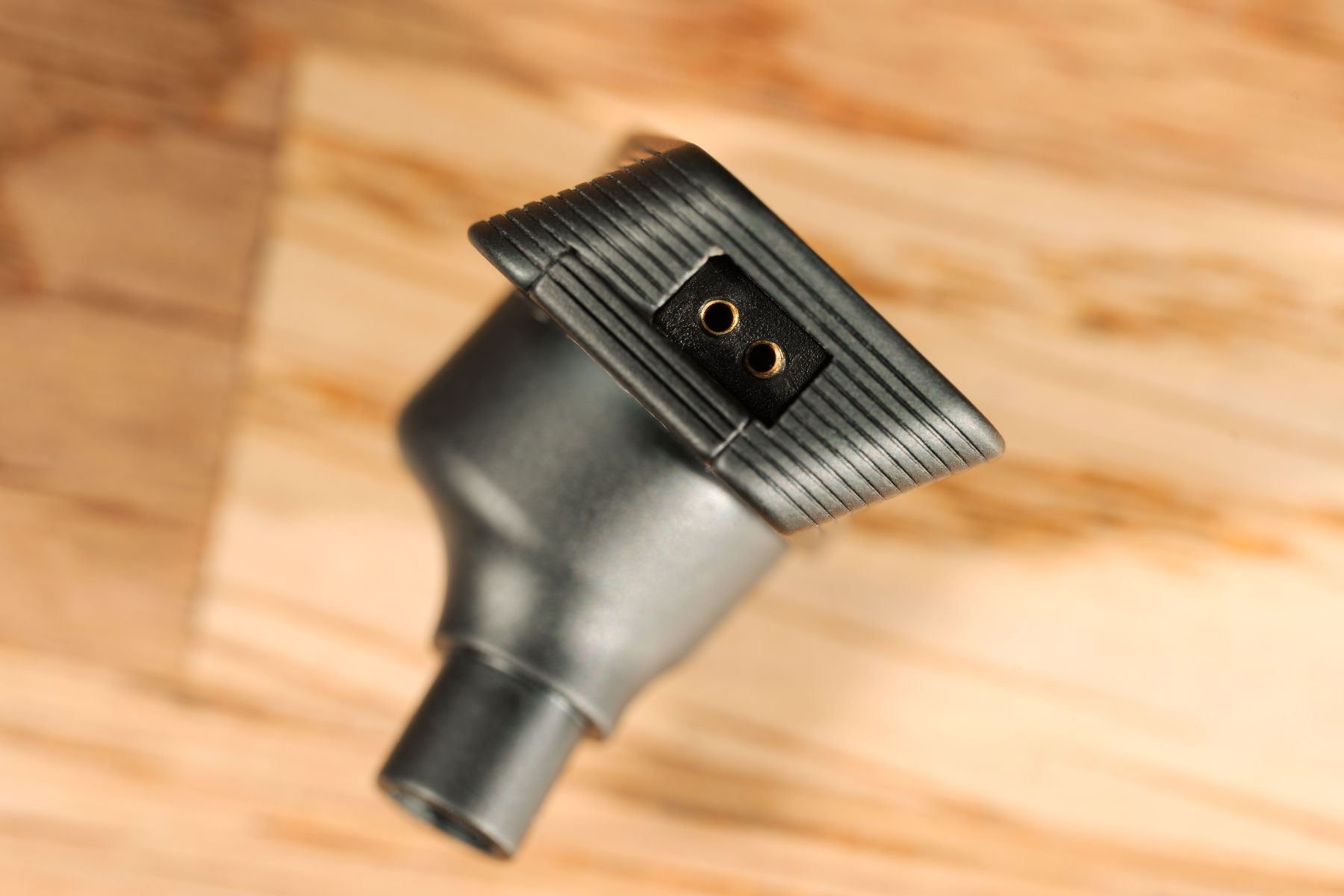
The connector for the 2-pin cable is located at the end.
There is another compensation hole on the opposite side of the shell.
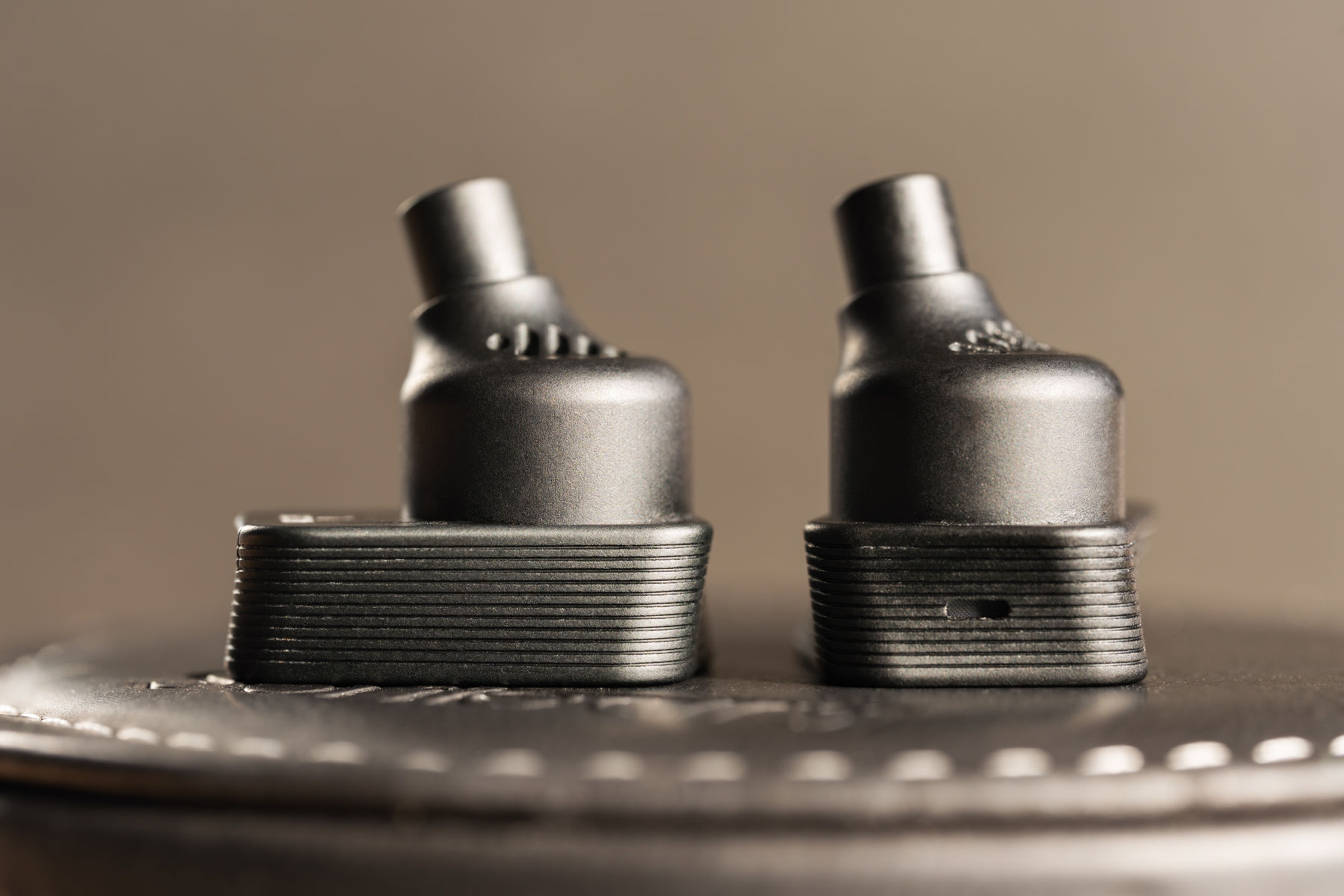
The length of the sound duct is 5 mm, and its diameter is 5.4 mm.
This shell shape and the topology of the functional elements provides for an unusual fit.
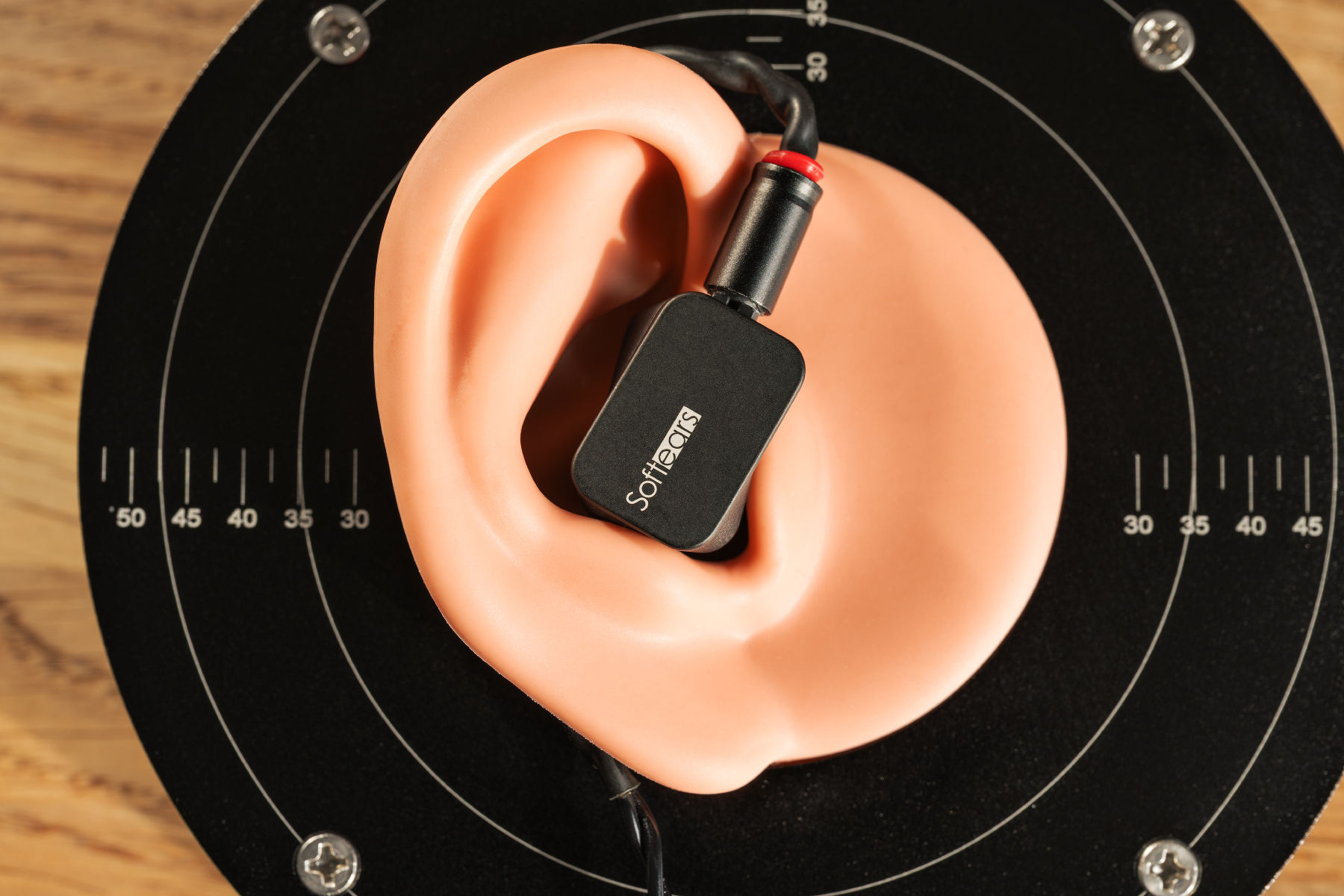
The earphone shells actually rest on a tragus and an antitragus, and the wire holding onto the ear adds stability.
And here I need to say a couple of words about their ergonomics and my own experience of their use.
Despite the somewhat extravagant fit, the earphones fit in the ears comfortably, but with some nuances. The widening of the sound duct and its merging into the cylindrical part is very sharp, that is, the maximum depth of the fit will be restriced by this very cylindrical part. It won’t fit into the ear canal under any circumstances because it’s too wide. But what’s worse is that due to the shape of the main part of the shell, you’ll have to place them so that one of the metal bends catches on the antitragus, and this will limit the minimum depth of the fit. There’s also no way to vary the angle of slope of the shell inside the auricle, as this is prevented by the cable being pulled up.
It turns out that Twilight sit in the ears in exactly one way conceived by the manufacturer. You can adjust the fit within very narrow limits, otherwise the earphones will either be poorly fixed in the ear or cause discomfort. In my particular case, everything worked fine with my ears, but experiments on my friends revealed a clear lack of versatility in the shape of the shells, and the impressions ranged from “it’s just convenient” to “you need to get used to it”.
I had to select the eartips for a long time and thoughtfully, if not ‘painfully’. My experiments ended with the following results: ddHiFi ST35, Whizzer ET100AB, TRI Clarion were all right if taking one size larger than I usually use. All other 54 models in my collection were a bad match. To my taste, Twilight require either long eartips that can slightly deform and bend when placed in the ear or wide ones that hold their shape rigidly, quite the opposite. This is because with the only possible fit, the angle of slope of the sound ducts does not quite fit my ears.
In general, Twilight raise some ergonomic issues, but it’s easy to figure them out. The hygiene issue is much more significant. The problem is that dirt gets stuffed into the microchannels that encircle the shells. And to pick it all out… I spent an hour getting the earphones into a state where the pictures of them wouldn’t be dreadful. And this is not a problem with the owner’s dirty ears: it’s just very, very difficult to extract skin secretions from the cavities that are so thin. The same relates to the main compensation hole: it’s tightly pressed against the auricle, and its sharp edges collect sebum as if with a scraper.
If I used Twilight every day, I would definitely give them a deep cleaning at least once a week, and not by means of the original brush as it’s unable to cope with the complex relief of the shells.
Last, but not least is sound insulation. It’s poor due to the fact that the compensation hole (in terms of the total area of the slots) is very large, so it perfectly transmits sound in both directions. I wouldn’t call Twilight open-back, but I would definitely describe them as suitable only for listening in silence or with minimal external noise.
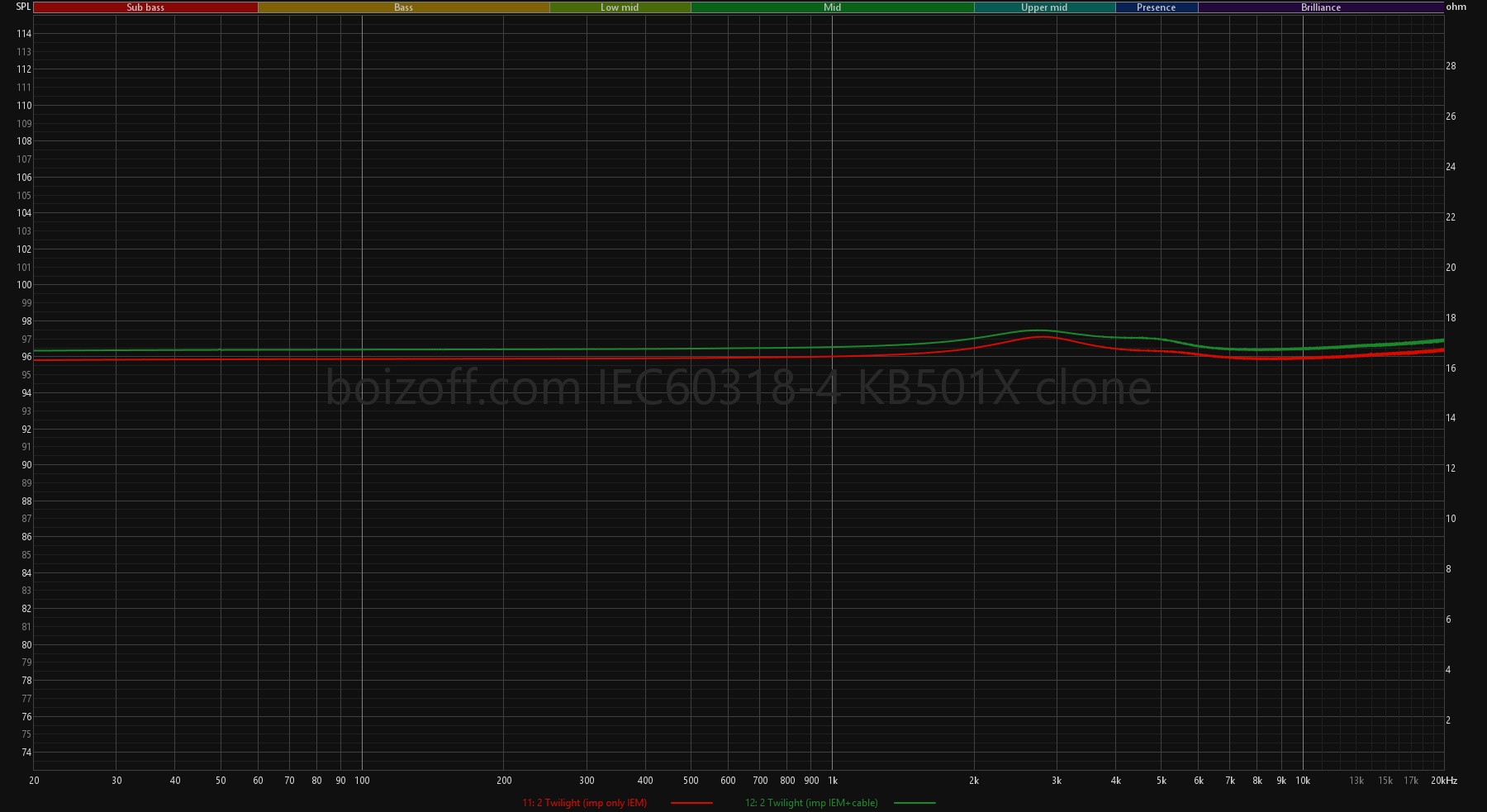
As for the impedance, I measured 16 Ω (at 1 kHz) of impedance of the earphones themselves, which is in line with the manufacturer’s promises. If we add a cable with an adapter, we’ll get a value of 16.4 Ω.
The sound
Standard links:
- the description of my rig is here;
- the audiogram of my hearing is here;
- articles on measurement theory and the whole shebang are here.
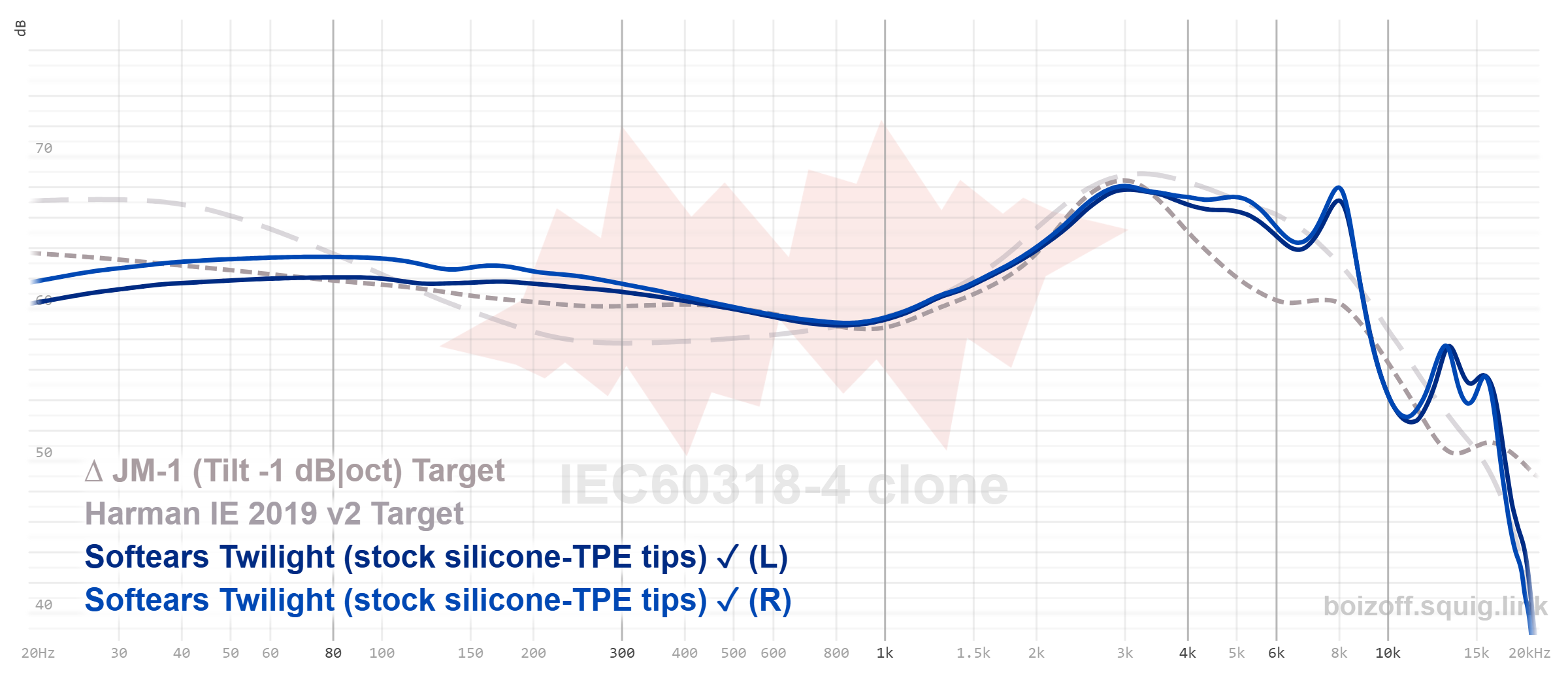
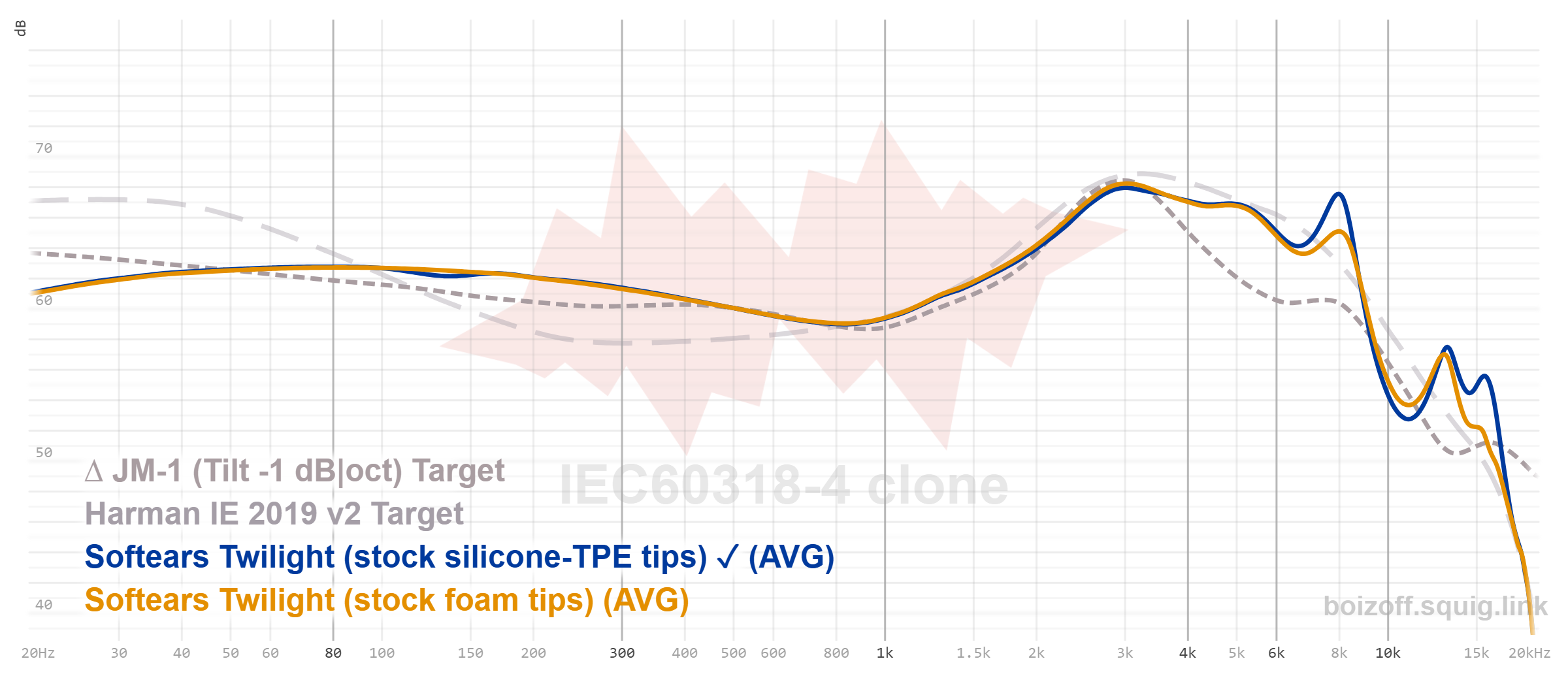
Frequency response of Softears Twilight with standard foam eartips:
Frequency response of Softears Twilight with due allowance for my fit when the second resonance is at 7450 Hz:
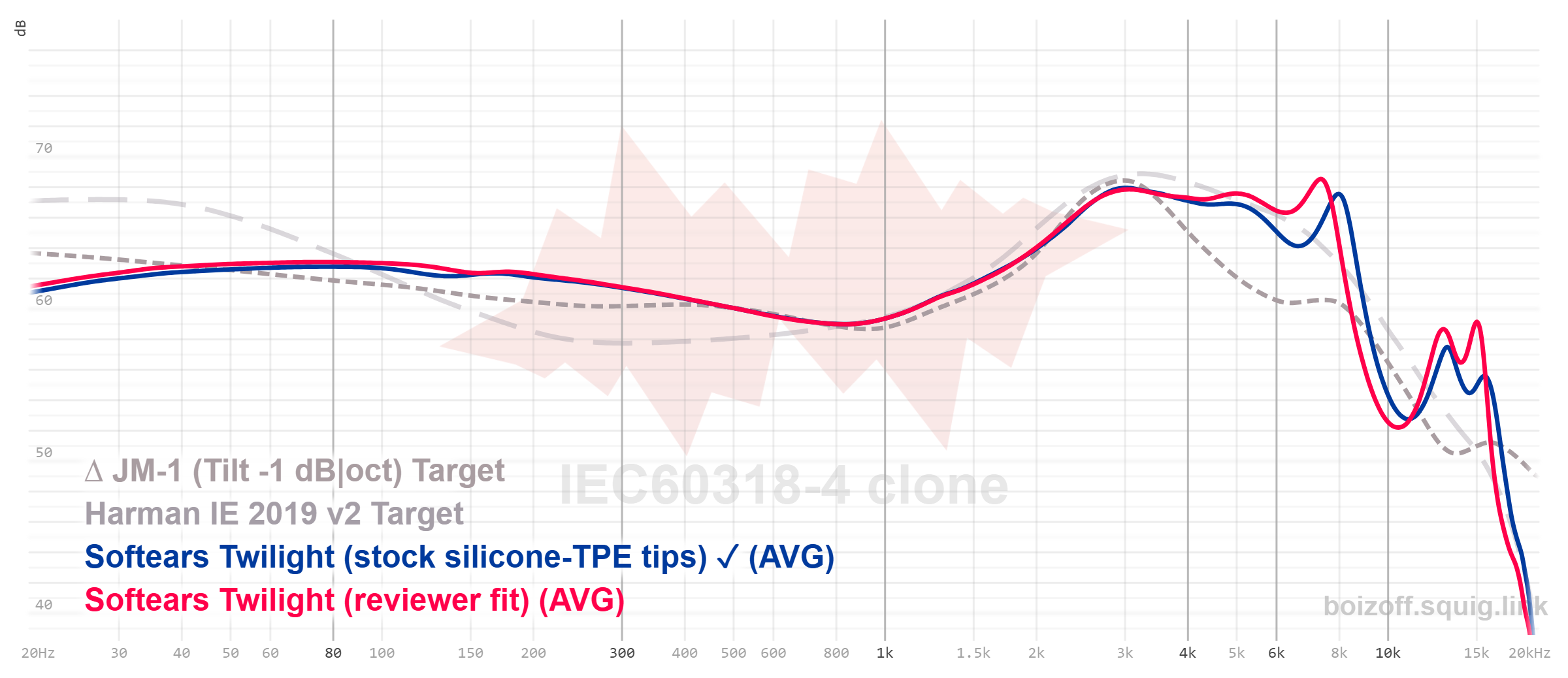
On the graphs, we can see a pretty common pattern for neutrally tuned dynamic earphones, which has a number of features in the Twilight’s case:
- In the lower frequency range, the emphasis is on bass rather than on subbass;
- The 20-1000 Hz segment is close to linear, it deviates smoothly and by 2 dB only;
- The 2 kHz-20 kHz segment is close to the Harman curve, but has additional accents in the area of the second resonance, as well as at 12-15 kHz.
I’ll note that the upper middle is unusually smooth on the Twilight graph. It’s extremely close to the Harman curve, and there is practically no dip at 10 kHz.
And I just have to note the channel discrepancy of 1.5 dB, taking into account the known price of the model and the manufacturer’s direct statement “each pair of headphones is produced and paired separately”. To tell the truth, I was counting on greater accuracy.
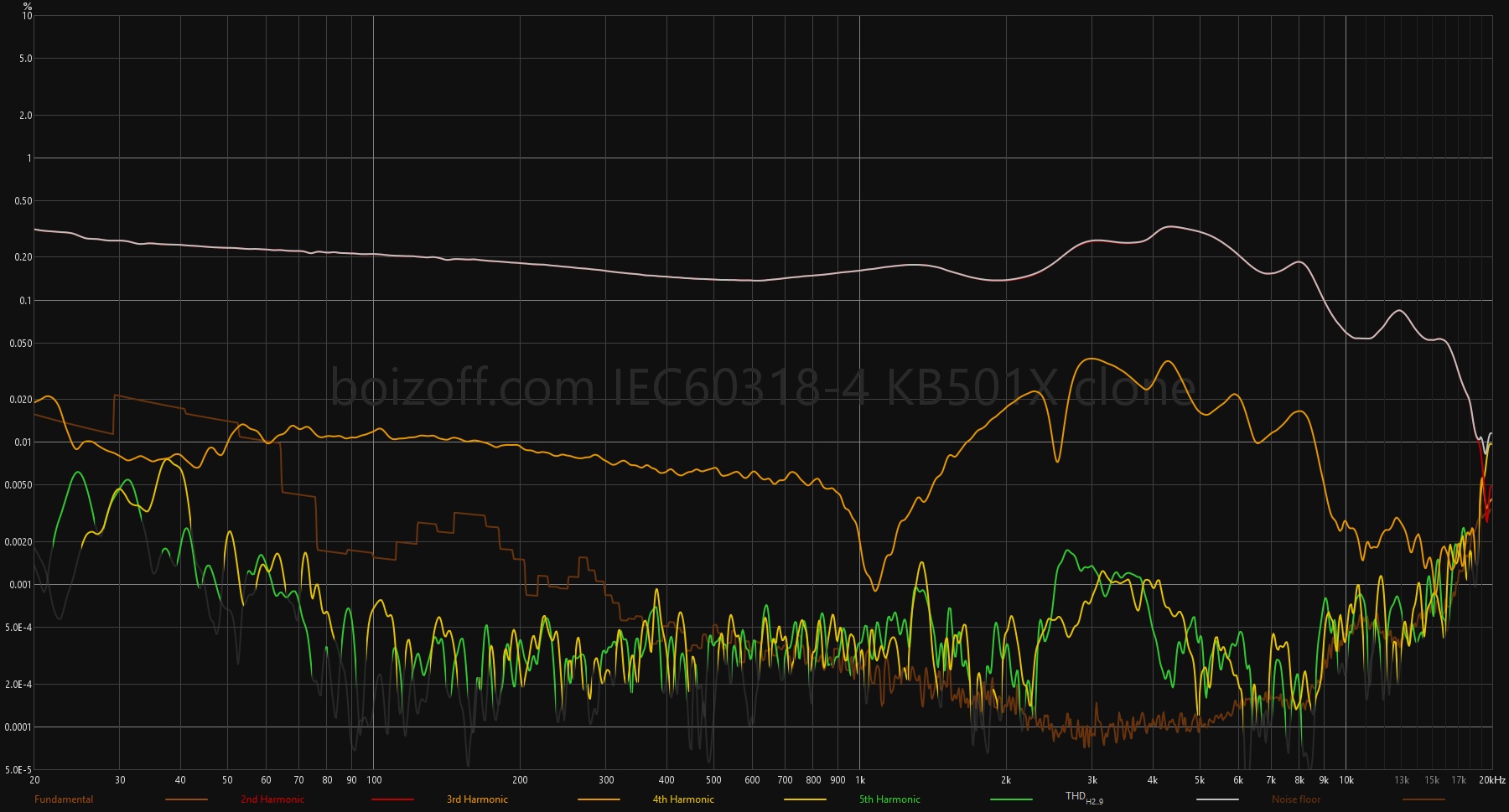
Nonlinear distortion at 94 dB with the ‘Use harmonic frequency as ref’ option turned off and on:
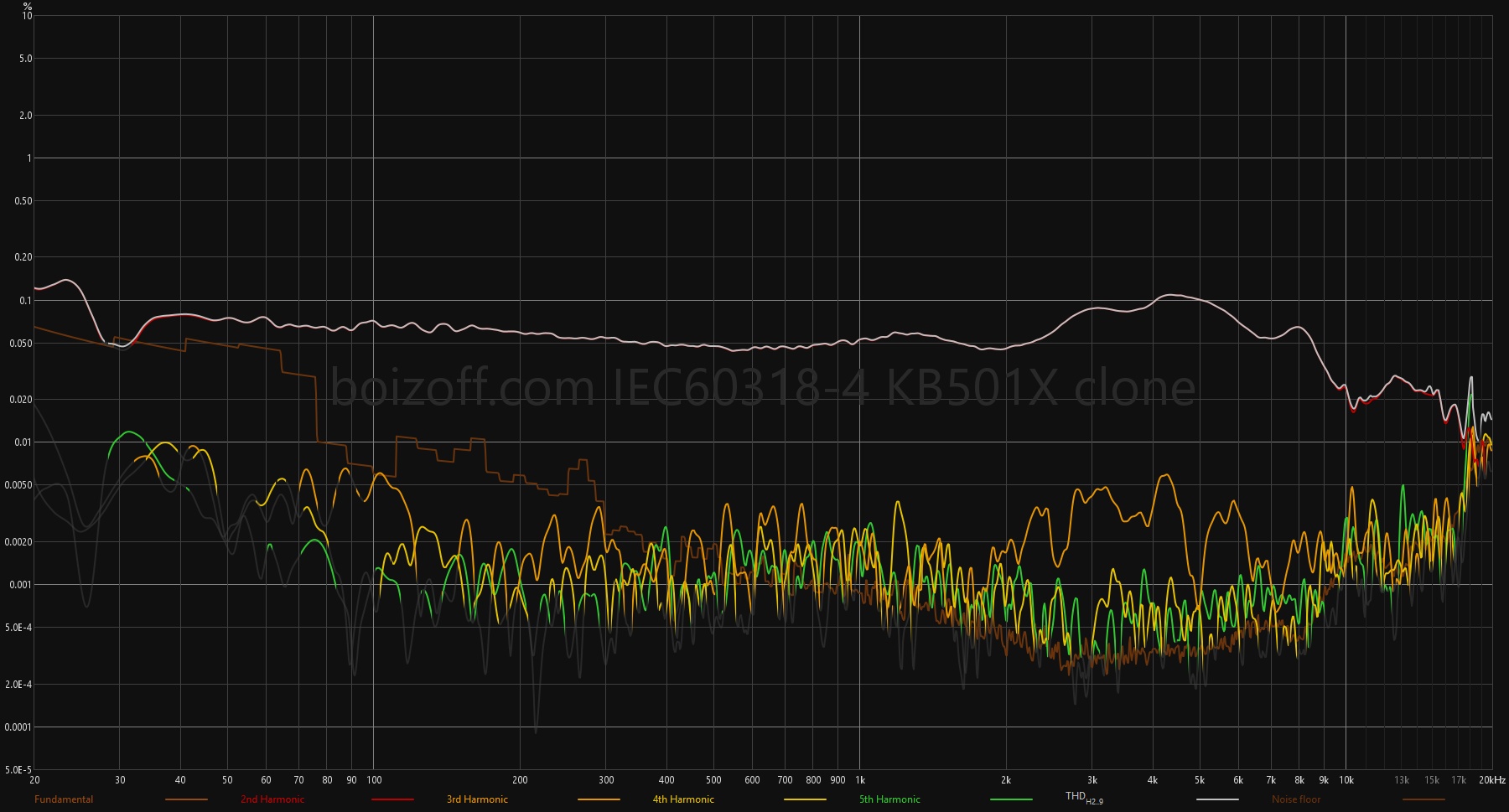
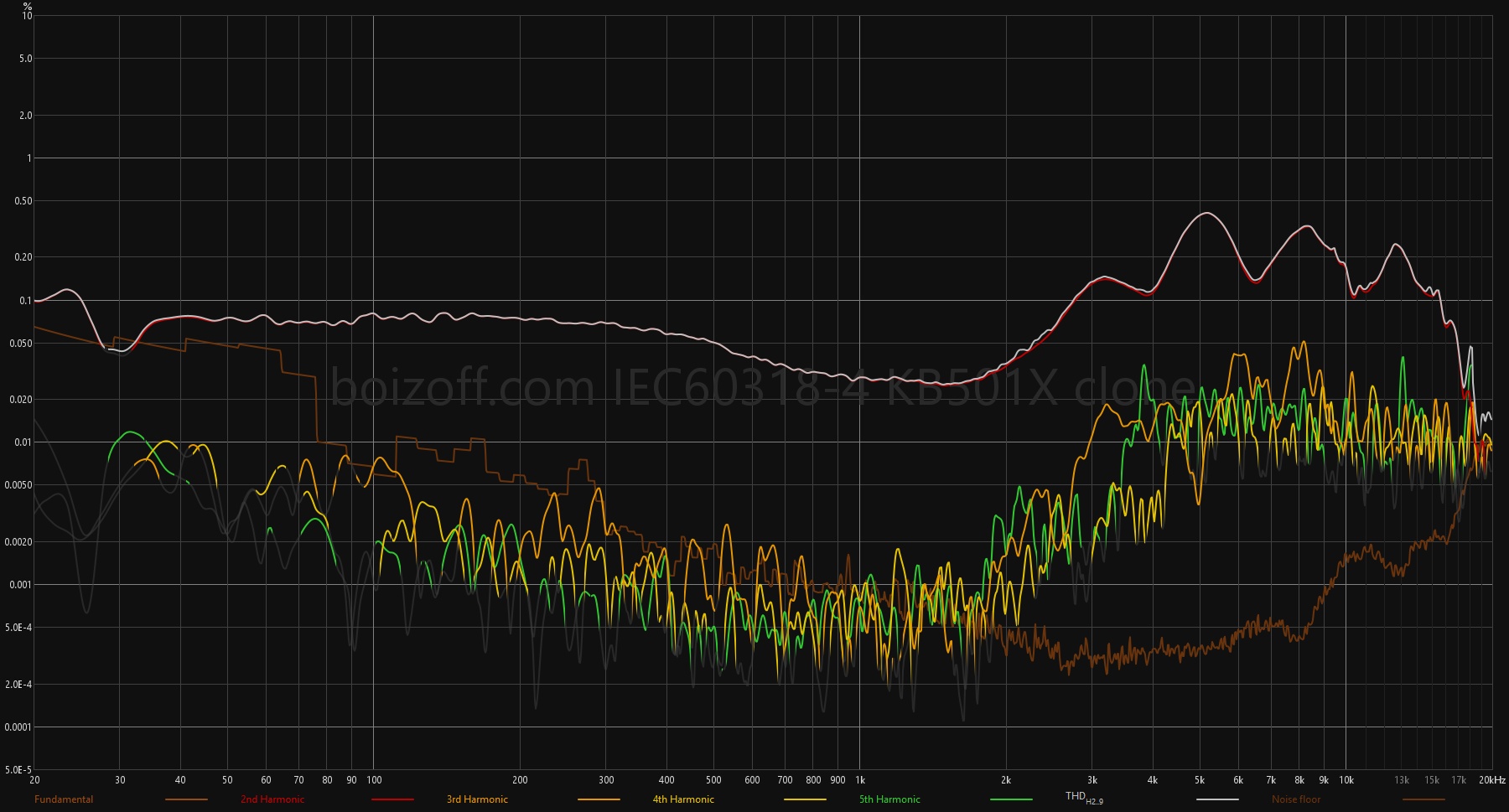
At 94 dB, the distortion does not exceed 0.4%, and at a frequency of 1000 Hz, it’s even 0.028%. This is an excellent result for a dynamic driver.
Nonlinear distortion at 104 dB with the ‘Use harmonic frequency as ref’ option turned off and on:
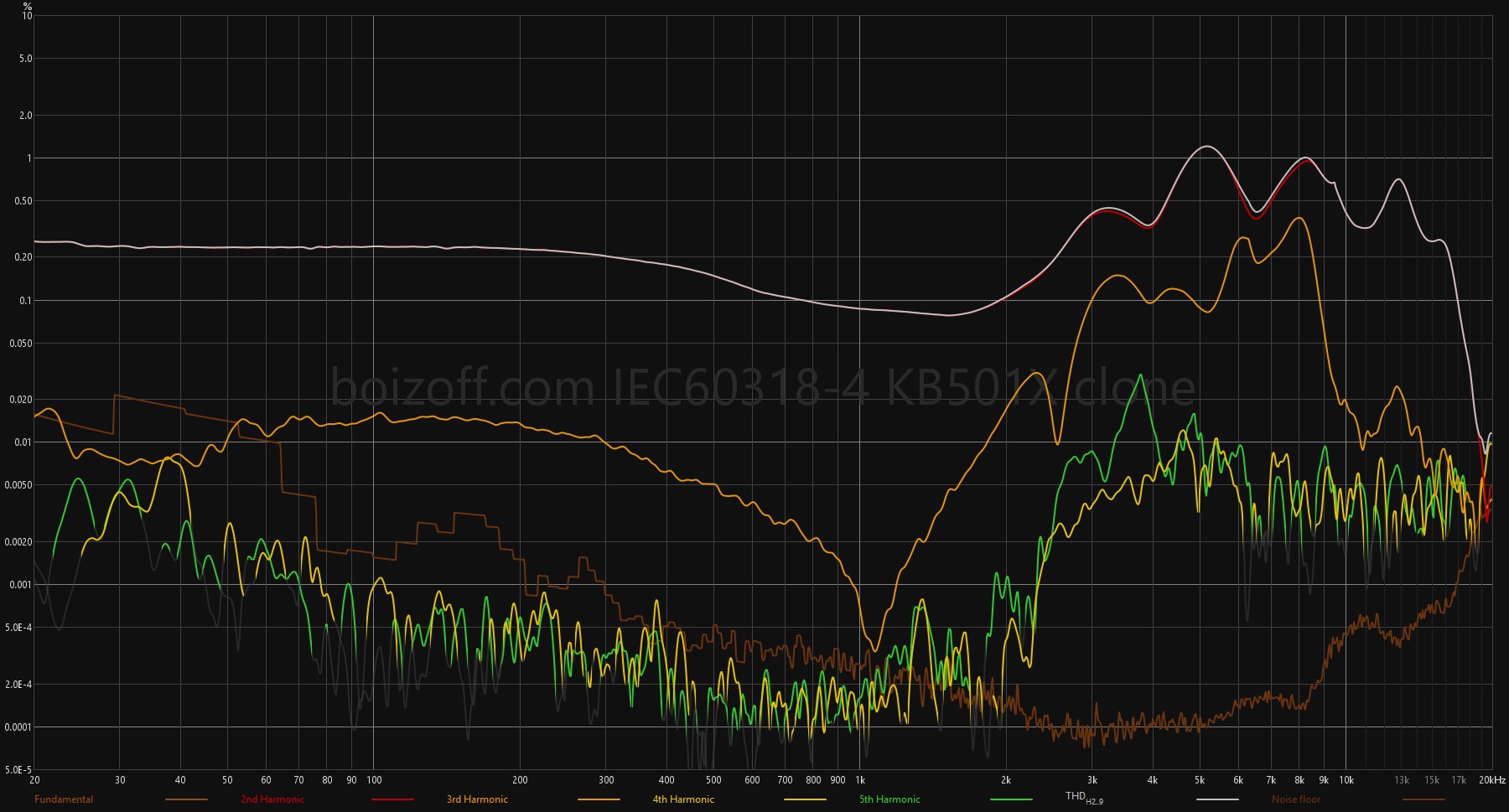
At 104 dB, the maximum distortion is 1.2% (at 5180 Hz), and at 1000 Hz, there’s a value of 0.087%.
Minimum phase response, group delay, and spectrogram in the ‘Burst decay’ mode:
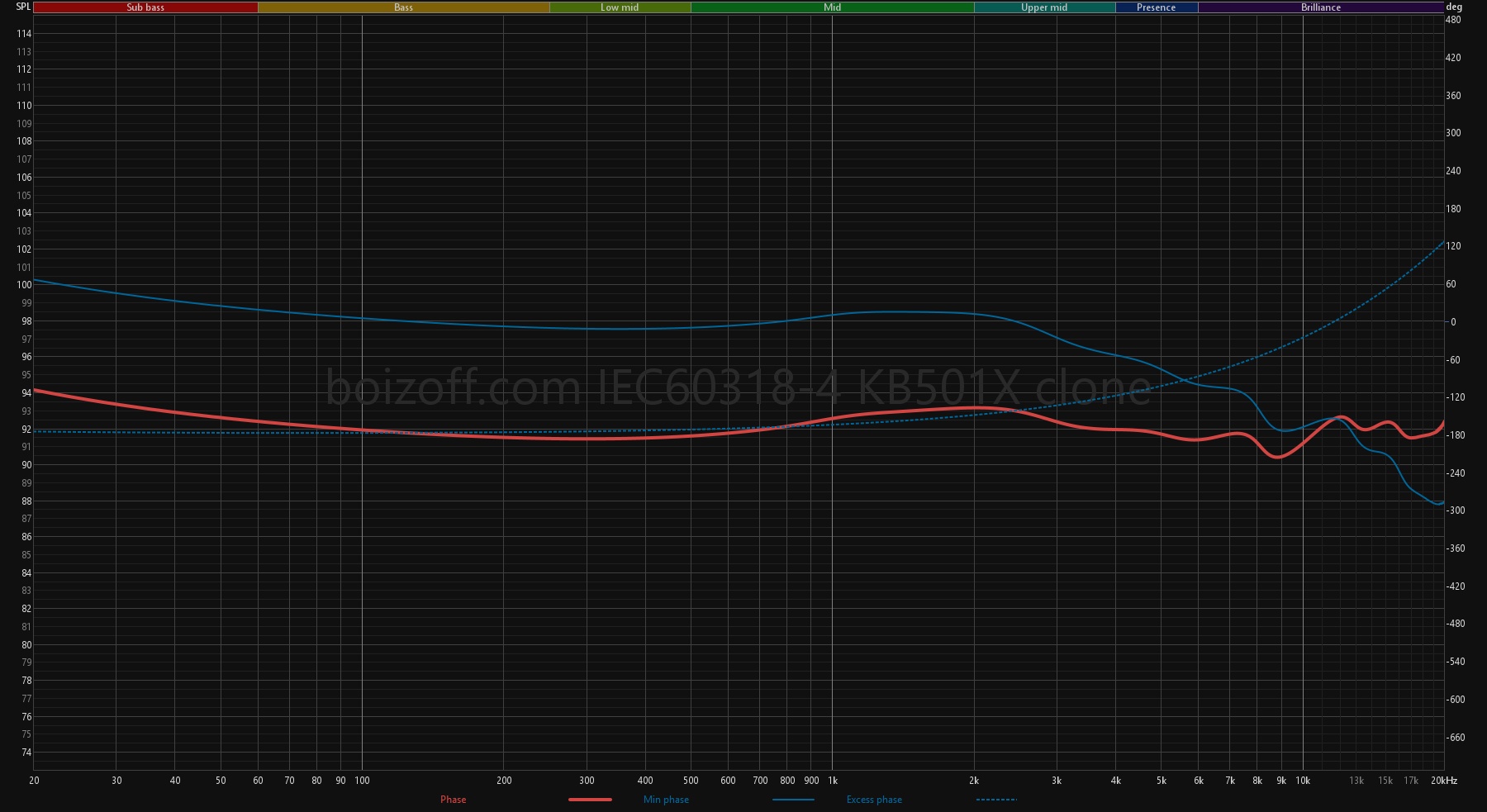
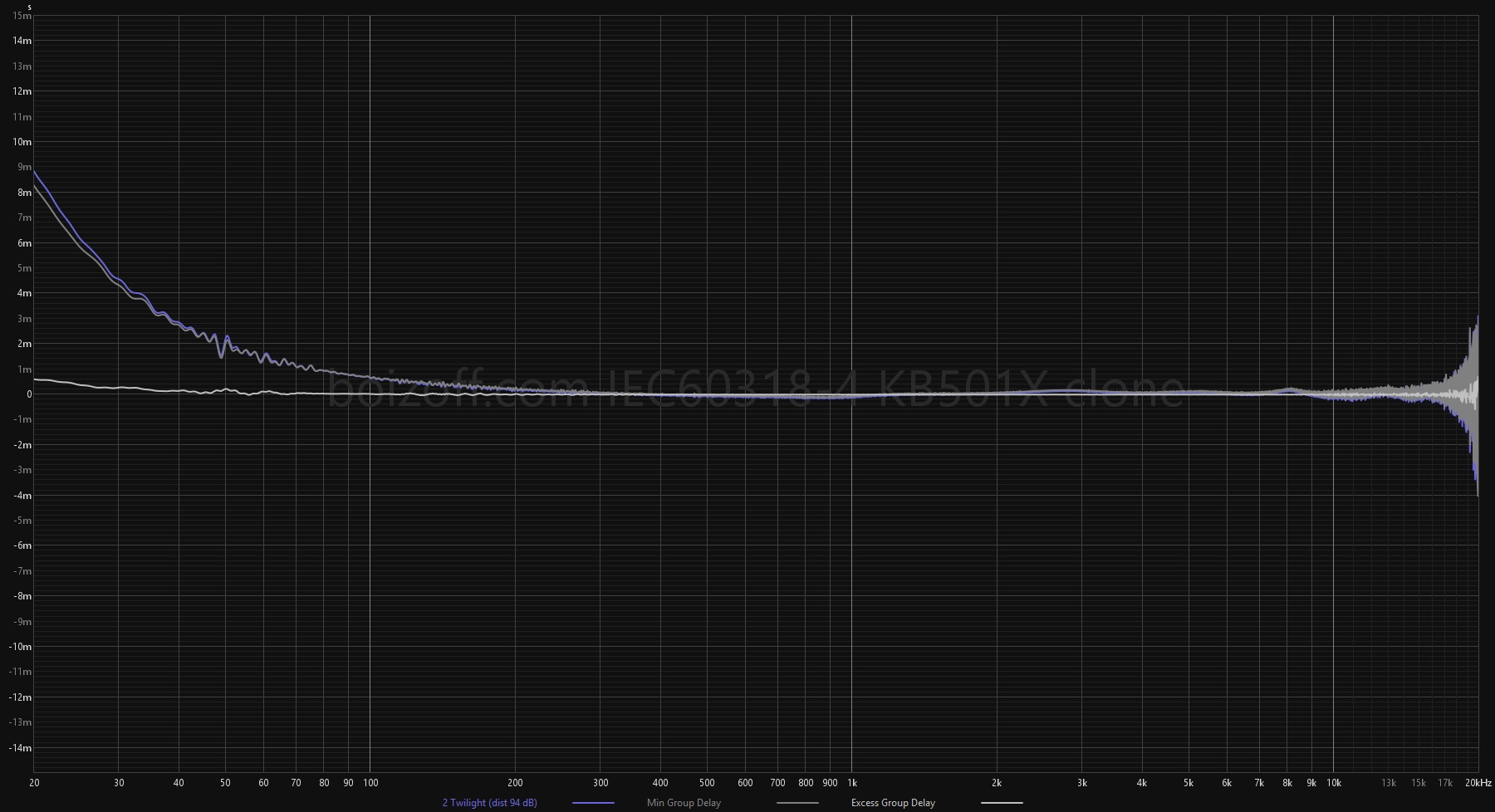
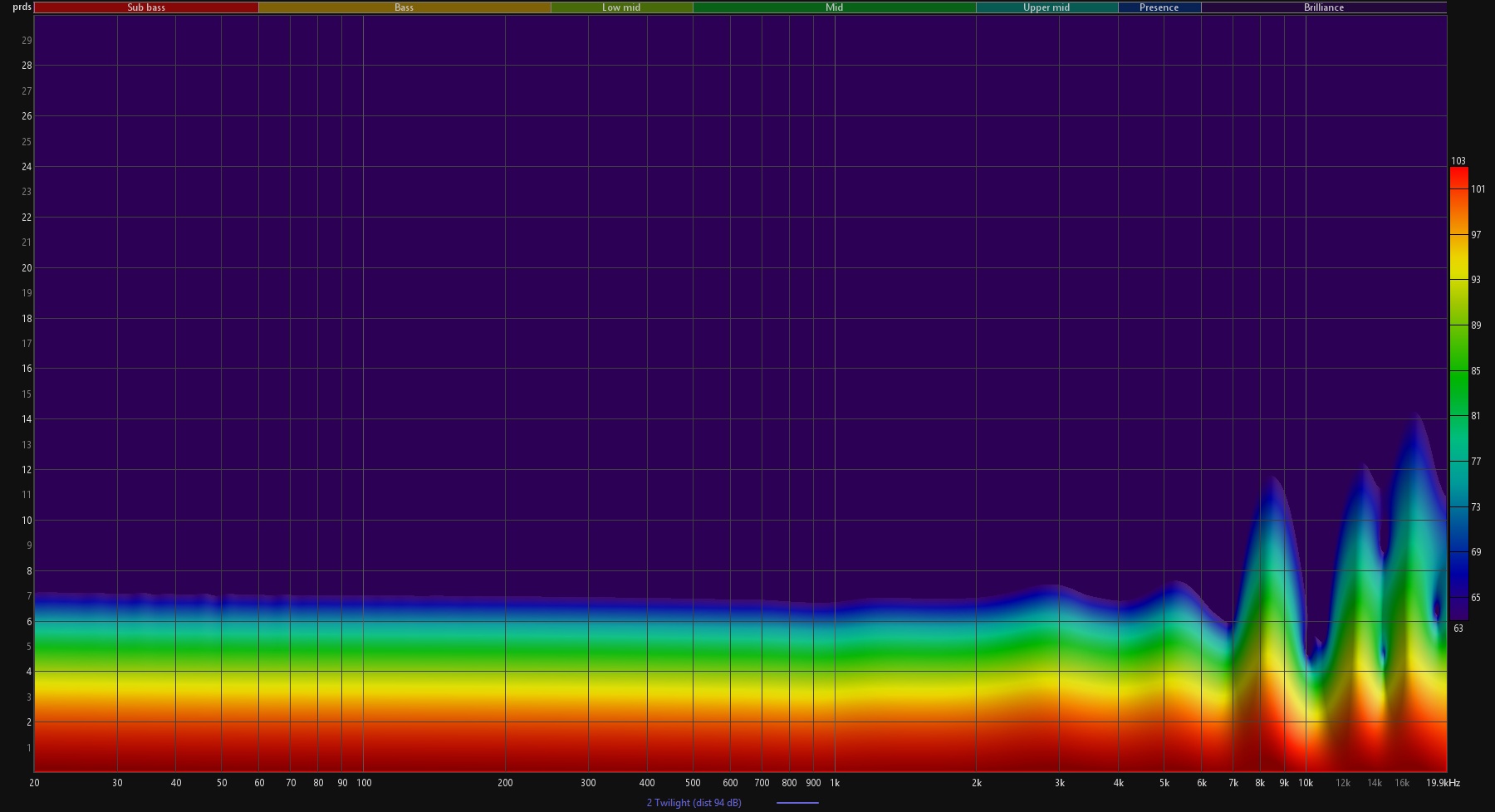
There’s nothing to comment on, everything is fine.
Next is my subjective opinion. Twilight are tuned neutrally. I was able to hear that raise on the bass, which is visible on the graphs, only after a painstaking selection of eartips, as I wrote above. The sound does not surprise with any special dynamics, the width of the sound stage, or ‘uniquely designed frequency balance’. Twilight have a different advantage: they give you the effect of ‘maximum detail’ of sound. You know, there are some headphones whose sound exposes subtle details of music records. It feels like you can hear ‘more’ and better than usual, as if additional miniscule elements appear on the usually rough texture of the musical flow. Twilight give you the feeling that you can hear just everything that can be heard in the track. Really everything, till the very end, to the most subtle shade, to the most fleeting overhang. Twilight involve you in listening with an unexpected trick – a huge amount of information that they ‘extract’ from each track. And, what’s important, the sound as a whole remains more or less natural. The upper middle sounds rather ‘thin’, but this is harmoniously balanced by a slight emphasis on the bass.
Suddenly, I’m ready to call Twilight’s sound delivery pretty versatile, although this conclusion cannot be made from the graphs. Perhaps, metal or hard rock will miss some low frequencies if you are used to a more active ‘bottom’. However, personally, when listening to Deceiver Of The Gods by Amon Amarth, I was ready to agree by the last track of this classic album that this is how it should actually sound. Yes, the upper frequencies are approaching the limit of comfort, yes, I love the ‘fatter’ sound, but damn, Twilight are incredibly convincing even with such music!
Extreme information value, accuracy and neutrality with a focus on light warmth (if you can find the right eartips) are the qualities for which you can truly love the Twilight sound.
Comparisons
I don’t understand what Twilight should be compared to. There are no other headphones of similar value either in hand or in my rating. It would be worthwhile to get something like Moondrop ILLUSTRIOUS, Final Audio A8000 or Sennheiser IE 900 when I was writing this review, but the owners of such rarities were not in my range.
If we look at the well-known, more or less neutrally tuned single-driver dynamic models such as Moondrop KATO / KADENZ, Sennheiser IE600, DITA Project M, the first two of them are much cheaper and not similar in tuning, and as for IE600 and Project M, I’ve never listened to them.
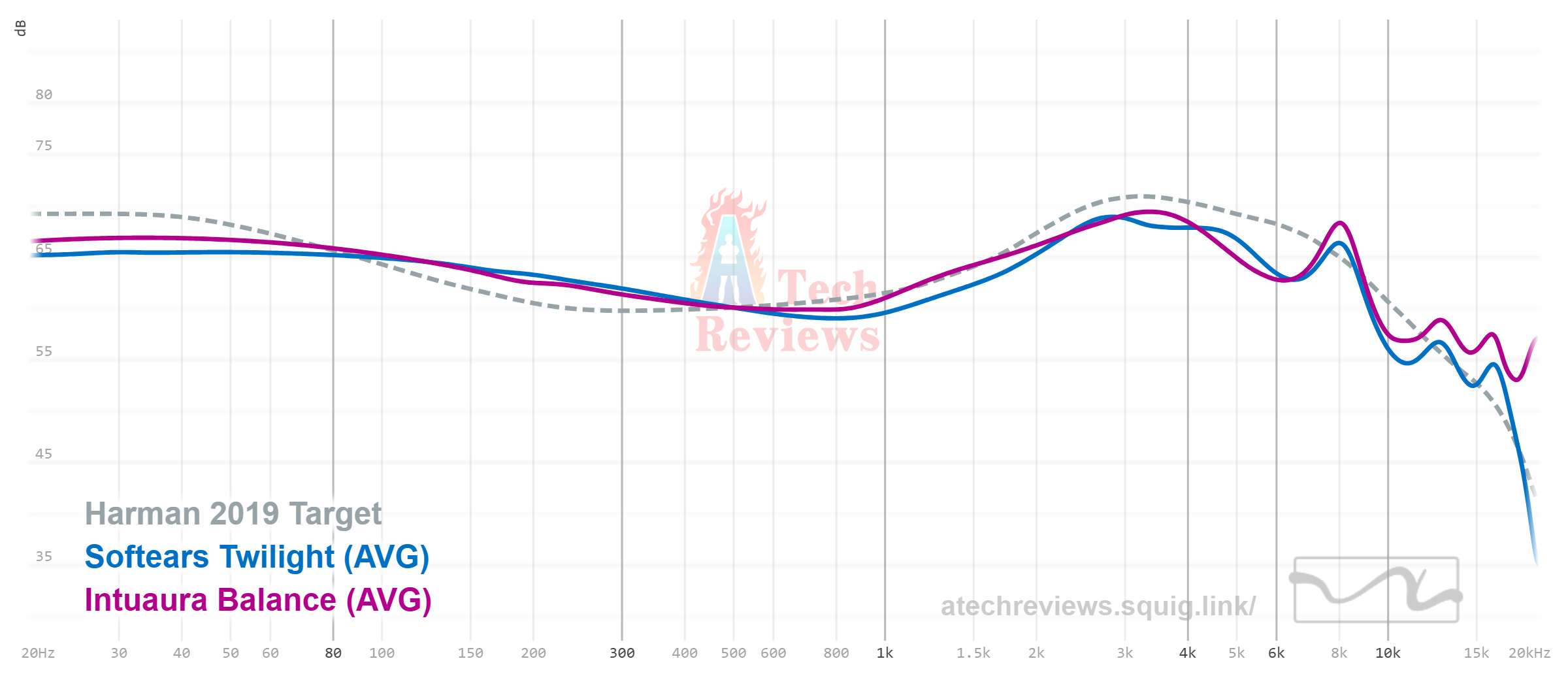
There is one recently released single-driver dynamic model that I would love to listen to and measure, but for now I can only look at other people’s graphs and make assumptions…
Summary
Trying to rationalize the purchase of in-ears for $930 is pointless. In this case, I will not undertake to explain why the manufacturer wants this money: the shells and drivers are taken from the previous Turii Ti model, so I simply won’t believe in the expensive RnD. And even the kit does not provide an answer to this question. Can we just suspect the manufacturer of greed?! Definitely not!
The choice for or against Twilight is like this: you either listen to these earphones and immediately buy them, stunned, or are left completely perplexed by the price for this sound. Therefore, I absolutely cannot answer the question of whether Softears Twilight should be purchased. I can advise to listen to them at least for those who appreciate neutral natural tuning and want to focus on the utmost detail in the sound or for those who desperately need ‘ultimate’ single-driver dynamic earphones — who knows, you may exist!
And, of course, you should have ‘spare’ $930 for in-ears.
To buy or not to buy: only after listening and familiarizing yourself with competitors in this price segment.


