

Hisenior Mega7 Earphones Review
In 2025, Hisenior released only 2 new headphone models. I’d even say, one and a half, because the first one was based on the ‘old’ Mega5-EST released in 2024. That is not good form in today’s IEM market; Kiwi Ears, for example, launched 7 in-ear models at once, ZiiGaat introduced 6, and Moondrop introduced 5. (And it’s actually impossible to sort out the load that KZ has dumped.)
So, Hisenior stands out in a crowd, you know. They’ve got one and a half models.
Actually, their real novelty is Mega7, hybrid earphones with one dynamic and six armature drivers, as well as the word ‘Mega’ in their name, which itself implies the manufacturer’s desire to clearly identify their relation to the incredibly successful first model of the line, even when the manufacturer is not bound to do so.
Therefore, Mega7 is what we’ll talk about today. The earphones cost me some $446 + some $26 as the customs duty, or $472 in total.

All but the sound
The earphones come in a well-packed box of adequate size, made of very thick, high-quality cardboard.

The set is quite well-stocked:
- the earphones themselves;
- a balanced cable with a 4.4mm connector;
- a 3.5mm → 4.4mm adapter;
- 14 pairs of eartips;
- additional meshes for sound ducts;
- a case;
- a cloth and a cable clip (to fix on clothes);
- a beautiful picture on thick cardboard, as well as some common papers.
The case is standard, round, without additional compartments and nets, but locked with a nicely clicking magnet.

The eartips are packed in two boxes, each of which contains two completely identical sets. The completely gray ones are called ‘balanced’, and the ones with a red core are called ‘smooth’. The main difference lies in the density of the sound duct material: it’s soft for completely gray eartips and harder for ‘red’ ones. A separate bag contains two pairs of foam eartips, made of slightly different foam with glossy and matte surfaces — this can be seen in the picture below.

The cable is kingly. It’s made by Hisenior itself and called ‘Orca’. Its image is engraved on the connector. (Needless to say, it’s made of virgins’ hair, and its strands are twisted on a full moon, the electrons flowing through such a cable with great confidence, with no loss of their musicality…) The cable is sold separately for $99 on the manufacturer’s website.


The splitter is made in the form of an aluminum bar with the name of the manufacturing company.

The original adapter raises a question about its appearance: it looks like Hisenior simply took a third-party solution to implement a possibility to connect the earphones to unbalanced sources because there is no 3.5mm version of the Orca cable. And it looks… weird.

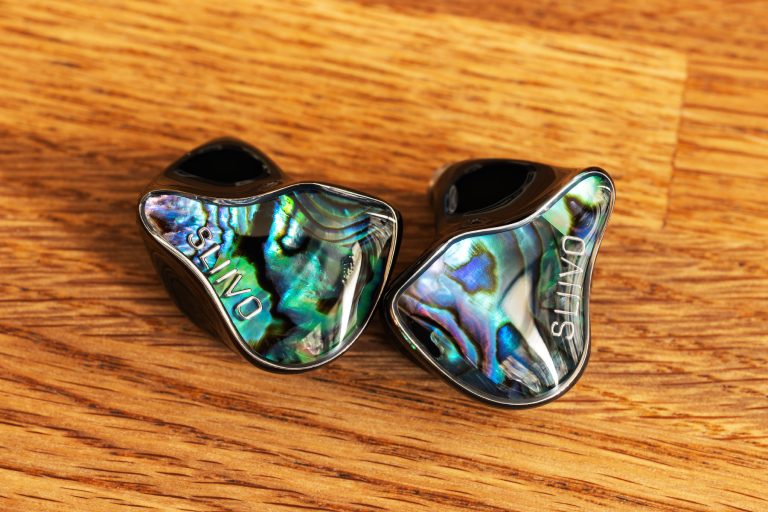
The earphones themselves look extremely modest. Their plain black shells are decorated only from the outside. FB letters emblazon the backplates under a thick layer of varnish, which might stand for FEBOS: ‘feel the beauty of sound’. The letters are sprinkled with glitter, which may seem colored in photographs. However, this iridescence is almost invisible in real life, which makes Mega7 look literally black and white.

It’s quite difficult to make a representative photo of these earphones, so, again, we can only see their rendered images instead of photos on the manufacturer’s website, and I keep saying that this is not fair to the buyer. And it’s not as difficult as it seems to take decent photos – for example, I can do it, and it takes me the light out of the window and one reflector, damn it! Doesn’t a manufacturer have more facilities and technical capabilities for taking vivid photographs of their products than a private blogger?
The connector area is covered with a coat of varnish on top, in the Hisenior’s traditional manner.

The meshes are neat and removable.

The compensation holes are oval. I mention it on purpose, because we know how Hisenior can have it.
The ergonomics of the earphones is almost identical to one of the Mega5-EST model, that is, it’s absolutely hassle-free (a detailed comparison is given below). The width of the sound duct is 5.4 mm in its narrow part and 6.1 mm in its wide one. The chamfer is pronounced, with a sharp edge, so any eartips will sit perfectly. I settled on Whizzer ET100AB, which provide both the maximum depth of the fit and high comfort, as well as good passive sound insulation in my situation.
Oh, and that’s what I nearly forgot:
The cable won’t fall out!
I do say it again, the cable won’t fall out!
Speaking of which, the cable is pleasant and soft, but I scratched my wooden table with its massive, angular metal splitter. The adapter is just a square peg in a round hole: it’s large and heavy, and it doesn’t fit the cable stylistically (I believe it’s fair to find fault with it for the earphones of their price). It will do for stationery use, but it won’t be convenient for portable use.
As for the eartips, I wish I knew why it was necessary to duplicate the sets, which are quite ordinary, by the way.
The electrical parameters of the model declared by the manufacturer are 21 Ω of self-impedance and 103 dB/MW of sensitivity.

That is, the impedance is really about 21 Ω per 1000 Hz, but, in general, it varies from 25 to 8 Ohms in the audible frequency range.
The sound
Standard links:
- the description of my rig is here;
- the audiogram of my hearing is here;
- articles on measurement theory and the whole shebang are here.
Frequency response of Hisenior Mega7:

These are frequency response measurements with original foam eartips, and they differ from the measurements made using original silicone eartips. When they are used for measurements, there is a giant peak at 16 kHz, as well as an actual increase in the area of 13-16 kHz:

While I was writing this review, the earphones (my very sample) were tested on several people from 20 to 35 years old. As it turned out, neither I nor the younger listeners could hear this peak with any eartips, from which I can conclude that this is an aberration of measurements, but it’s not just about my rig: check out other measurements on squig.link.
The way I hear the Mega7 sound corresponds to the frequency response measurements with foam eartips.
Actually, that’s what we can see on the measurements:
- the volume at 3 kHz is 1 dB below the Harman curve, while the volume at 20 Hz corresponds to it;
- the ranges of 200-800 Hz and the ‘middle of the middle’ are tuned closer to the IEF Preference 2025 than to Harman;
- the volume of the upper middle is somewhere between the Harman curve and IEF Pref 2025;
- some ‘air’ is added after 10 kHz.
Nonlinear distortion at 94 dB with the ‘Use harmonic frequency as ref’ option turned off and on:


Nonlinear distortion at 104 dB with the ‘Use harmonic frequency as ref’ option turned off and on:


This is exemplary performance for the earphones of this price, what else is there to say? At 94 dB of volume, THD doesn’t go beyond 0.5% over the entire audible frequency range, while at 1000 Hz, at the point for which the distortion is usually indicated by the manufacturer, it’s even 0.039%. At 104 dB of volume, there’s a maximum of 1.7%, and even then at 14 kHz. At 1000 Hz, it’s 0.14%.
Minimum phase response, group delay, and spectrogram in the ‘Burst decay’ mode:


There’s nothing interesting, just boring, near-perfect pictures.
How do I tend to evaluate the Mega7’s sound subjectively? Well, there are headphones that seem to have been created ‘on impulse’, ‘by ear’, Bajie, for example. And I assume that the Mega7’s sound was the result of a completely different, extremely balanced approach. Hisenior measured much more than twice before cutting. The Mega7’s sound is a perfectly balanced V-shaped sound delivery, free or almost free from any nuances and flaws, but endowed with a noticeable expansion in the ultra-high frequency range. All frequencies (within the framework of the concept chosen) have been measured on a scale. The tuning of each frequency range has been checked under a microscope. The earphones sound both ‘fun’ and balanced and accurate, as well as ‘wide’, ‘airy’, and ‘detailed’. The trick is that there are airier, more accurate or more balanced headphones, but these models will lose out in other aspects, while Mega7 has it all, probably not with distinction, but definitely with credit.
Mega7 can be recommended as ‘the best earphones for $400+’ to a person who has money but doesn’t know what exactly they want in terms of sound. They will click with HF-phobes, bassheads will miss the ‘bottom’ just a bit, fans of ‘neutral sound delivery’ will have a little too much lower frequencies, and audiophiles will complain about a slightly reduced ‘middle’ and not really ‘layered overhangs’. But none of them will tell you that they didn’t like these earphones – everyone will be able to move on with them and enjoy music.
What more can I say? It’s excellent tuning. Hisenior spent their time well.
Comparisons
Mega7 won’t stay out of the comparison with their iconic predecessor, so that’s what I’ll start with: Mega7 and Mega5-EST.

As for the shape of the shells, it’s almost identical. Mega7 ones are a millimeter thicker, and their sound ducts are a millimeter longer.

Besides, Mega7 have a slightly reduced protrusion resting on the antihelix, while Mega5-EST have it more pronounced. But, again, it’s about millimeters and their tenths.
Frequency response of Mega7 and Mega5-EST:

Mega7 lost their bass massiveness compared to Mega5-EST, but won in the sense of ‘speed’ of the low-frequency component. Mega7 are calmer at the second resonance around 8 kHz and don’t have a high-frequency peak at 15 kHz.
So, in fact, all the minor flaws that I complained about in my Mega5-EST review have been fixed in Mega7. To be honest, Mega7 and Mega5 are quite different in sound, but let’s face it, I’d personally choose Mega7 from these two models.
And here come the comparisons with models for nearly the same price:
- Moondrop Meteor (here is a review);
- Moondrop Variations;
- Elysian Audio Pilgrim;
- XENNS Tea Pro.

Frequency response of Mega7 compared to Meteor:

Actually, everything can be seen from the graphs – Meteor have a pronounced ‘middle’ and a more evenly perceived ‘top’, whereas Mega7 rely on subbass and bass to a much greater extent in their sound delivery.
Frequency response of Mega7 compared to Variations:

The situation is opposite here. Variations sound more contrasting in terms of the top-middle-bottom ratio, since they are an example of an almost perfect Harman tuning with all its pros and cons. The Mega7 sound is ‘calmer’, ‘more balanced’, it has more ‘air’, and the sound delivery is not so ‘detailed’, but also not so ‘loud’.
Frequency response of Mega7 compared to Pilgrim:

Pilgrim sound wider, significantly bassier and ‘airier’ to the point of losing naturality; they sound ‘close’ to the listener. Mega7 are perceived to be ‘calmer’ and more ‘authentic’; on the contrary, they move the sound stage away from the listener.
Frequency response of Mega7 compared to Tea Pro:

Tea Pro, as we can see from the comparison of the graphs, have a much more pronounced low-frequency component, slightly more volume around 2 kHz, as well as a clear emphasis at 8 and 13 kHz. The Mega7’s sound is more balanced, and it also has a much smoother high-frequency component.
Summary
I think that what Hisenior has done is next to impossible. The company has released earphones with a V-shaped ‘airy’ sound delivery that everyone or almost everyone will like. Some reviewers call them boring. Get real, ok?! What IS boring is when KZ releases a pile of models that all sound so different, but are all equally faulty in terms of tuning, and they do it every month, not even every year.
It’s relatively difficult to discuss Mega7 because they don’t have any striking features in their design or sound. Their unique feature is their absolutely amazing versatility and precision of tuning, which made it possible to implement this very versatility. I won’t be surprised at all if some listeners consider Mega7 an ‘endgame’, and I’ll even agree with them: by and large, you can stop at this sound. In more expensive ‘good’ models, you’ll get taste-based, but not drastic changes in sound delivery, and it is far from certain that you’ll perceive these changes as improvements.
To buy or not to buy: go right ahead.