

Simgot SuperMix 5 Earphones Review
Simgot SuperMix 4 were very good earphones, but with a nuance of very sharp and harsh upper frequencies, and this couldn’t corrected with any eartips. But the shape of their shells was excellent, the cable was decent, and the box was beautiful. Therefore, as for me, the trajectory of the SuperMix line seemed obvious: it was necessary to do exactly the same thing, but to correct the sound on the ‘tops’. It would make a very worthy competitor to Truthear NOVA, which is already an excellent result itself.
However, Simgot decided to take a different tack. Which one? What has changed in their new model? Did they do it right, after all? That’s what we’re gonna talk about today.
SuperMix 5 earphones are available for $220 ‘over there’ and for some $163 on Russian marketplaces.
All but the sound
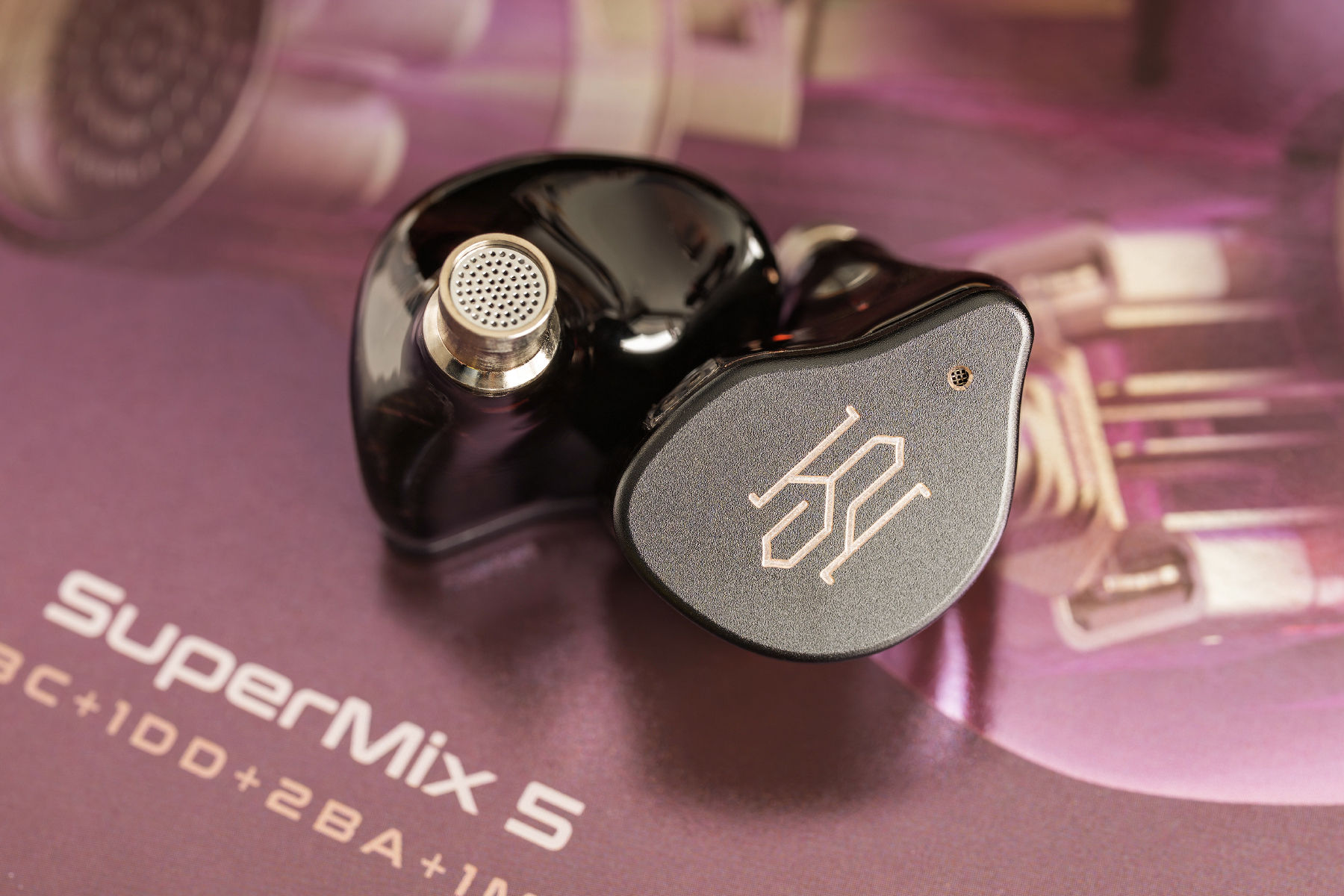
While the SuperMix 4 box was green, the purple color was chosen as the main one for the 5th version.
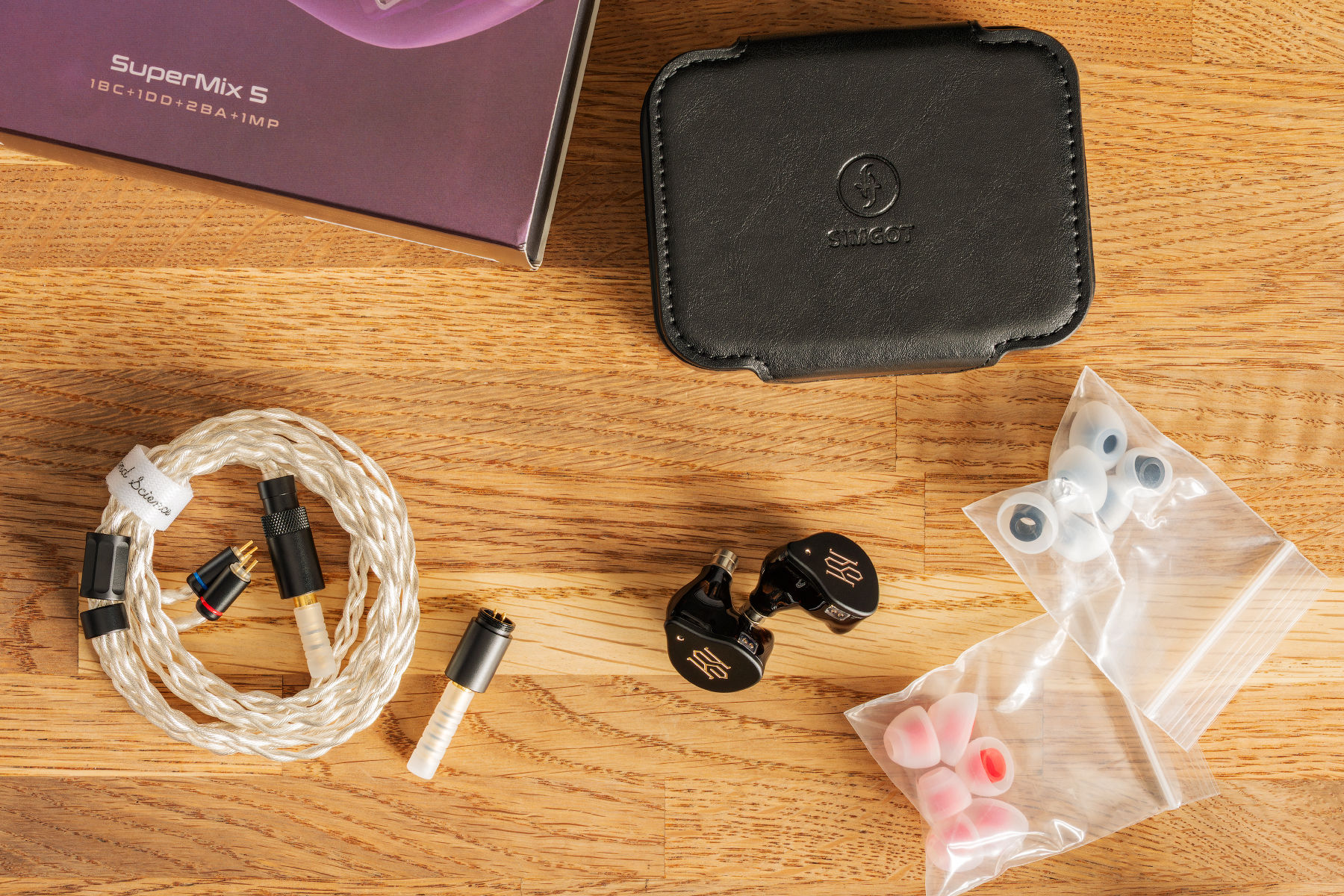
The box contains the following items:
- the earphones themselves;
- a cable with 3.5 and 4.4 mm replaceable connectors;
- two sets of silicone eartips;
- a case;
- some papers.
No special extras, but thanks for the cable, anyway!
The case gives cause for writing a separate and substantial paragraph about it.

Hard, seemingly made of leather (but I’m not sure), the case has a size suitable for comfortable placement of earphones with the cable and accessories in it. There are elastic loops on the lid suitable for securing, for example, a small DAC such as CX31993, as well as replaceable cable connectors. Removable eartips can be put under the mesh in the main compartment. The lid is locked with a magnetic fastener. And this is an extremely rare example of a manufacturer getting their mind right and doing it in a decent way, not pretentiously or just beautifully, but stupidly, that is, as usual.
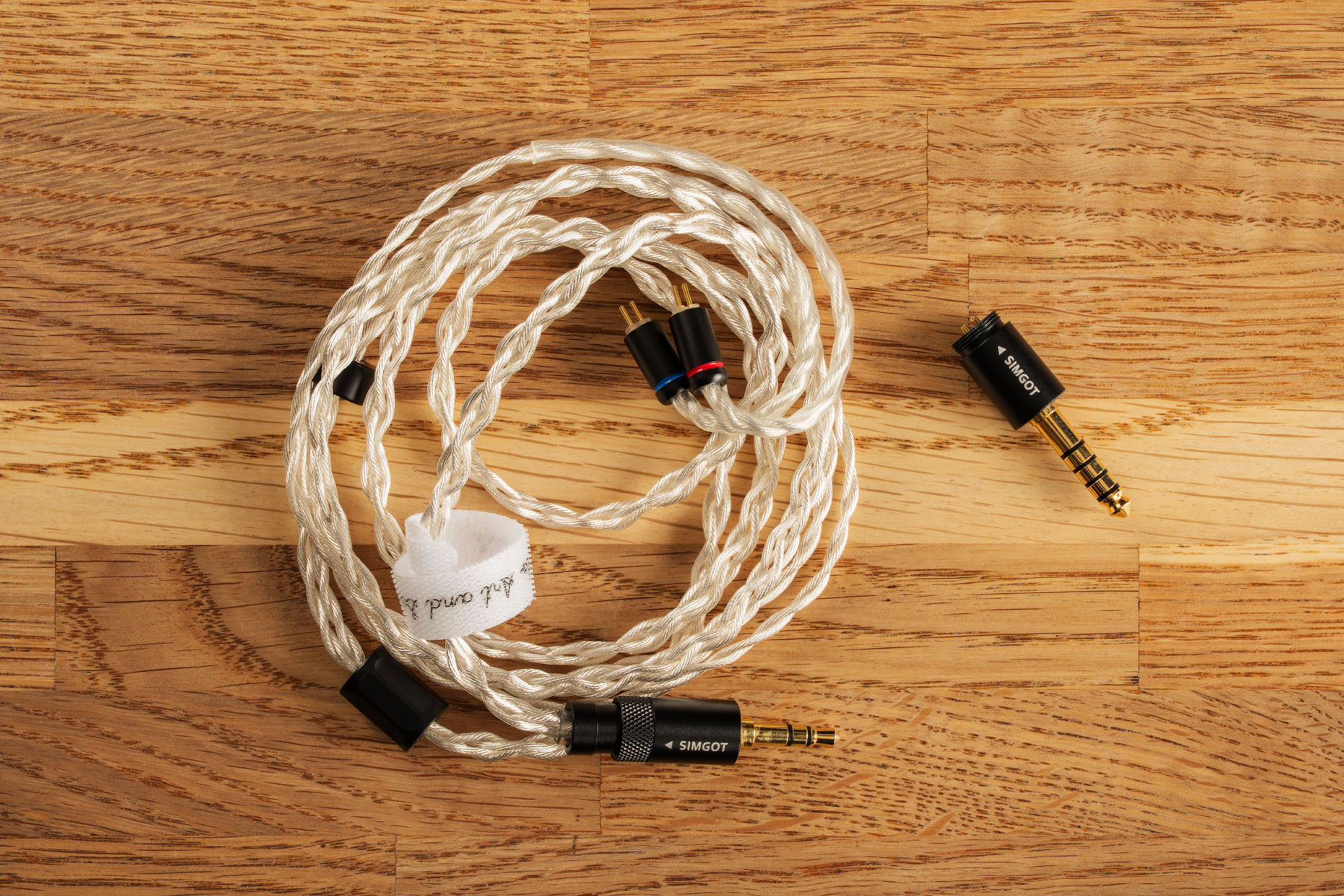
The cable is simple but nice. The geometry of the splitter and the limiter make them convenient to use. Replaceable connectors are held frictionally, there are no threaded rings. But the whole thing doesn’t seem to loosen up too soon.
The eartips are the most commonplace, average ‘just eartips’. With the current price of SuperMix 5, I’d expect a more thoughtful approach or at least some variety. The sets are in different colors, but there are no other distinct differences between them either by touch or by measurements.

Next come the earphones themselves. They’re made in translucent hollow shells, quite simply, but neatly. There are no rampant colors, opalescent inserts or any other appealing decorative elements — just rough black metallic backplates with milled logos of the product line. And, well, with meshed compensation holes, too.
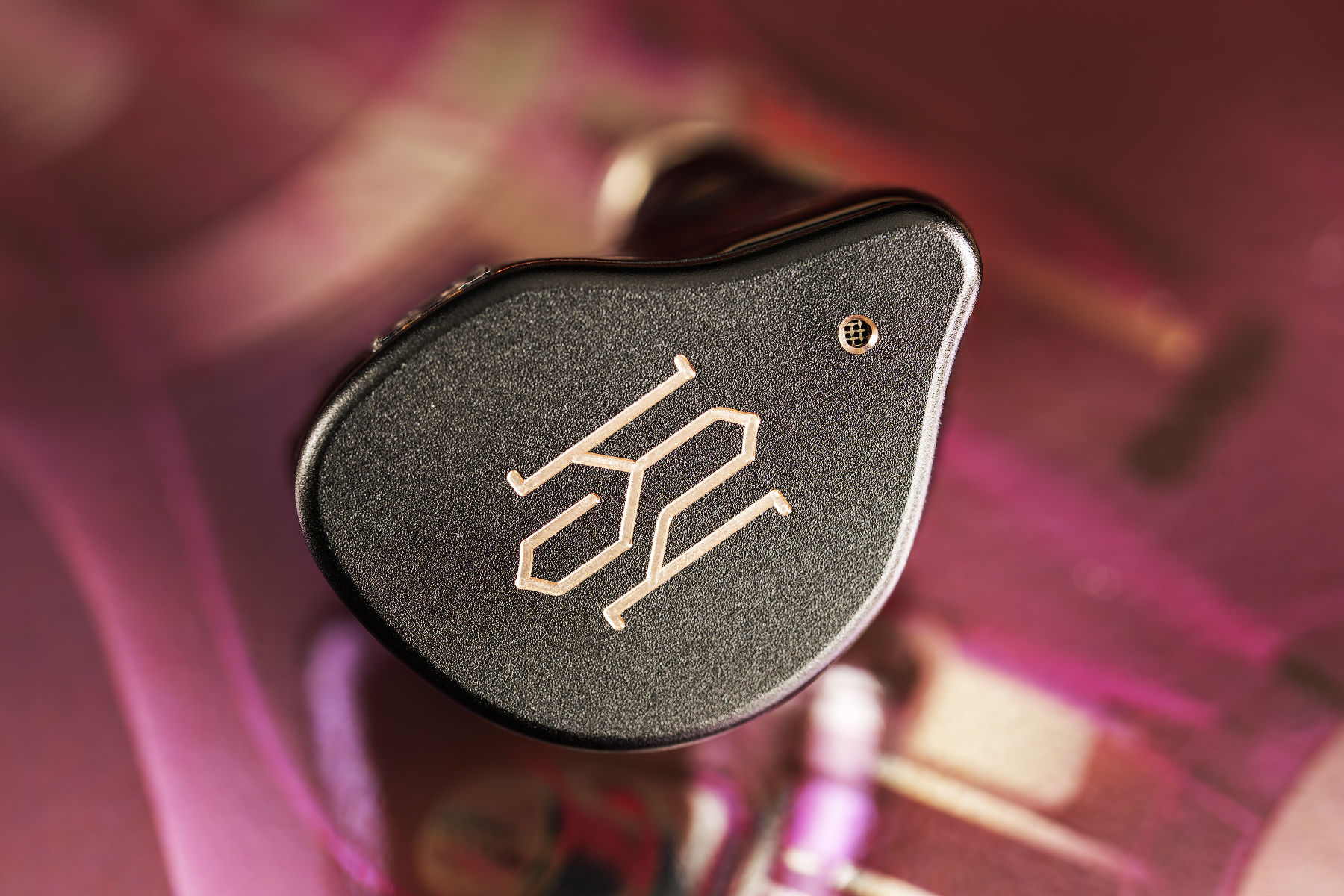
The connection area for the 2-pin connector is flat, the cable doesn’t fall out.

The metal tube of the sound duct is 5.2 mm long and 6 mm and 5.7 mm thick at its thickest and thinnest parts respectively. The shells are ‘thick’ (look at Truthear NOVA on the left and Binary Acoustics Chopin on the right below for comparison), closer to large ones in terms of volume.

With me, everything works perfectly in terms of ergonomics: the shells sit in my auricles without any pressure on their parts and don’t get loose. But I know that at least one person felt uneasy about them because of the ‘fins’ on the inside of the shells. Therefore, I personally have nothing to scold the shape of the SuperMix 5 shells for, but it may not suit someone, which, however, applies to any headphones on earth.
As for the eartips, I can recommend ddHiFi ST35, but mostly because I really like this model (and I will definitely write about it in the next part of the famous multi-episode magnus opus) and not because ST35 are somehow particularly well suited for this very model of earphones. Sedna Earfit VIVID Edition were also a great fit, as well as the new HE Sonic made of thermoplasmic elastomer (these ones). So, the general guideline is to choose the eartips with the maximum contact area between the shells and your ears: this will let you fully and clearly feel how bone conduction drivers work (in other words, just choose Zhulinniao Zhu Rythme).
Speaking of drivers and other technical stuff, SuperMix 5 are based on many drivers, even of different types:
- bone conduction driver;
- dynamic driver;
- armature drivers, 2 pcs;
- microplanar driver.
The manufacturer specifies the following electrical parameters: 19 Ω ±15% (at 1 kHz) of impedance and 120 dB/Vrms (at 1kHz) of sensitivity.
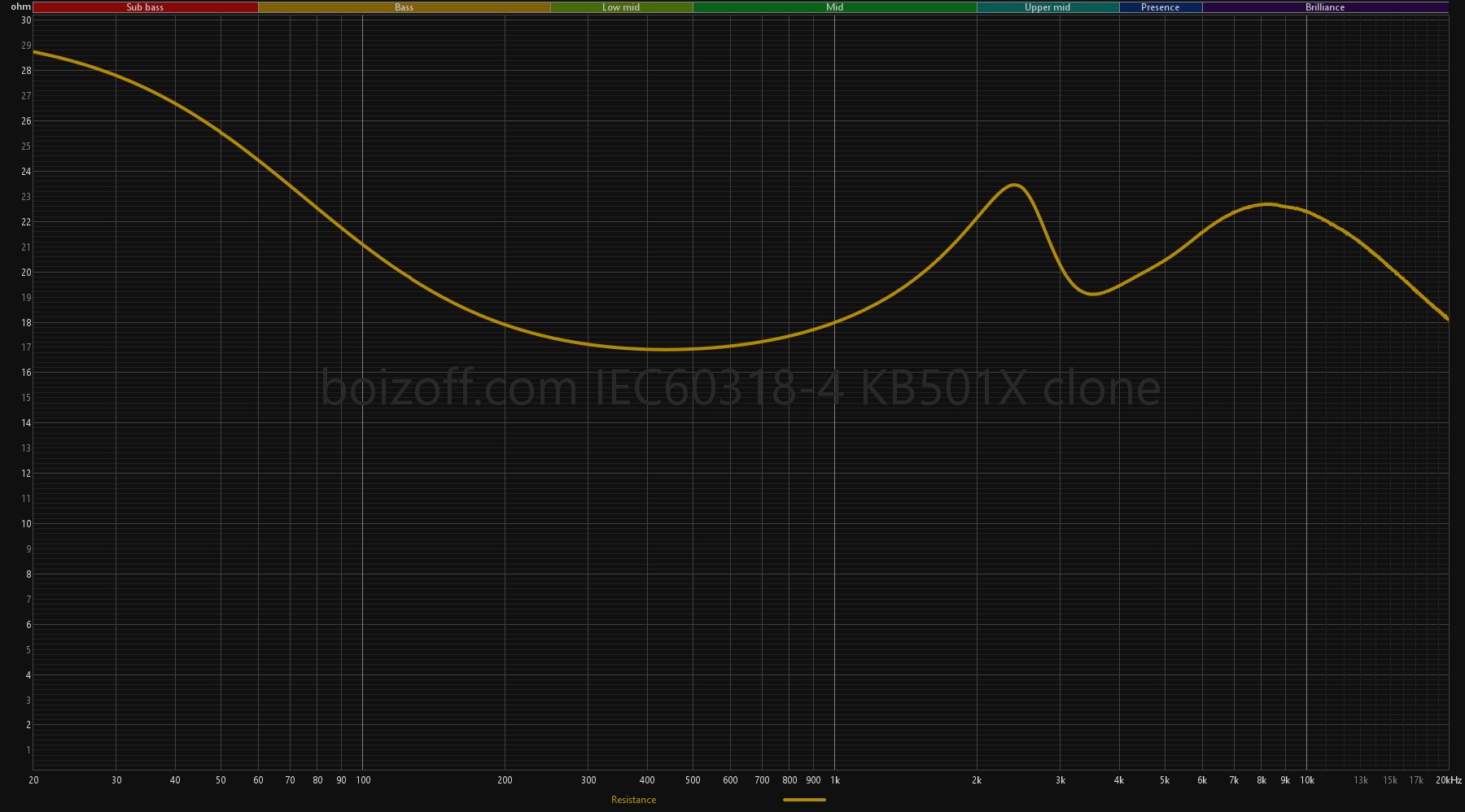
I managed to measure 18 Ω at 1 kHz, with a minimum and maximum value of 17 and 20 Ω. If we measure the impedance not of the earphone itself, but add an original cable with a 3.5 mm connector, we’ll get the following picture:
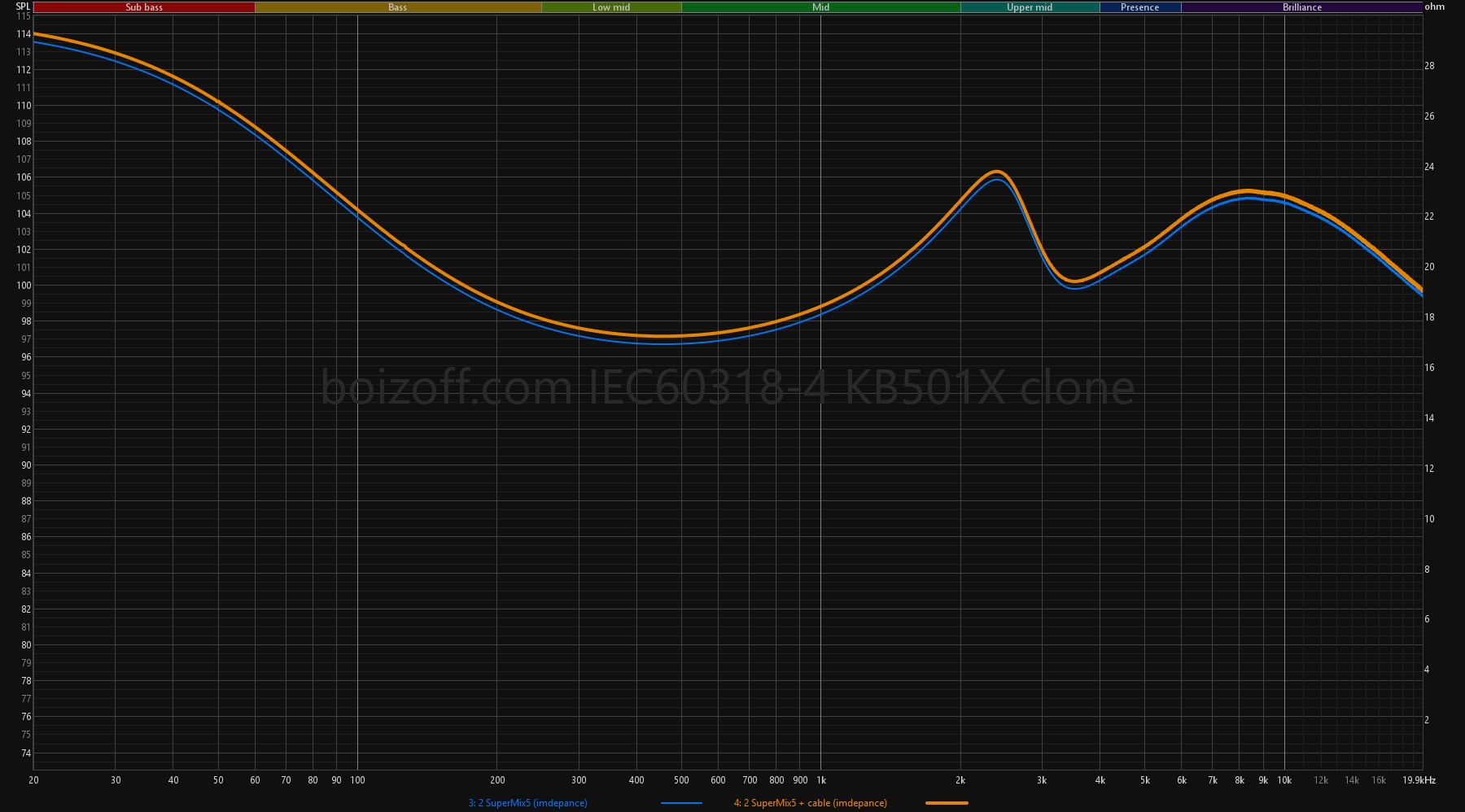
That is, the impedance of the standard cable (cable + connectors) is about 0.25 Ω.
The sound
Standard links:
- the description of my rig is here;
- the audiogram of my hearing is here;
- articles on measurement theory and the whole shebang are here.
Frequency response of Simgot Supermix 4:
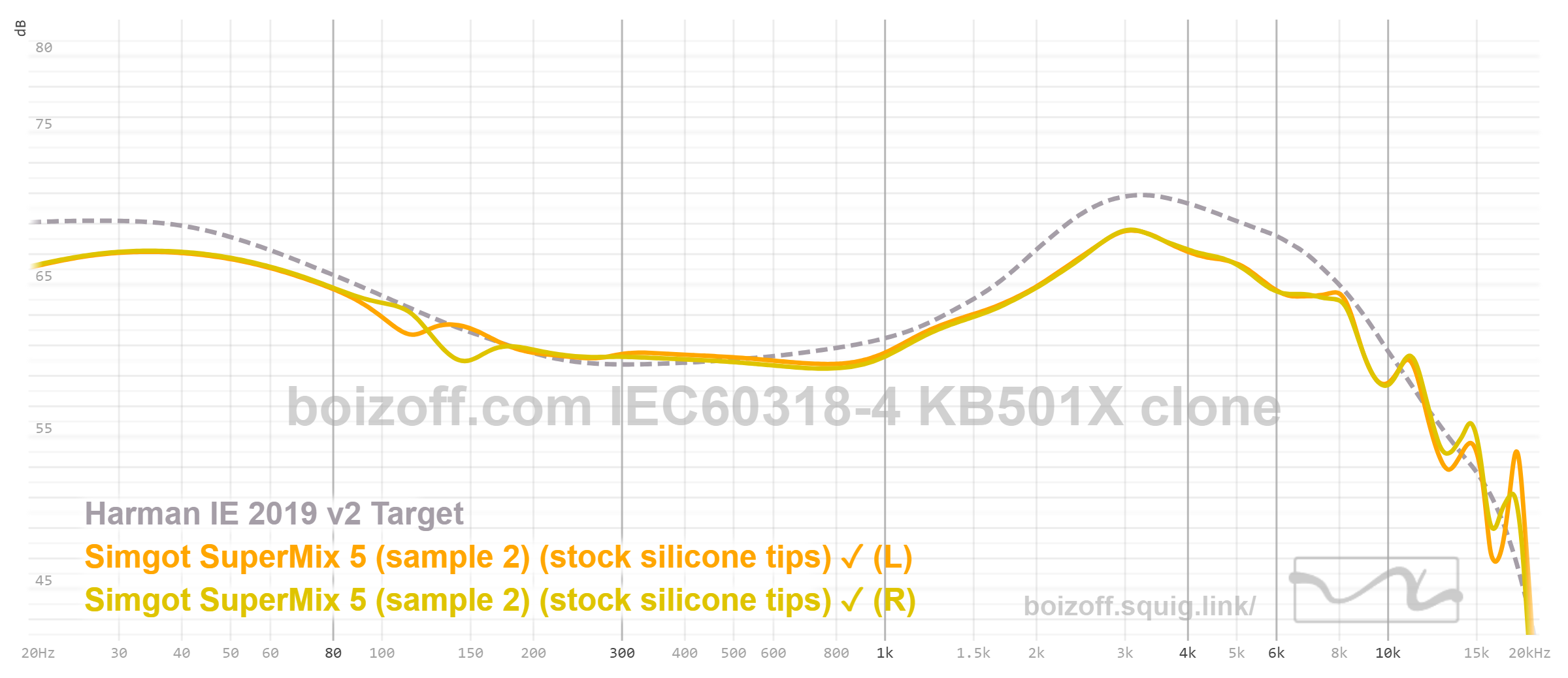
This was the picture when the measurements were made so that the second resonance occurred at 8 kHz. With my ears and the geometry of my auditory canals, it’s shifted to the left, nearly to 7.7 kHz.
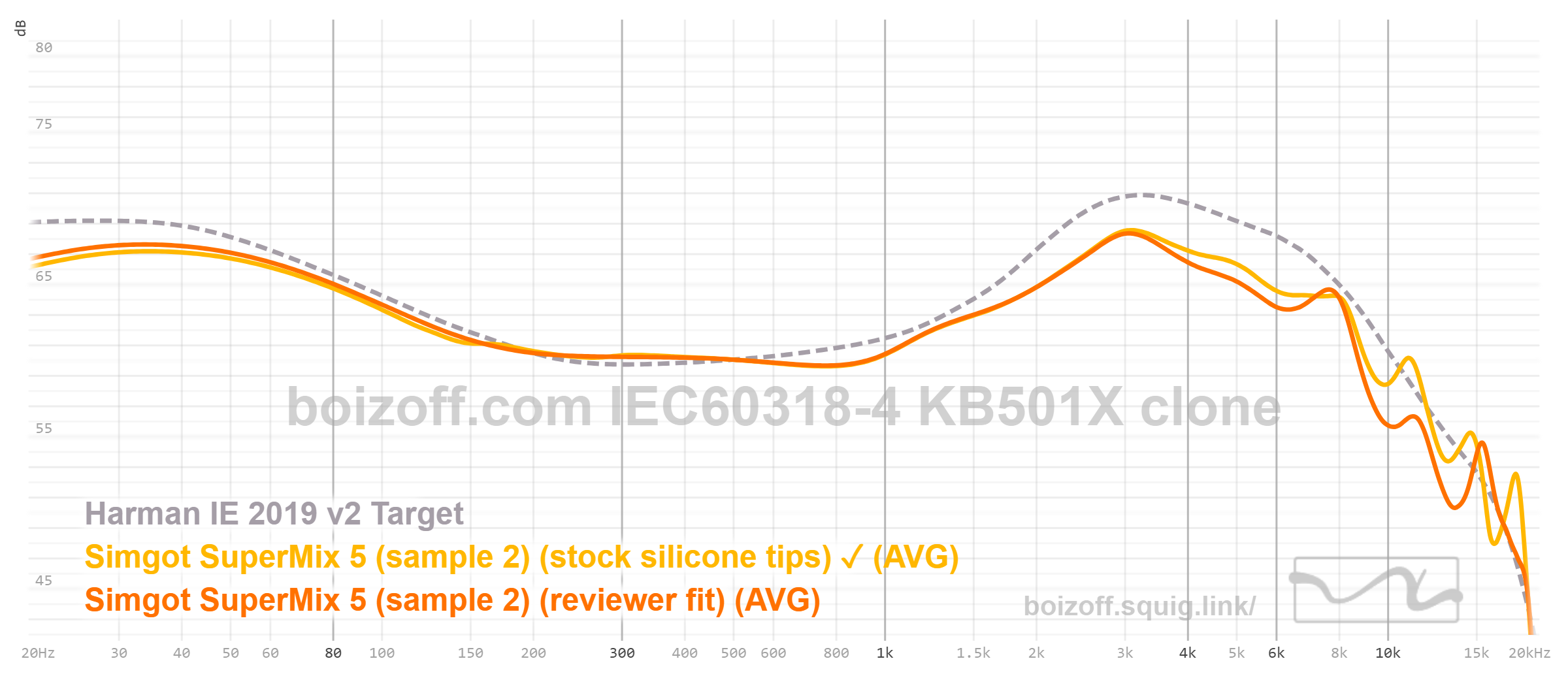
This leads to a change, though not a radical one, in the frequency response. The radical ones were with AFUL Cantor or Kiwi Ears Arete 2 (you can find them on my squig).
There is some dependence on the eartips (for example, foam ones), but the effect is minor, too:
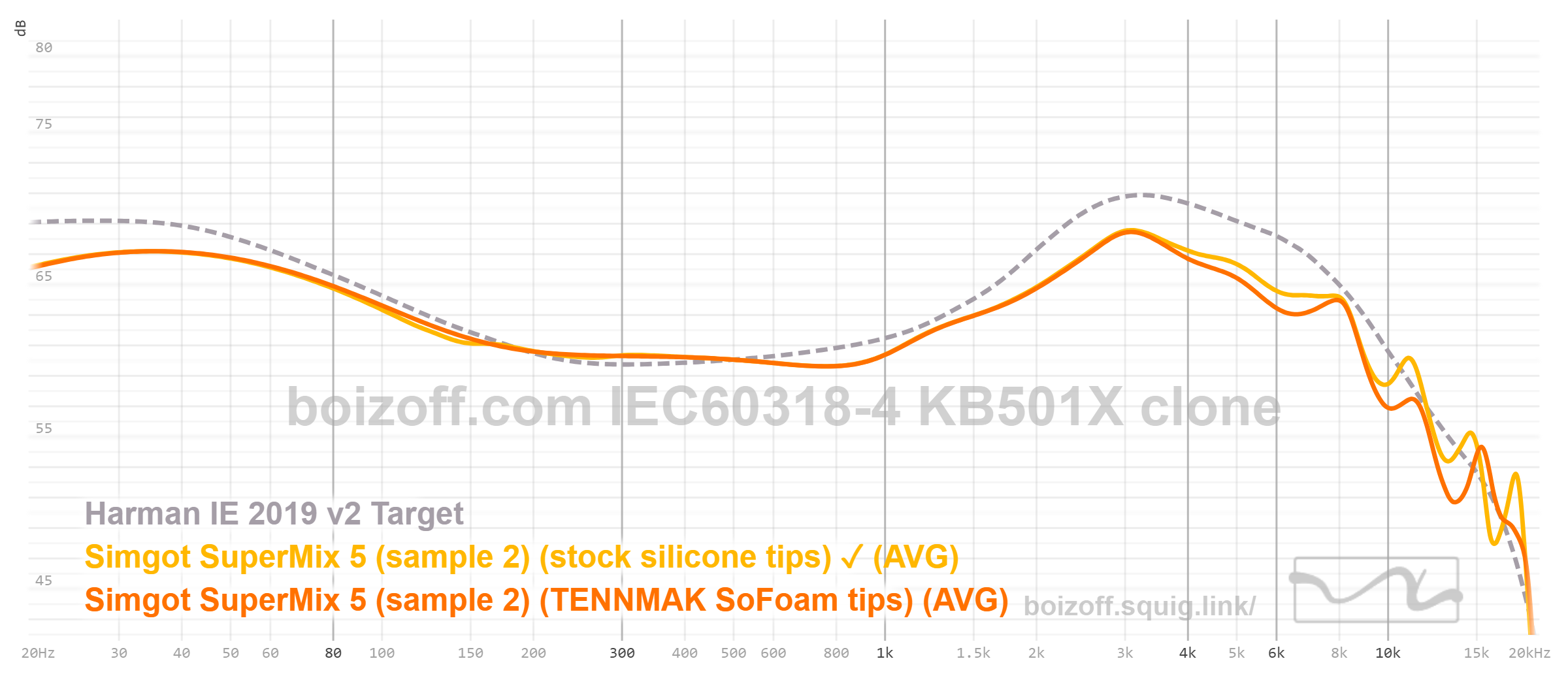
What can we see in these pictures? We can see the Harman target curve with its ‘contrast lowered’ (that is, the ‘bottom’ and ‘top’ have been lowered by an equal number of decibels) and its shape roughly retained. In fact, the manufacturer did a bit cleverer move: the mid- and high-frequency ranges were lowered a little more than the lower frequencies, while the ultra-high-frequency ‘tail’ from 10 kHz and above was not changed. Besides, we can see a strange aberration at around 120 Hz, and only on a measurement with silicone eartips:
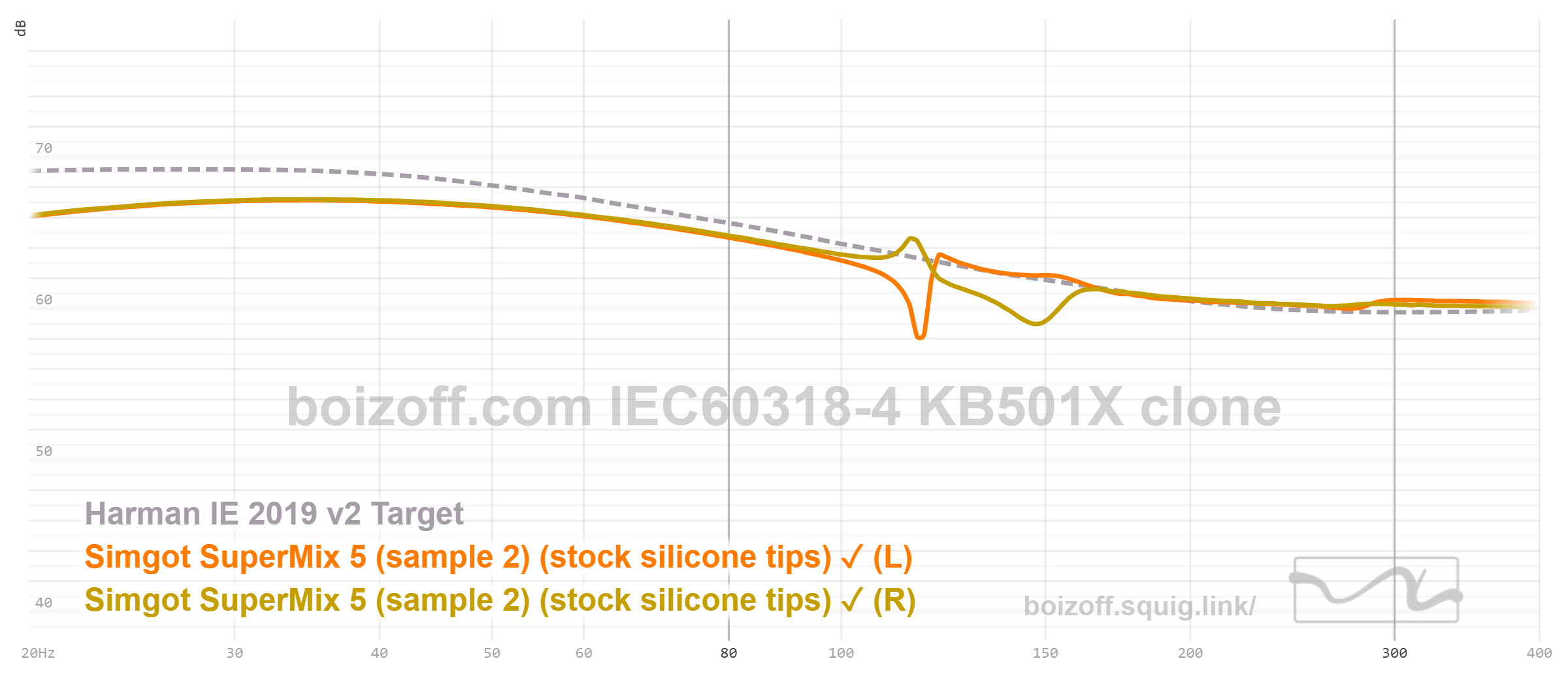
These are the tricks of the bone conduction driver, which vibrates violently when playing, literally. When using foam eartips to make measurements, the earphone shells are fixed in the coupler very tightly, and the foam dampens vibration, but silicone eartips don’t do it at all, hence such curbs and dips on the frequency response graph.
It is worth noting that the bone conduction driver usually plays somewhat higher, at frequencies of 200-250 Hz. Here is an example of KBEAR KB02:
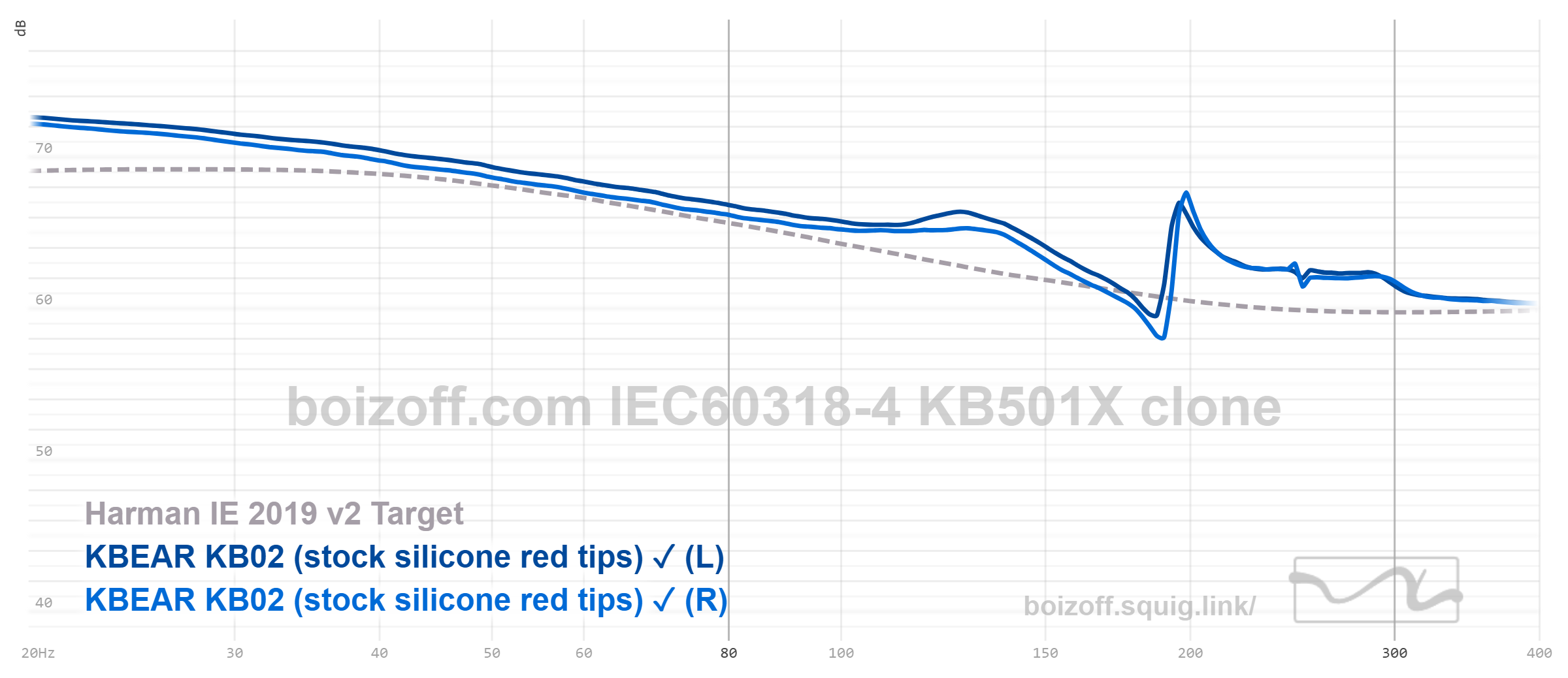
In SuperMix 5, the frequency of this type of driver is moved unexpectedly low, to the area of 120 Hz. I’ll note that my conclusions directly contradict what’s written about this very driver in open sources (for example, 200-7000 Hz are indicated as operating frequencies), but we literally see something else on the measurements. And it’s also not clear where the primary source of information about the driver is.
The aberrations on the measurements induced by the displacement of the central axis of the earphone’s sound duct relative to the coupler axis look similar (but not much else), for example, at 150 Hz:
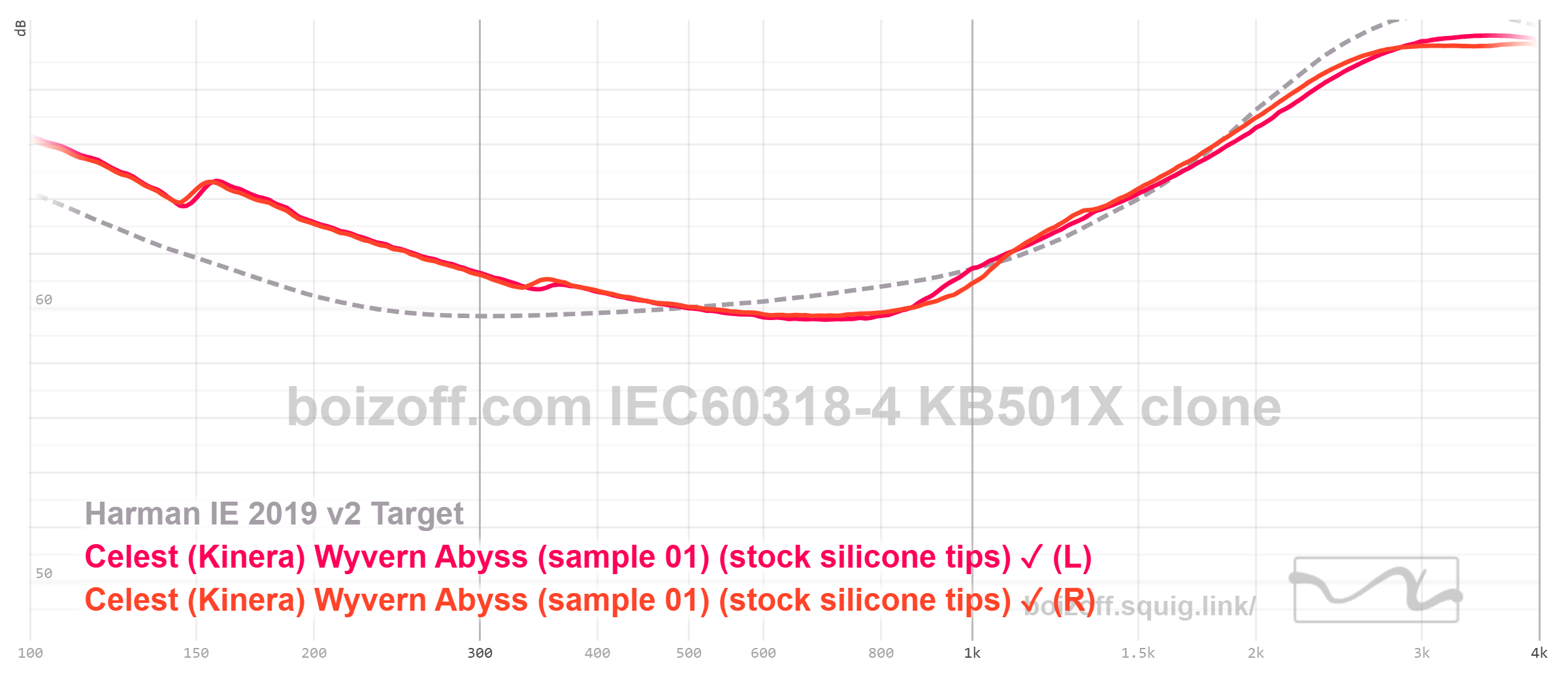
That is, there is a break in the curve, but not the ‘spikes’ typical of the bone conduction driver.
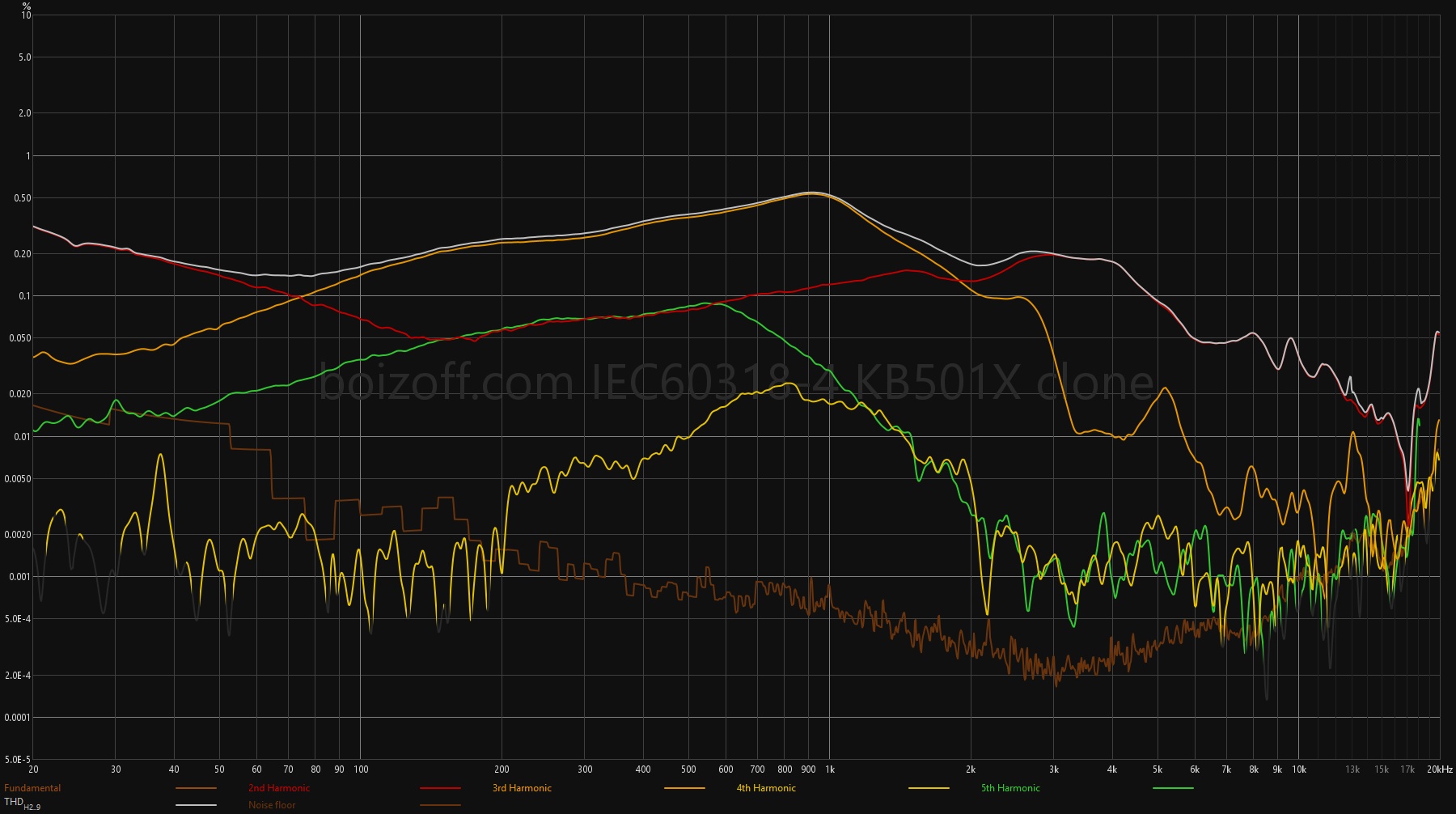
Nonlinear distortion at 94 dB with the ‘Use harmonic frequency as ref’ option turned off and on:
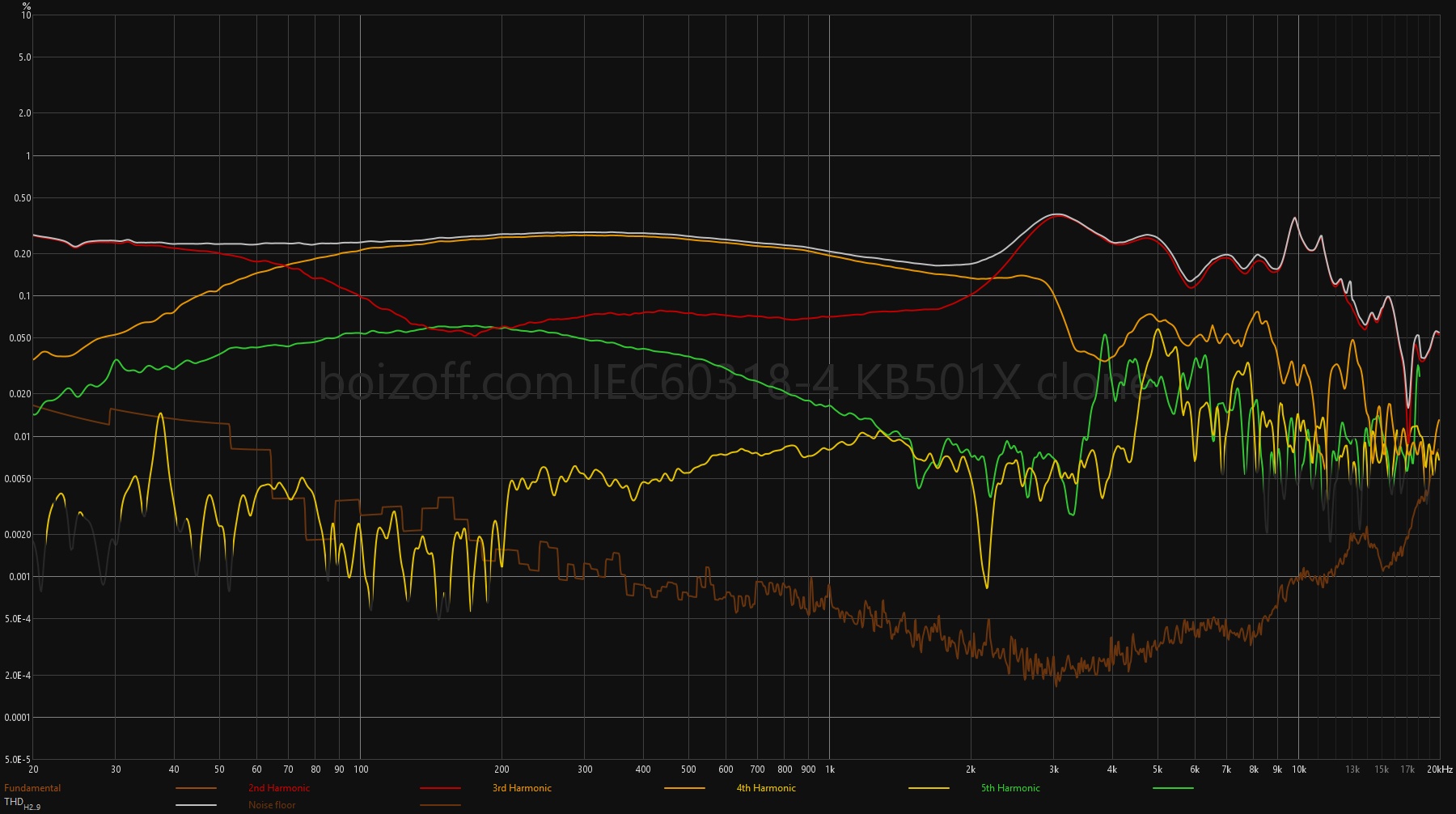
Nonlinear distortion at 104 dB with the ‘Use harmonic frequency as ref’ option turned off and on:
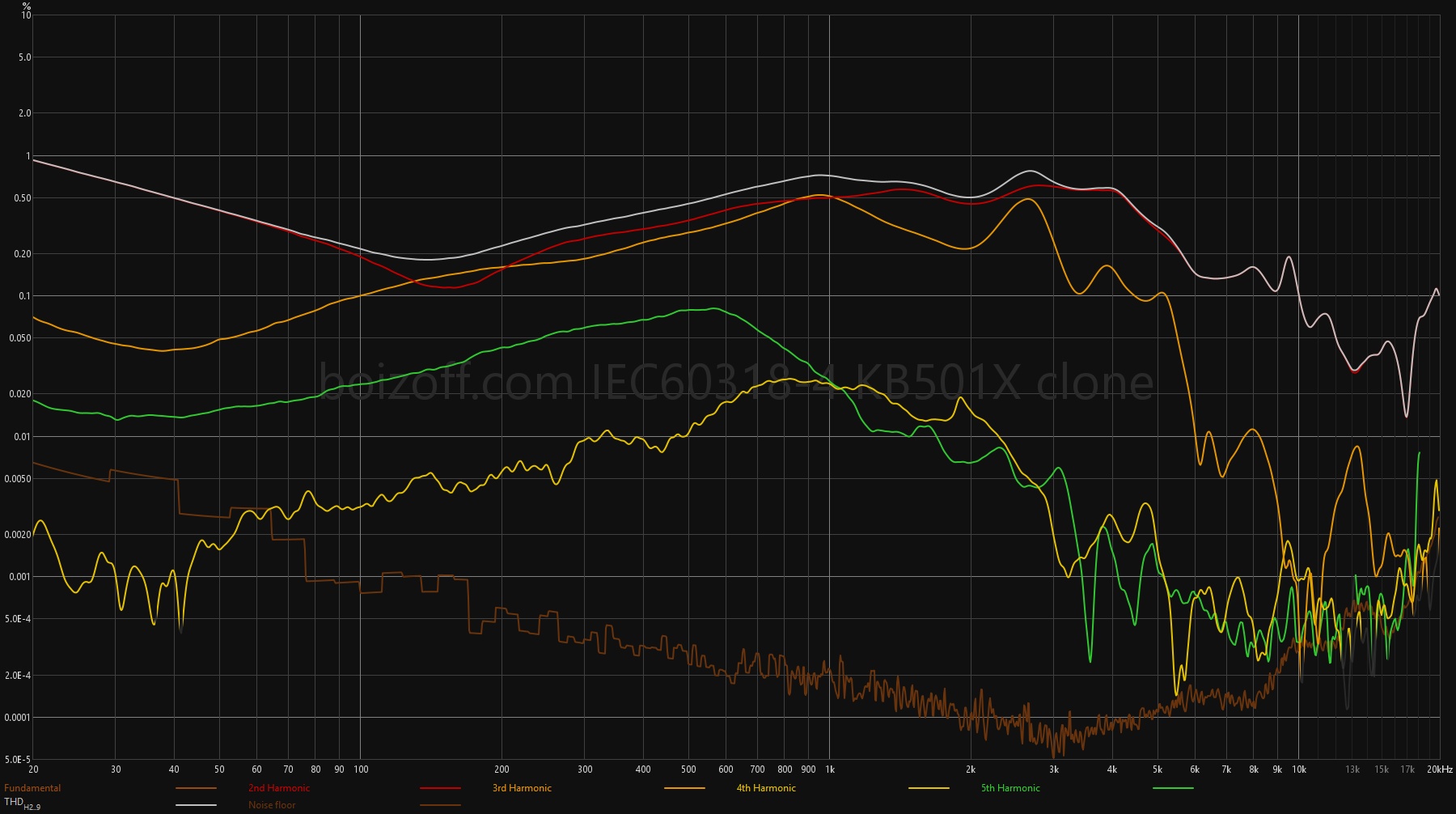
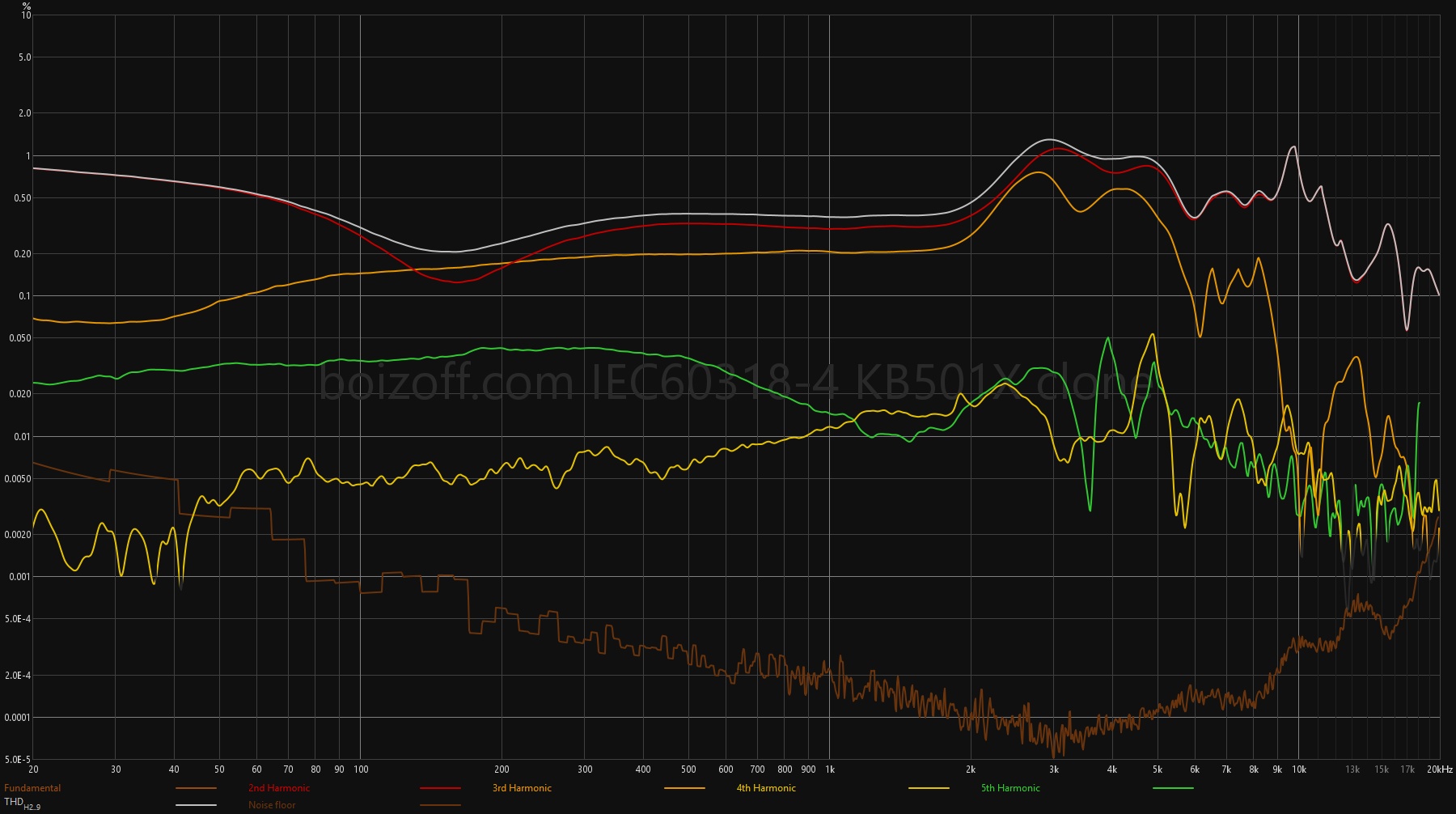
At a volume of 94 dB, non-linear distortion does not exceed half a percent (0.52%, to be precise), regardless of the graph presentation mode. And this is awesome. At 104 dB, ‘Use harmonic frequency as ref’ has a maximum level of 1.2%, which is not an outstanding result, but it won’t bother in any way in real life either. For their price, SuperMix 5 are not excellent, but very good in this parameter. They’re on par with Myer Audio SLIIVO SL224, for example, which are twice as expensive.
Minimum phase response, group delay, and spectrogram in the ‘Burst decay’ mode:
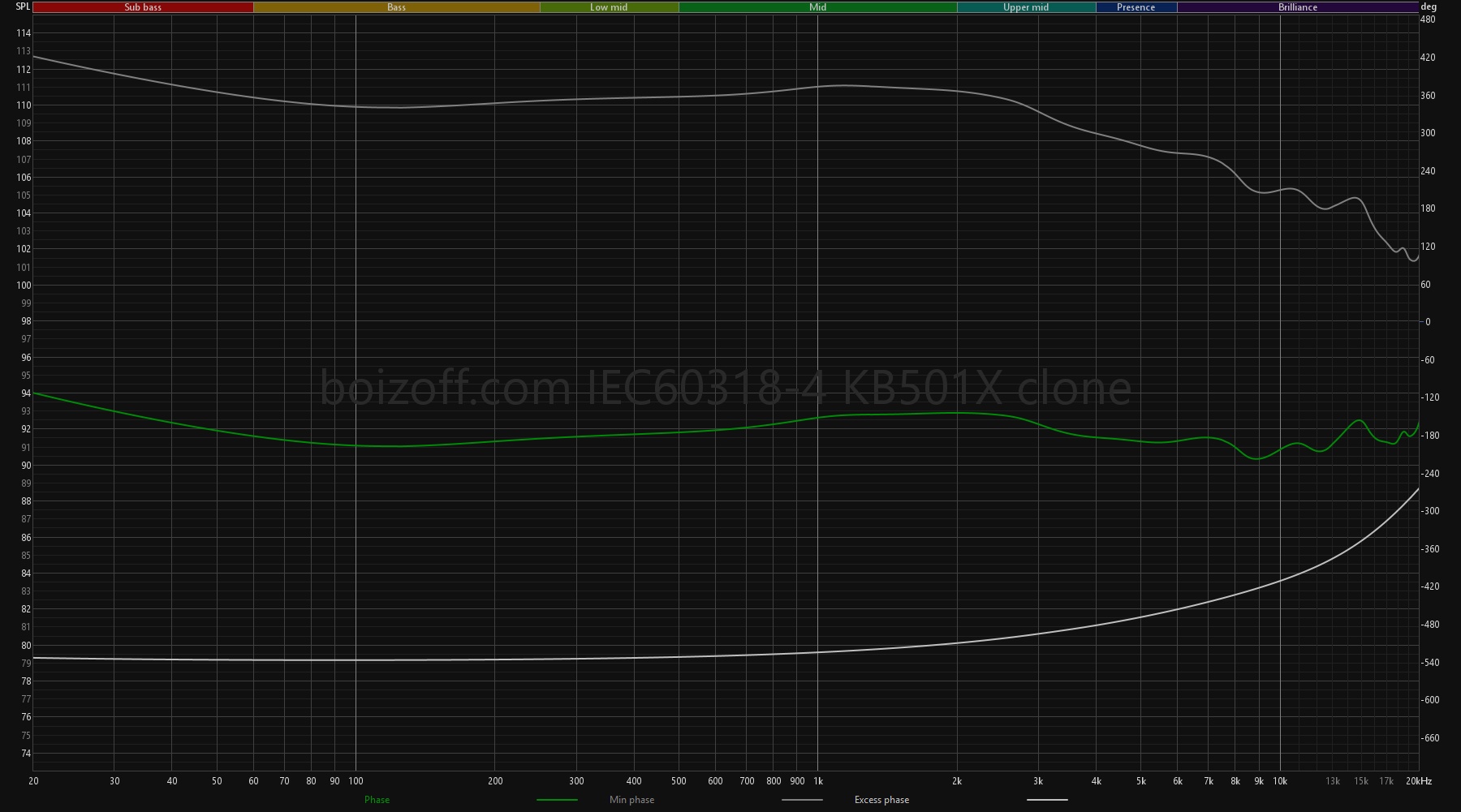
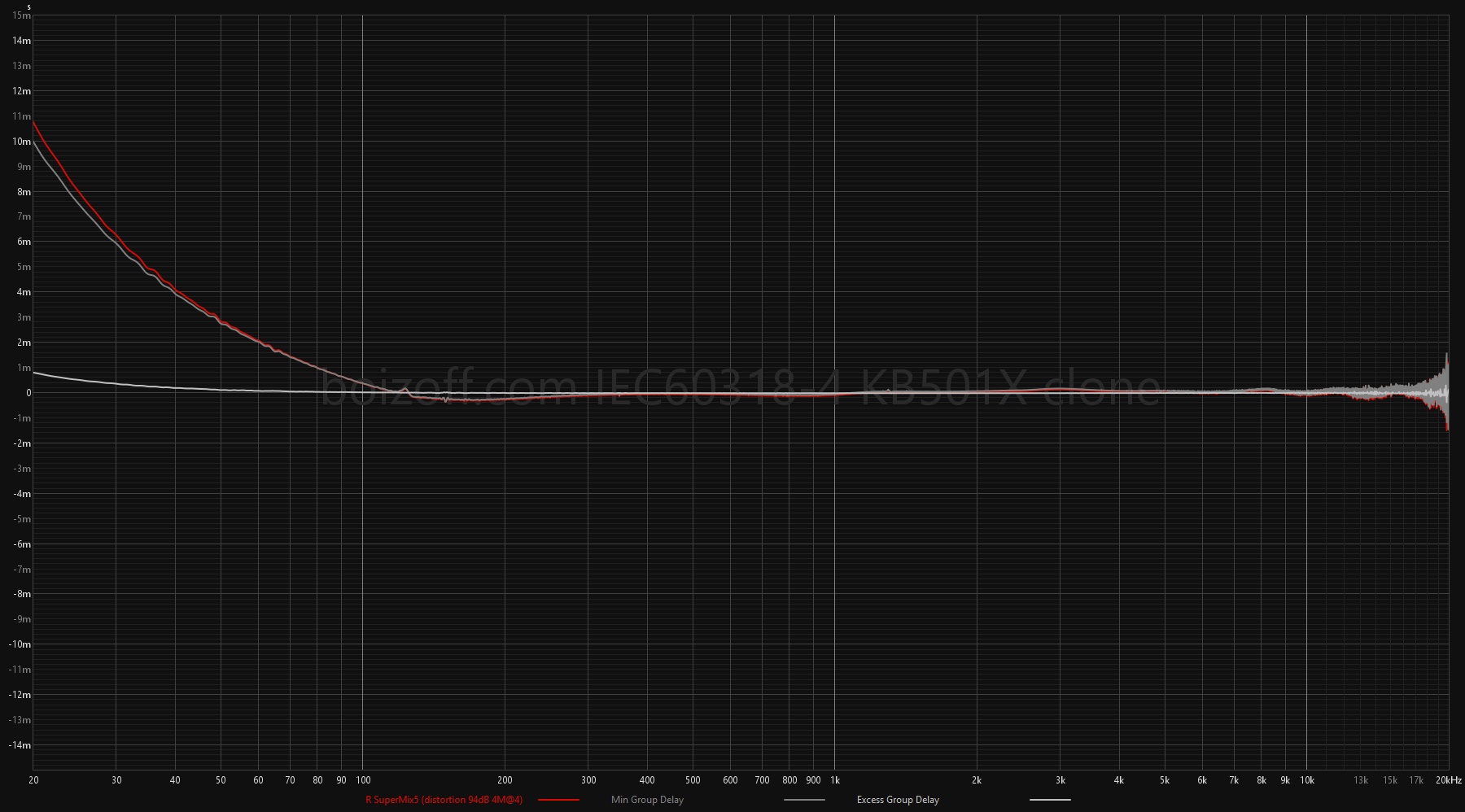
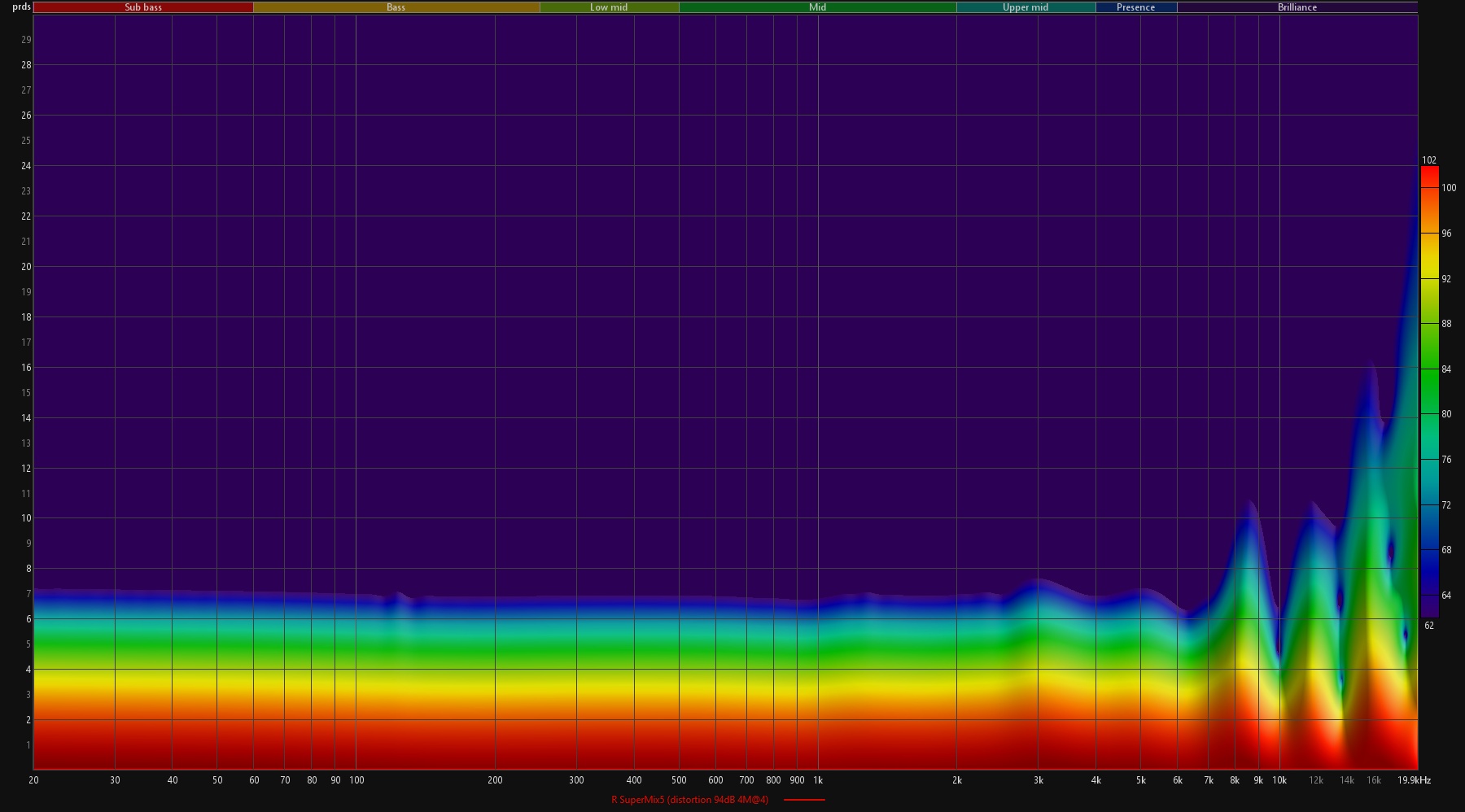
Everything is fine, and the spectrogram is really exemplary even for IEMs.
With intent to write this review, I did my best to get a second sample of this model so that I could make at least a weak judgment about the repeat accuracy:
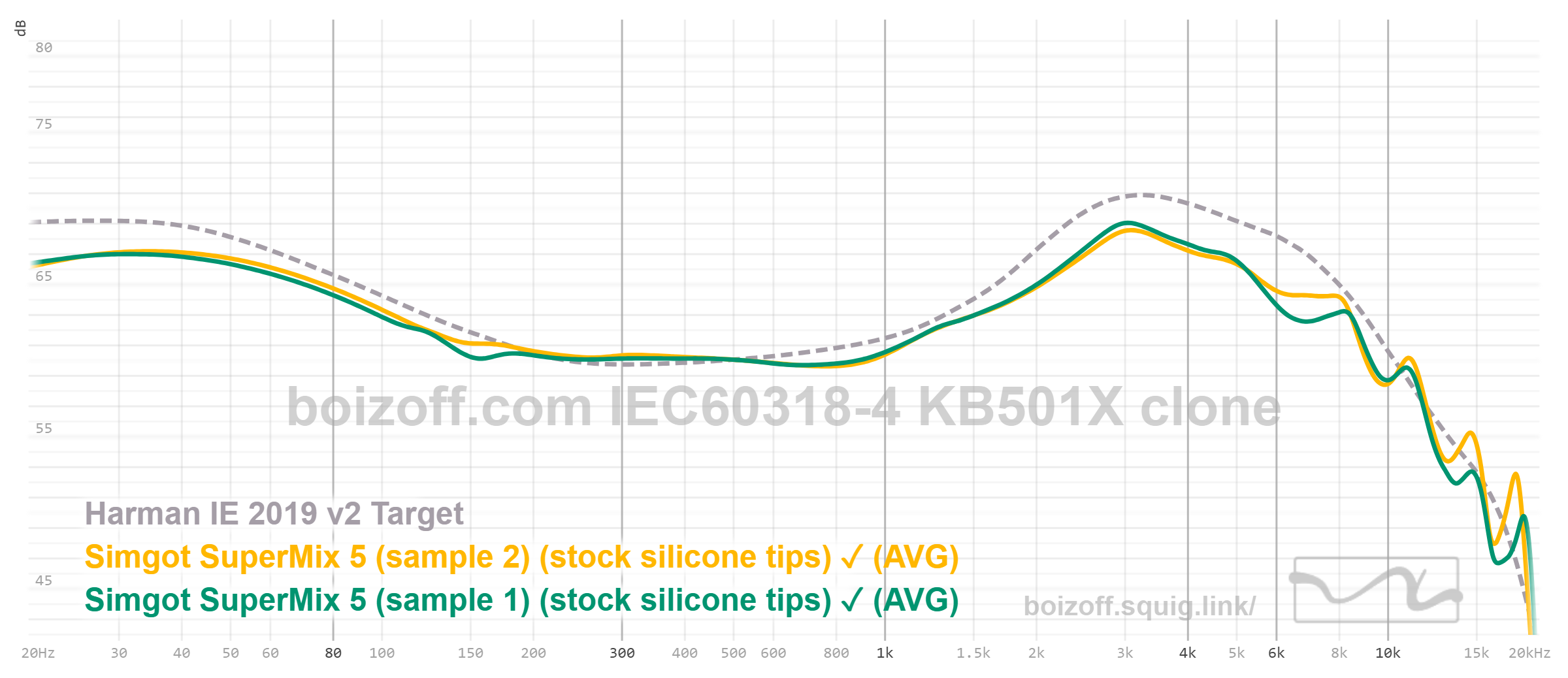
The eartips are the same (not just the same model, but literally the same), the second resonance is in the same place. The repeat accuracy is… so-so, to put it bluntly. There’s room for improvement. B-minus.
SuperMix 5 have a really interesting, even unexpected sound delivery, which I wanted to describe in a laconic and elegant way, but I failed. The sound delivery is quite neutral with a very smooth (in terms of the absence of narrow peaks and dips) frequency response. The sound is full-fledged, natural, a bit ‘from afar’. However, there are some peculiarities:
- There is no sawing ‘top’. There is none of it ever and wherever and with any depth of the fit, which is great.
- A slight (slight, I should emphasize) feeling of sound warmth, which I wouldn’t have been able to guess from the frequency response graph. And the main contribution to this feeling seems to be made by the bone conduction driver. The earphones don’t have any extra rise on the bass, so I’m talking about the overall feel.
- High-grade and very precisely tuned ultra-high frequencies. The earphones don’t give you an incredible amount of ‘air’, but they just play in an accurate and detailed way.
That is, SuperMix 5 sound in the realm of accordance with the Harman curve, but not so contrasting, not so expressive, and not so aggressively jumping at the listener with its typical thunderous bass and ringing top. But they preserve this delivery style overall.
I’m gonna praise the bass individually because if you turn up the volume – and these are the earphones for high volume, and I’ll explain why below — it seems that… something else is ‘moving’ under the layer of low frequencies. It’s like there’s another dimension other than the sound where the earphones also communicate something to the listener, and it’s no longer perceived by the ear, but rather by the body. There’s no effect of the over-ear headphones, let alone the floor-standing speakers, but, damn it, SuperMix 5 are clearly taking a step in this direction. And I’m inclined to believe that this is due to the bone conduction driver again. By the way, I didn’t get this feeling right away, but only somewhere around the fifth or seventh hour of listening. It’s implicit and appears when listening at a relatively high volume, about 85-90 dB.
All in all, we’ve got the earphones that have two unique qualities. Firstly, with a tuning that’s so ‘comfortable’ for the ear, they let you listen to any music and do it for a long time and loudly. With this in mind, you won’t need to complain about the loss of details in the sound, humming bass, etc. No way! This is a normal, full-fledged, immersive sound, but tuned so cannily. Secondly, these are almost ideal earphones for the street: while the ‘pure Harman’ ‘falls apart’ in the conditions of intense urban noise masking, with only the ringing top remaining, then SuperMix 5 add their strange ‘warmth’ when the volume is increased. And this is exactly what we need on a noisy street or in public transport. In other words, the sound remains tonally ‘whole’. I can expressly state that SuperMix 5 is one of the most successful models specifically for outdoor use.
Comparisons
Here I have to refer to my rating and compare it with everything that corresponds to the SuperMix 5 price category. But I don’t see the point in considering all the relevant models because the difference will be too obvious already from the graphs. Therefore, let’s mention the main competitors:
- Simgot SuperMix 4 as its predecessor;
- Truthear NOVA;
- Kiwi Ears KE4;
- Kiwi Ears Orchestra Lite;
- TRI I3 MK3.
Frequency response of SuperMix 5 compared to SuperMix 4:
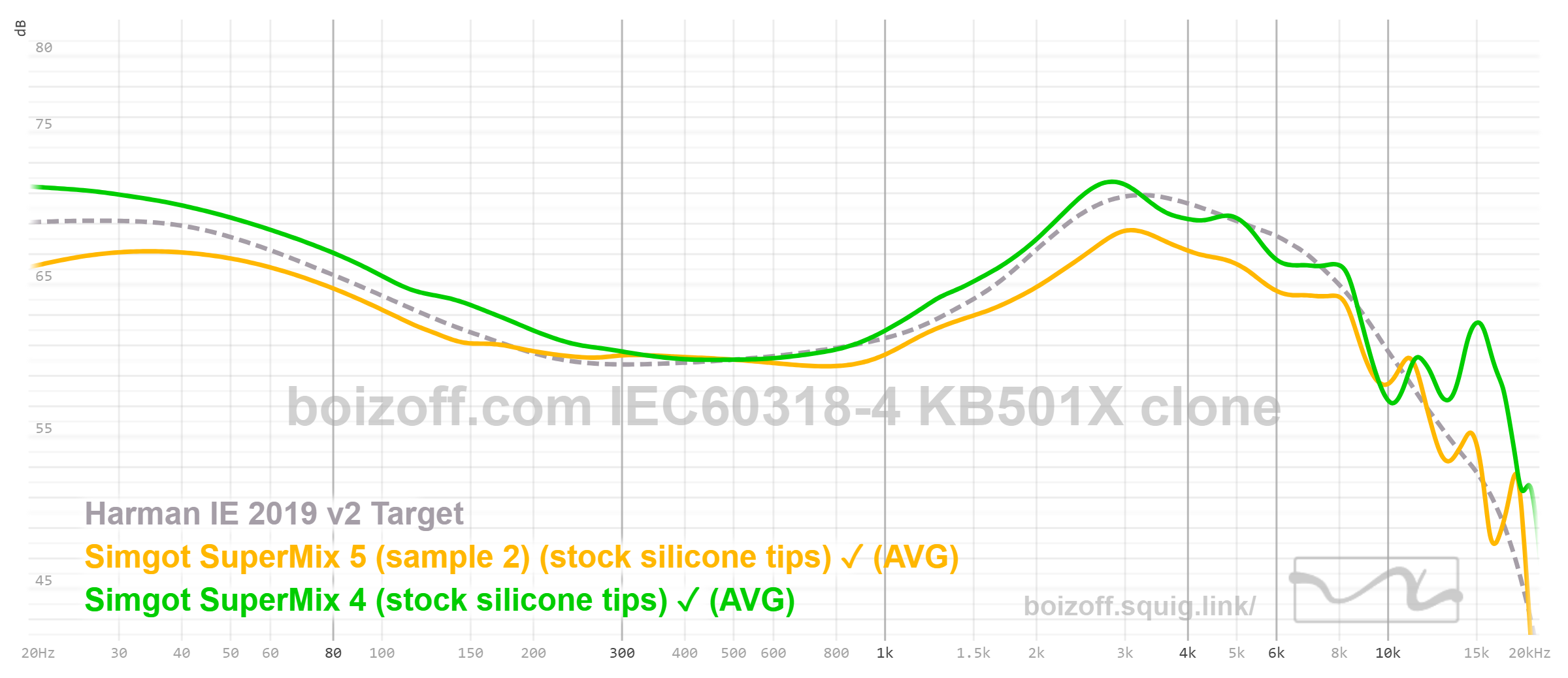
Actually, I’ll repeat what I wrote above: while SuperMix 4 provide an even more contrasting sound delivery than the Harman curve does, as wells as complements it with an unpleasant, clearly perceived peak at the very top of the audible range, SuperMix 5, on the contrary, sound reserved and comfortable.
Frequency response of SuperMix 5 compared to NOVA:
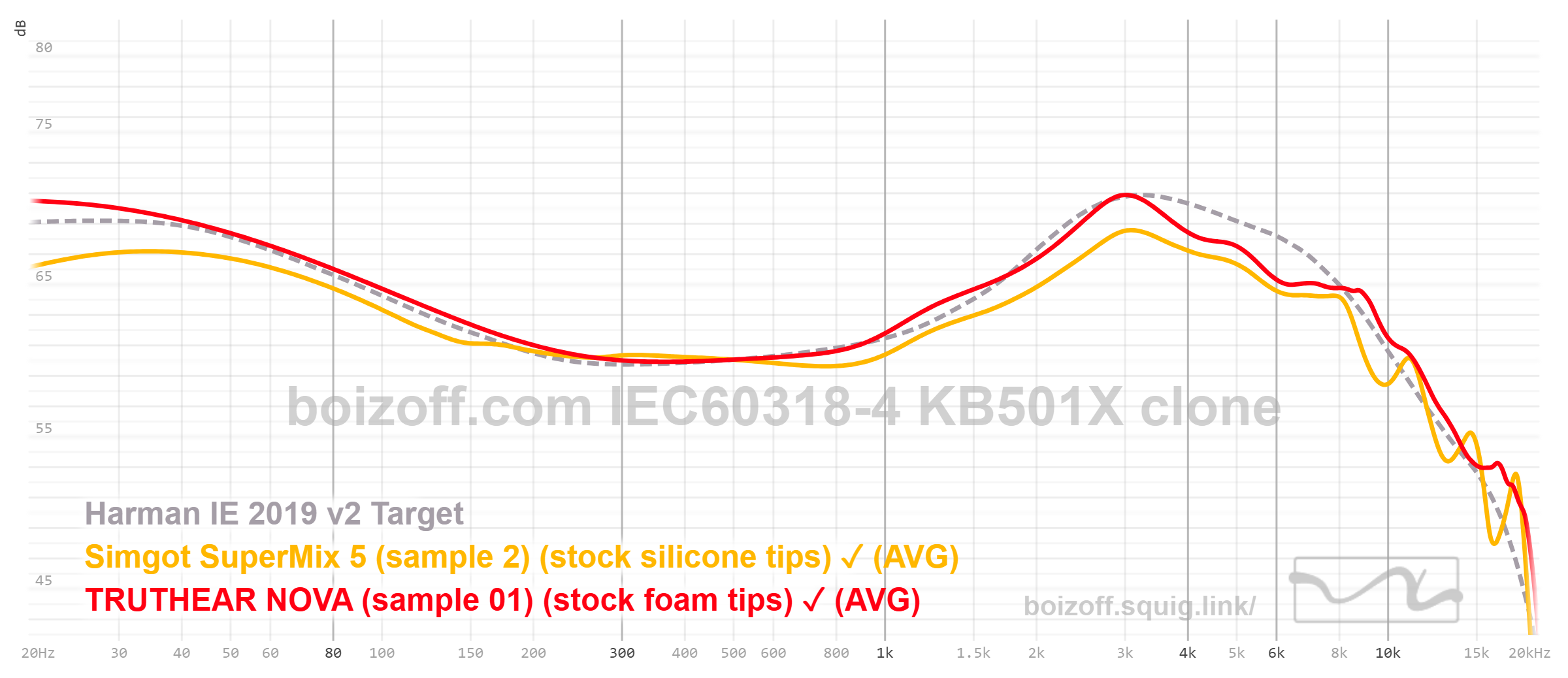
I think I’ve already said enough about the difference between SuperMix 5 and the Harman target curve. Plus, the Simgot model has a decent cable and not just a blue rope.
Frequency response of SuperMix 5 compared to KE4:
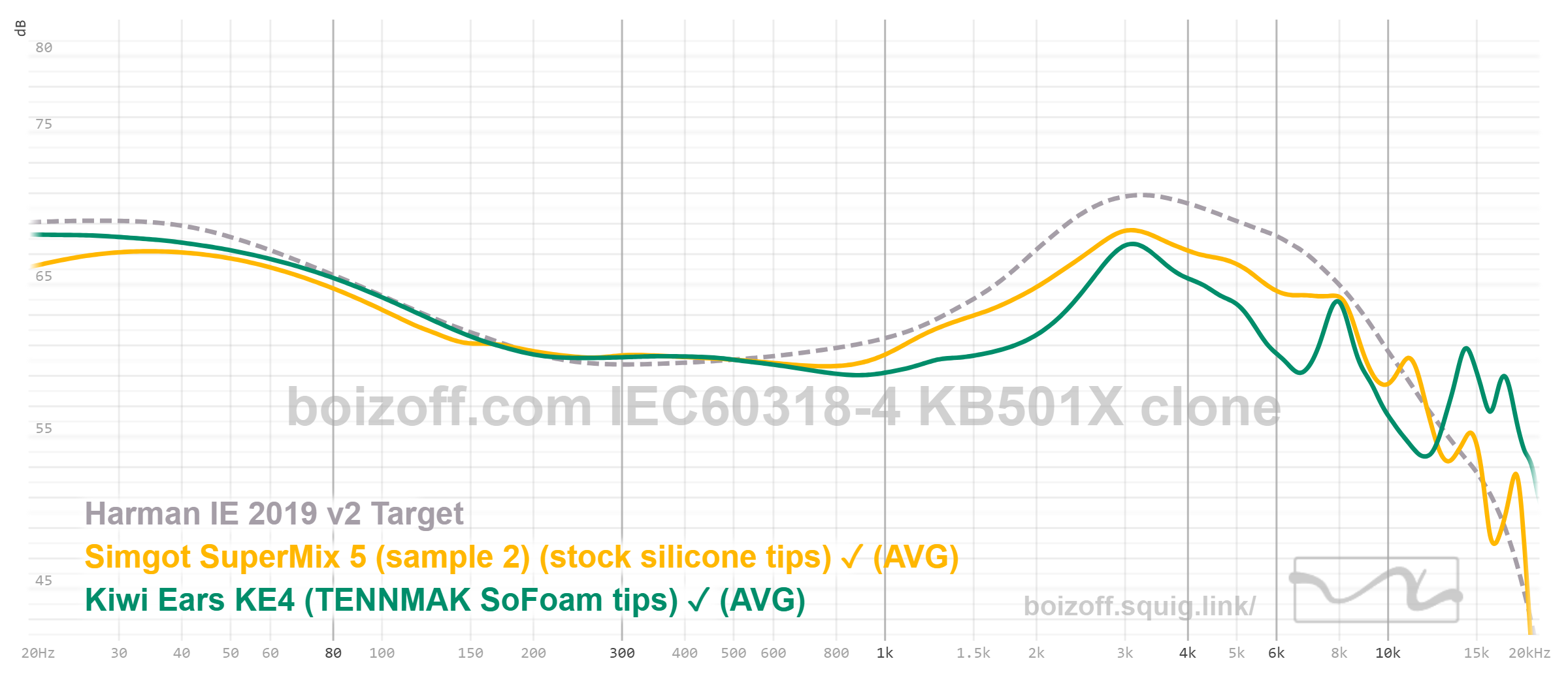
KE4 are really ‘warm’ earphones, which is quite evident from the graphs. SuperMix 5 sound more authentic and natural, but lack the ‘air’ that KE4 have.
Frequency response of SuperMix 5 compared to Orchestra Lite:
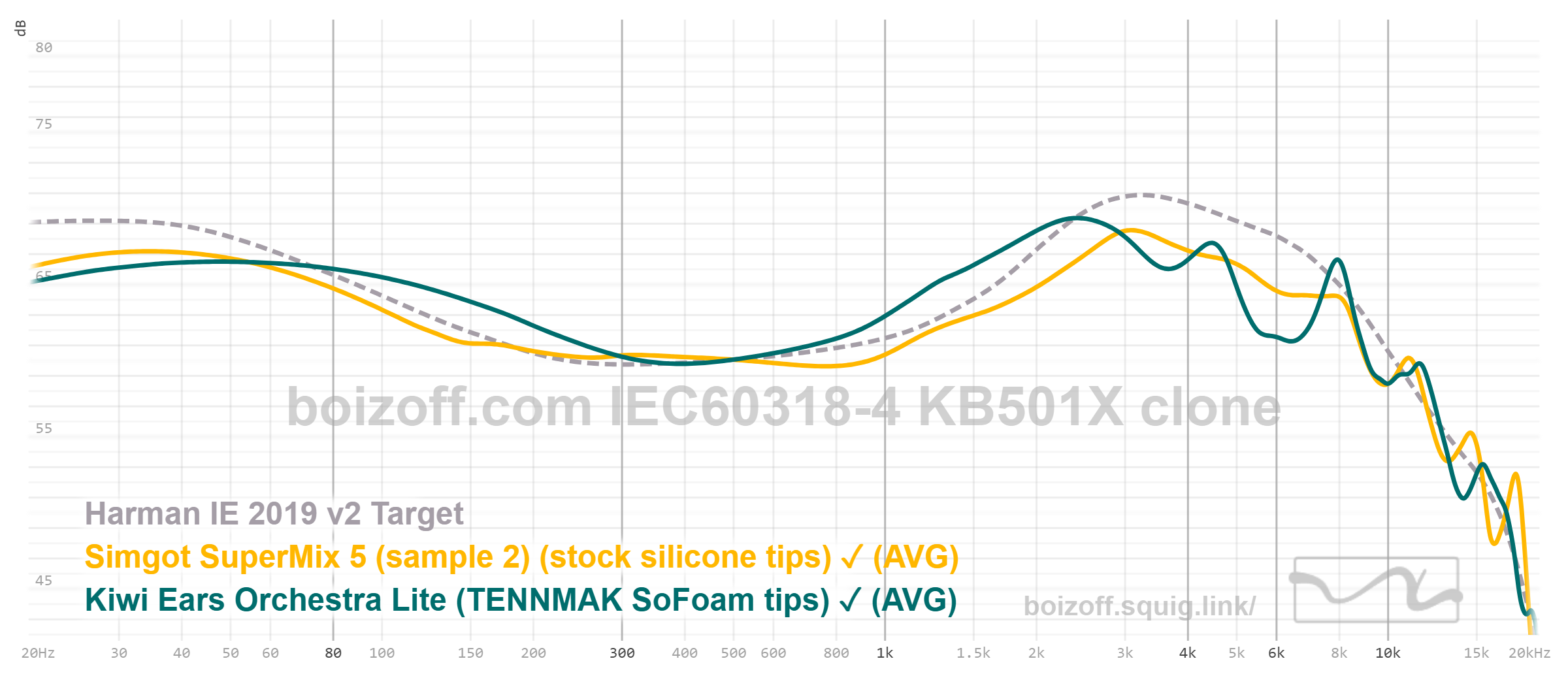
Orchestra Lite are much better at isolating the listener from external noise simply due to the lack of compensation holes, but this is why they can also cause discomfort to some listeners when placing the earphones in ears. The basis of the Orchestra Lite sound is a clear middle and aggressive bass. SuperMix 5 are more tonally accurate and even neutral (within the framework of this comparison), but their sound is perceived as less detailed.
Frequency response of SuperMix 5 compared to I3 MK3:
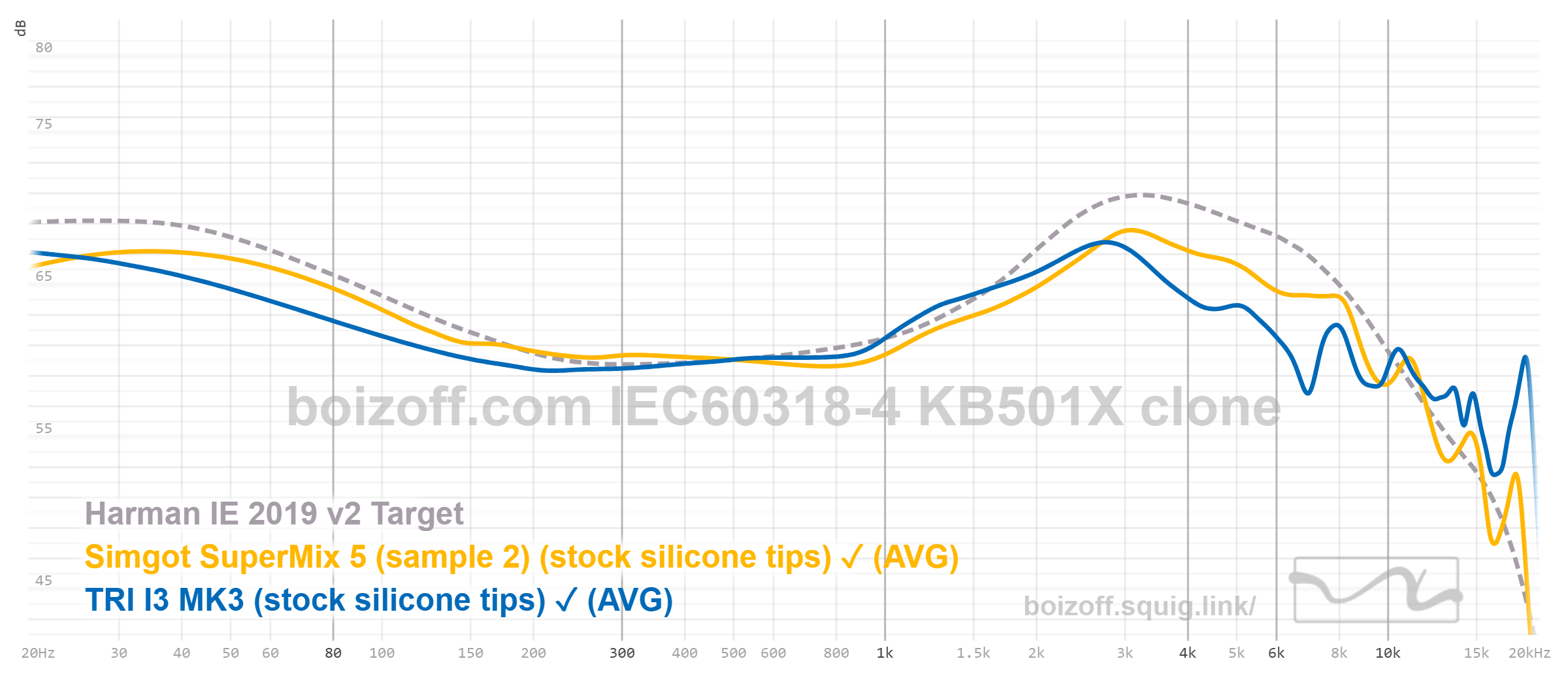
I3 MK3 are airier and more neutral, and they also win on the versatility of their shell shape. They feel more comfortable in the ears. SuperMix 5 sound richer, ‘angrier’, and more striking.
Summary
It must have been a great piece of luck and work to make good earphones in the niche of some $130-195 at the frontier between 2025 and 2026. Making something decent, but also different in sound from existing models recognized by the community is actually a real achievement of the national economy. And Simgot did it.
From my point of view, Simgot does not always manage. At the very least, let’s take the EW200/300 line, which is well-liked by reviewers, but extremely controversial in many respects, especially in sound, with and without a DSP cable.
But SuperMix 5 really ate: there’s a cable with replaceable connectors, a normal case, well-made comfortable shells, and, most importantly, a sound that has no competitors in this price category (taking into account the nuances of its tuning). To make it utmost clear, these earphones are not ‘breakthrough’ models like Mega7, SLIIVO SL224 or K9. They are just very, very good. And this is quite enough for SuperMix 5 to enter the best headphones section of my ranking.
The only thing to be afraid of is the inconsistency of sound tuning between different instances of the model, although the current industry average shown in the picture above is already a good result.
To buy or not to buy: to buy, especially if you are looking for versatile earphones and usually listen to music at high volume.