


Hongshu Audio Halo EH-1 Over-Ear Headphones Review
Electrostatic headphones are still something of an exotic niche. Personally, I’ve only had hands-on experience with them twice: the Warwick Sonoma and the Stax SR-X9000. To be honest, neither listening session left a particularly lasting impression. The biggest drawback of electrostatic headphones has always been the price. It typically started at around $1,000-1,200 for a complete package consisting of both the headphones and the dedicated energizer/amplifier they require.
At least, that was the case until very recently.
The Chinese manufacturer Hongshu Audio set out to change the situation last month with the introduction of the EH-1 electrostatic headphones and the EHA-1 amplifier, offered as a bundle for a surprisingly affordable $650 (roughly 55,000 RUB, plus around 5,000 RUB in import duties). That’s exactly what we’ll be looking at today. More importantly, we’ll try to answer a question that audiophiles have been debating for years: do electrostatic headphones really possess that special kind of magic, or is it all just hype?
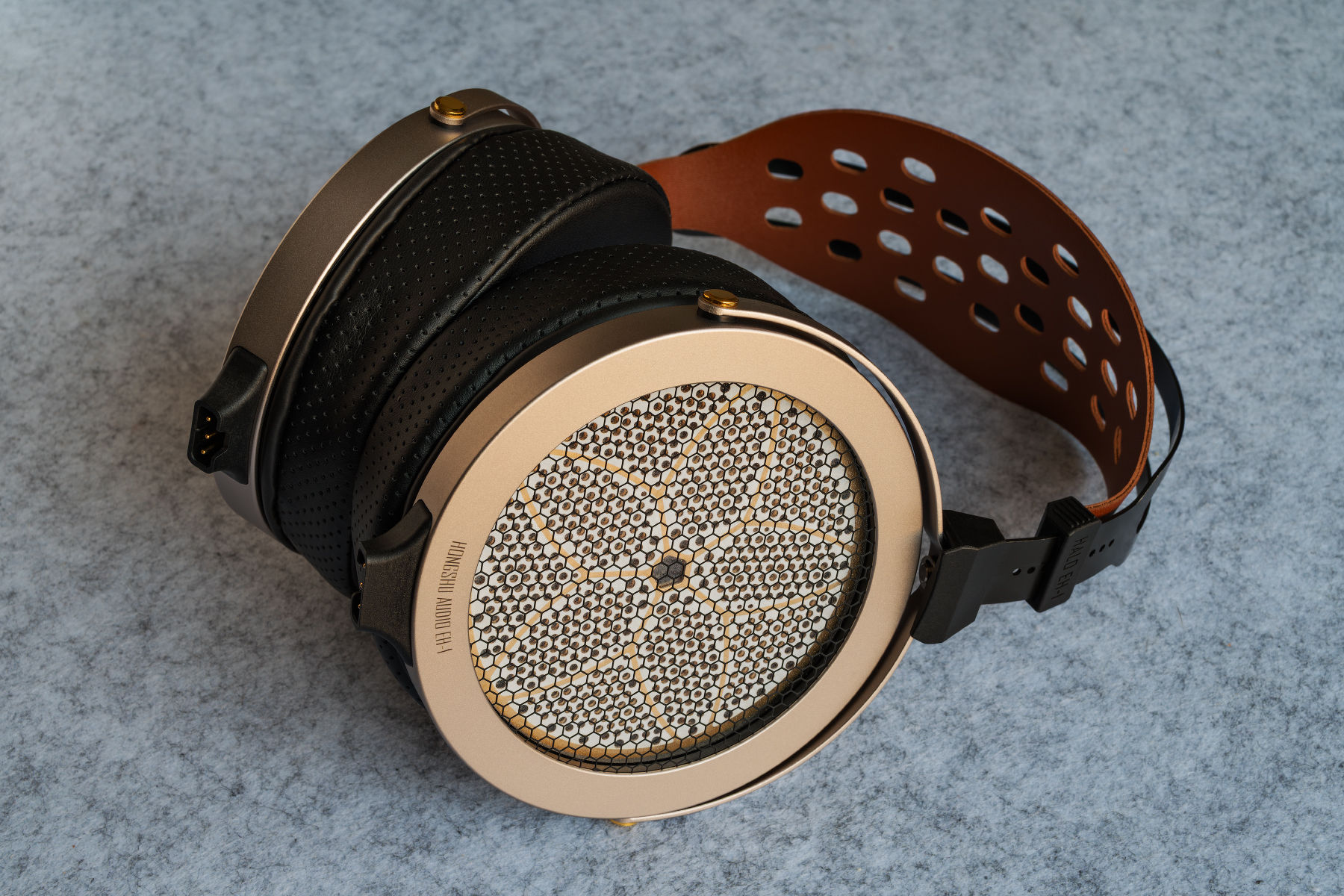
And of course, I can’t go any further without thanking Dmitry, my most dedicated subscriber, who sent these headphones over for review.
A bit about Hongshu Audio and the EH-1
Halo Acoustics was founded in Shanghai in 2019 and set out to develop electrostatic headphones and the dedicated amplifiers, or “energizers”, needed to drive them.
The company’s first product was the Halo EH-1 V1, which went through three revisions. Technically speaking, the unit that landed on my desk would be the EH-1 V4. It was with the fourth version of its headphones that the company decided to enter the international market, rebranding itself as Hongshu Audio.
Currently, Hongshu Audio produces just a single headphone model, the Halo EH-1 V4, along with the EHA-1 amplifier. Both products are available separately or as a bundle. A brief disclaimer on the front page of the company’s official website mentioning “future electrostatic speaker systems” strongly suggests that the manufacturer also intends to venture into electrostatic loudspeakers in the future.
Electrostatic Headphone Technology
Electrostatic headphones are still a fairly rare breed, so it’s worth spending a moment on how they work and the principles behind them.
The original patent (US Patent 1,082,248) was granted to Josef Unterholzner in December 1913, which means the technology is now more than 110 years old.
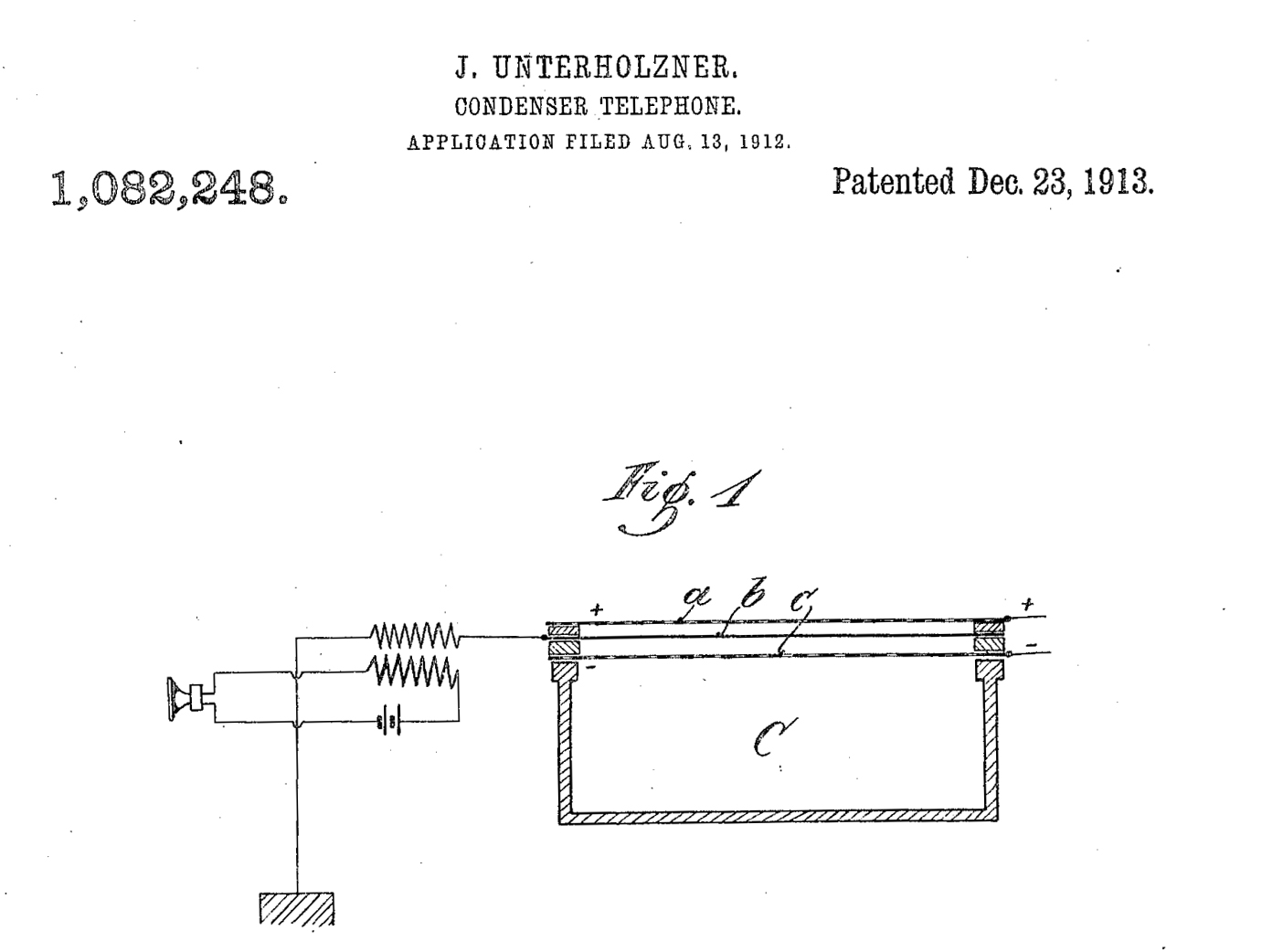
The left side of the figure above shows the supply circuit, while the right side depicts the condenser capsule, consisting of conductive plates (a, b, and c). Plate b acts as the diaphragm, moving in response to the voltage applied to plates a and c.
Over the past century, the signal delivery systems and materials have evolved considerably, but the basic “sandwich” concept with a moving diaphragm suspended between two plates has remained unchanged.
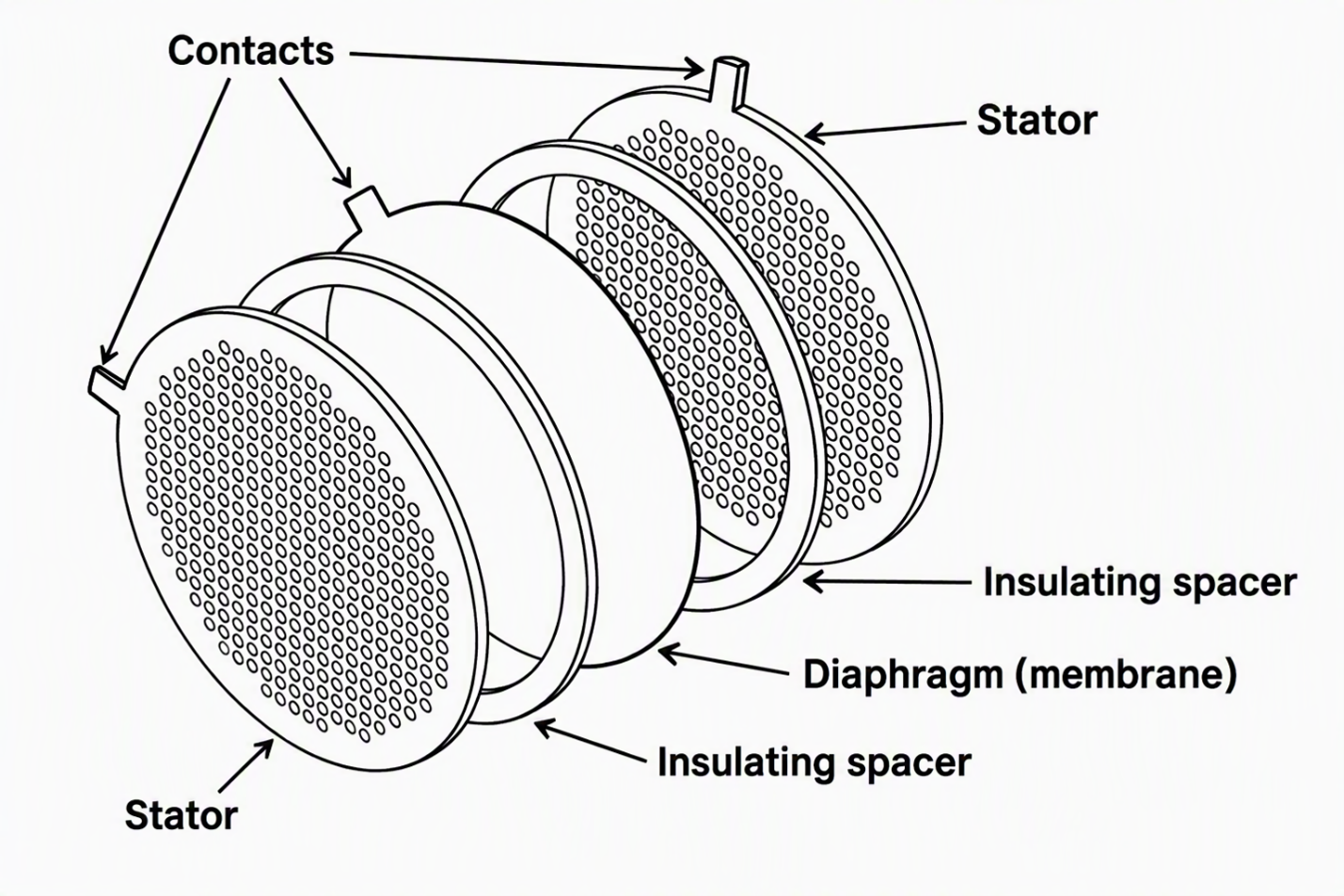
The design of a modern electrostatic driver looks like this:
- A conductive diaphragm made from an extremely thin polymer film (1-3 μm) is suspended between two conductive flat perforated stators. The diaphragm is separated from the stators by insulating spacers.
- DC bias voltage is applied to the diaphragm, giving it a static electrical charge. The standard value for modern models is 580 V.
- AC voltage, determined by the music material being played, is applied to the stators. It typically ranges from 300V to 600V at peak levels.
- An electrostatic field proportional to the audio signal is created between the stators and the diaphragm. The resulting Coulomb forces cause the diaphragm to move in accordance with the signal applied to the stators.
- Additional acoustically transparent films are placed on the outer sides of the driver to protect it from dust and moisture, both of which are particularly harmful to electrostatic headphones.
The result is a symmetrical “sandwich” structure like this:
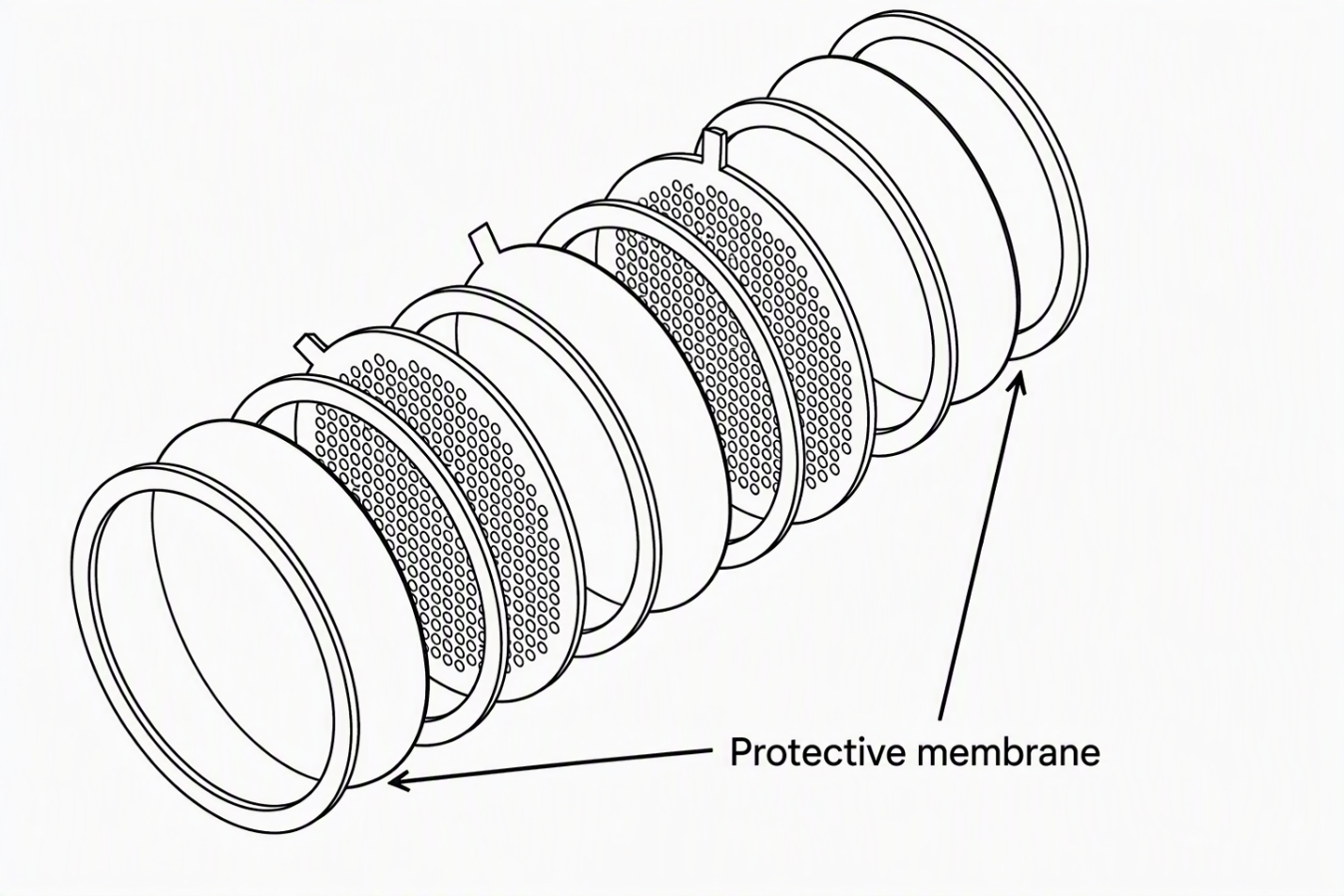
As you can see, electrostatic headphones require high-voltage drive signals and therefore are always used with dedicated amplifiers, commonly referred to as energizers.
As for consumer models:
- The first were the STAX SR-1, introduced in 1959.
- Over the years, other manufacturers have released their own models, including KOSS (ESP/6, 1968), Pioneer (SE-100, 1971), Sennheiser (Unipolar 2000, 1977), HiFiMan (Shangri-La, 2016), Warwick Acoustics (Sonoma Model One, 2017), Audeze (CRBN, 2021), Dan Clark Audio (CORINA, 2023), and many others. I almost forgot the wonderfully eccentric-looking Jecklin Float (1987).
- Electrostatic in-ear monitors also exist, take Shure KSE1500 as an example.
- The world’s most expensive headphones, the Sennheiser Orpheus HE-1, are electrostatics, too.
All but the sound
The headphones come in a simple cardboard box:
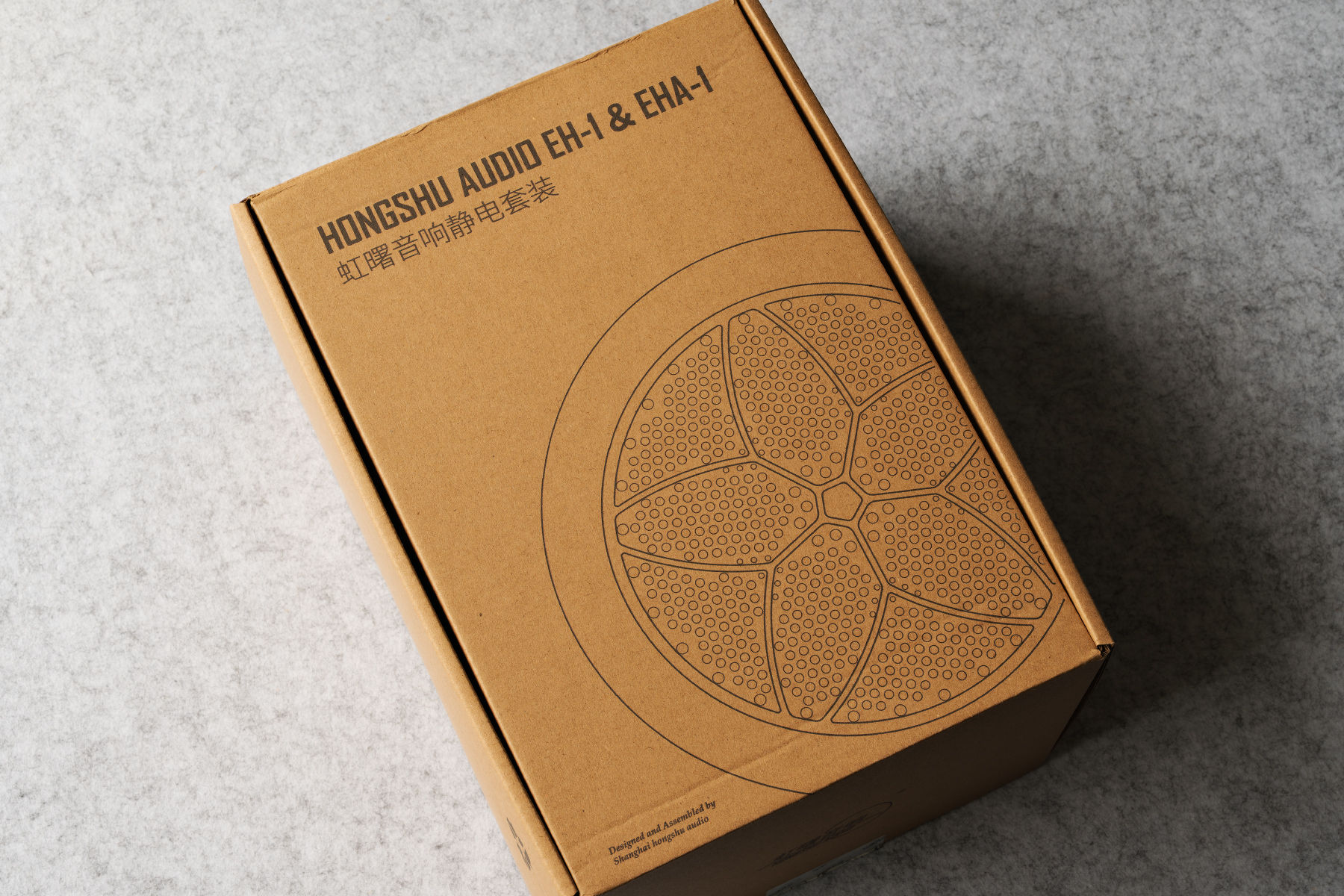
Inside the box you’ll find:
- The headphones with earpads;
- The cable;
- The amplifier and its power supply;
- A hex key;
- The user manual.
The included cable is the EC-1, a classic six-conductor ribbon cable. Its flat geometry allows the conductors to be spaced apart, minimizing the risk of arcing between adjacent wires. It also helps reduce the cable’s parasitic capacitance and crosstalk.
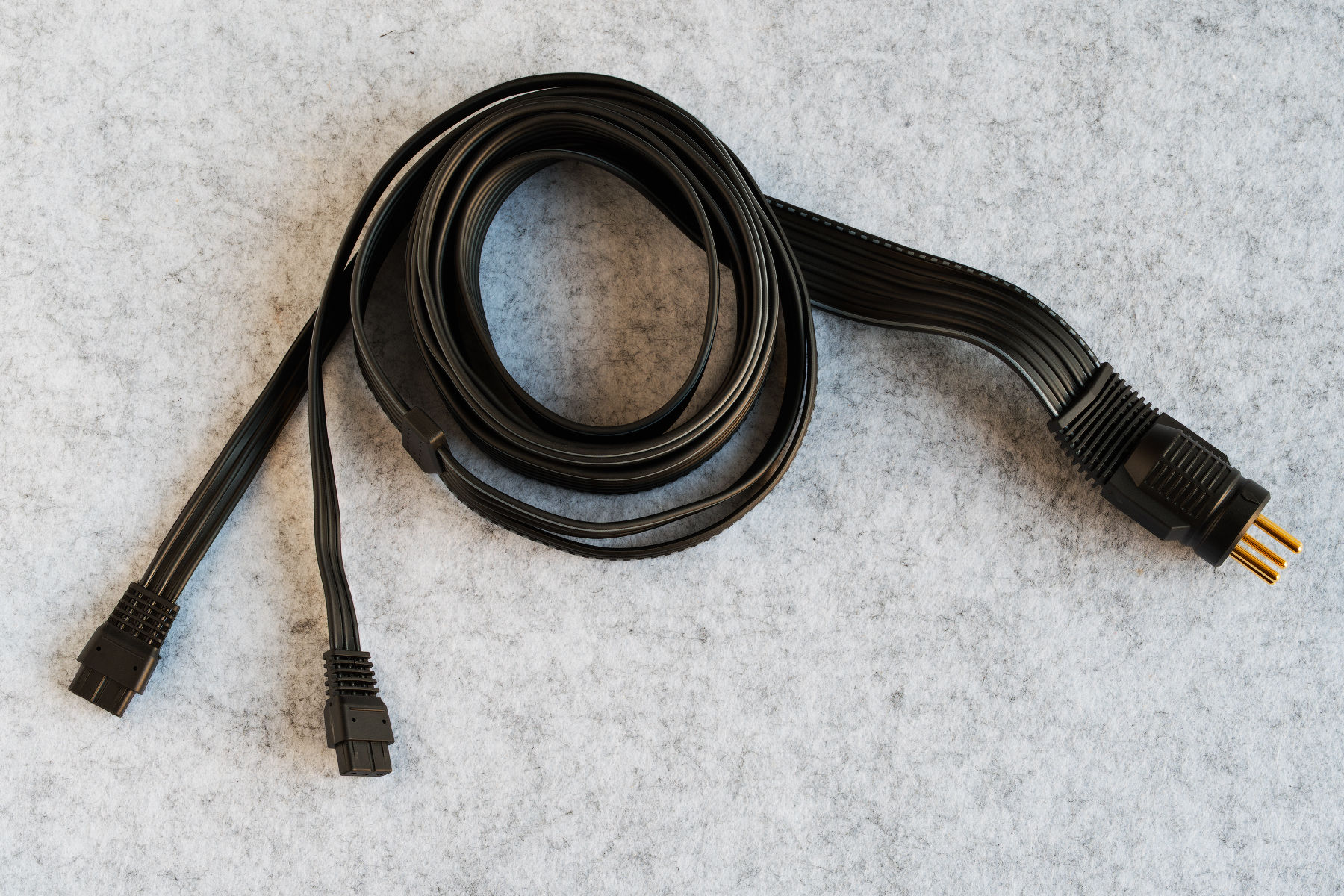
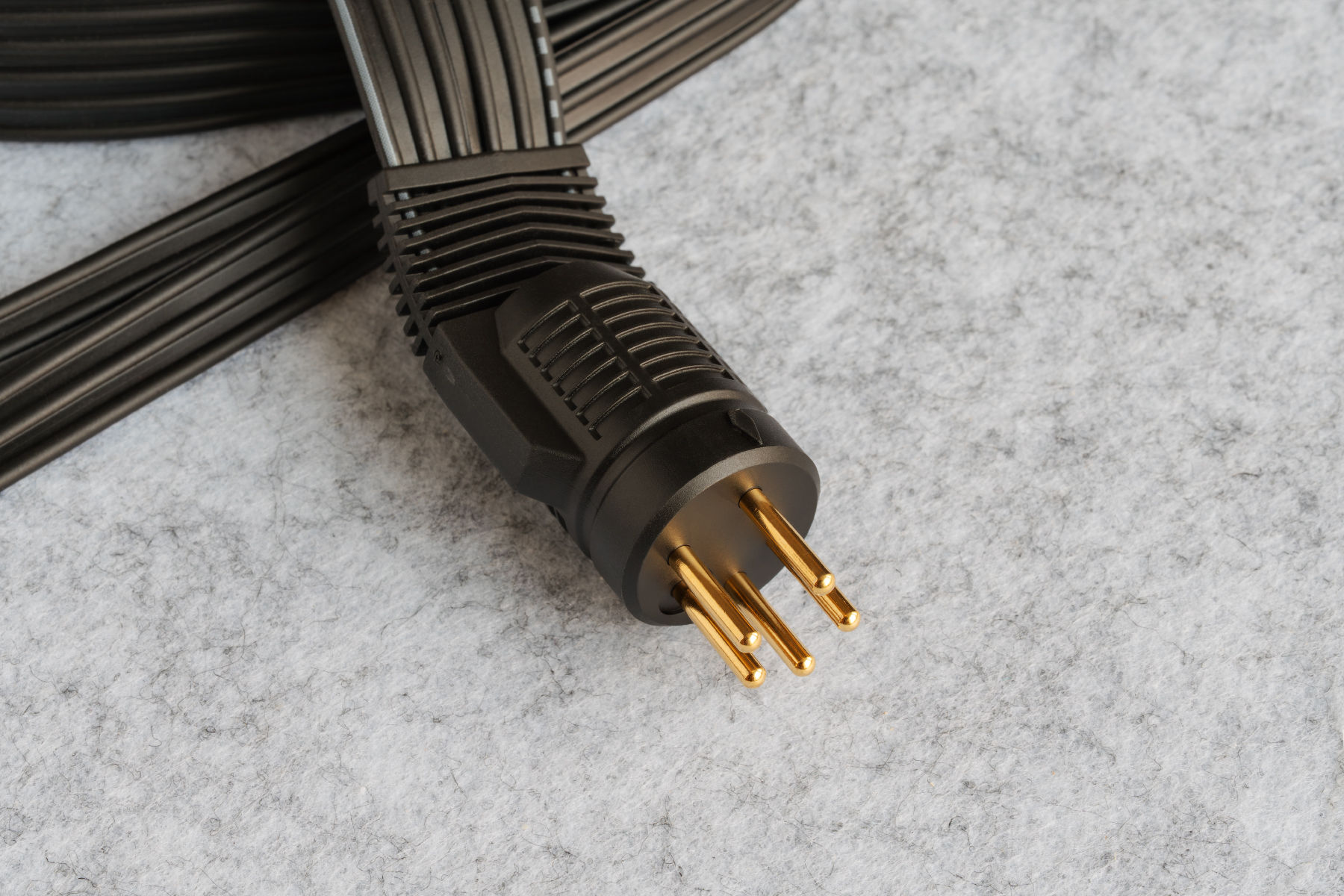
The cable looks rather substantial, but in practice it’s quite comfortable to use, especially considering its 90 g weight and 1.8 m length. It’s soft, flexible, and appears to be made from a rubber-like material. One end of the cable is terminated with a 5-pin DIN5 connector, which is used to connect it to the amplifier.
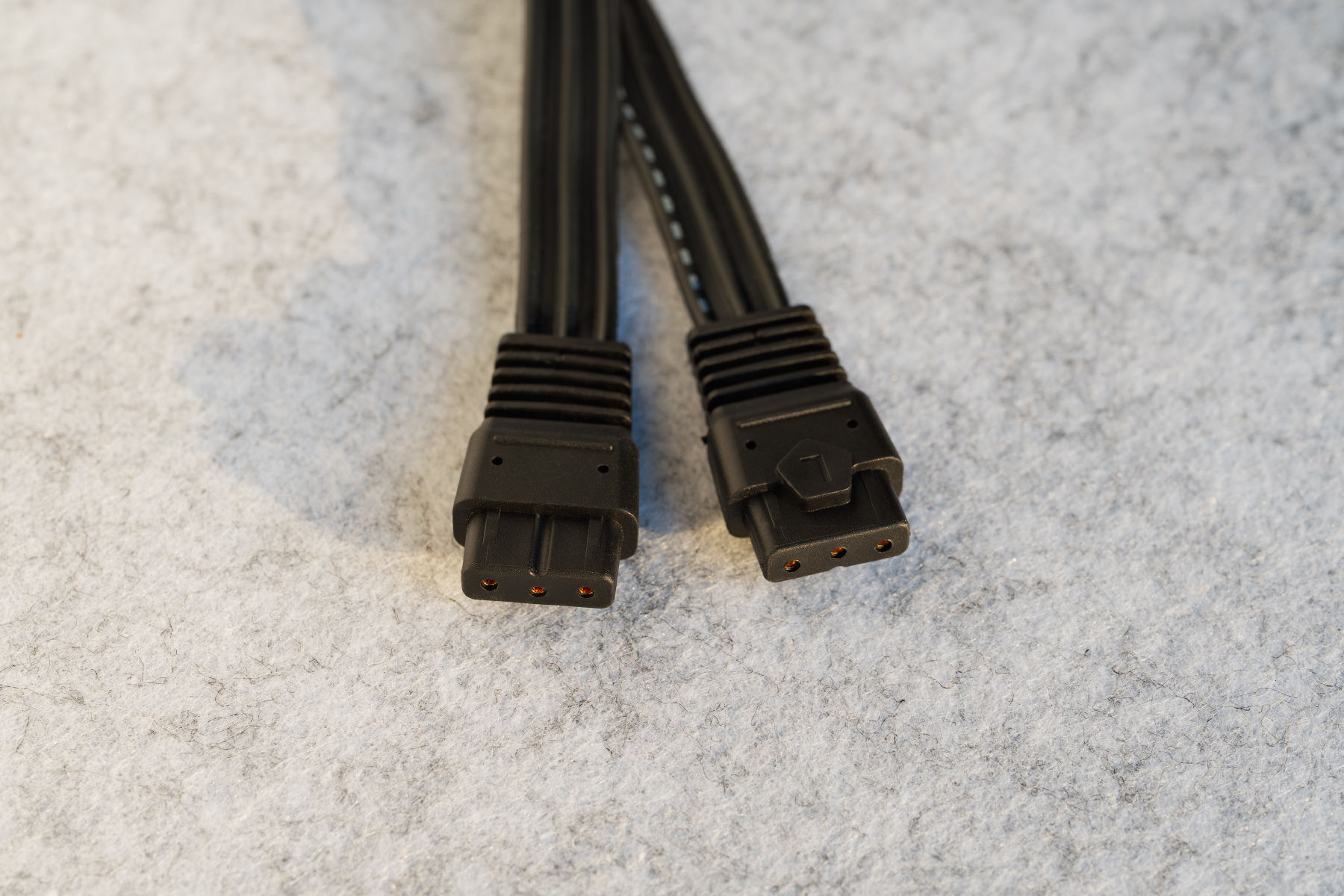
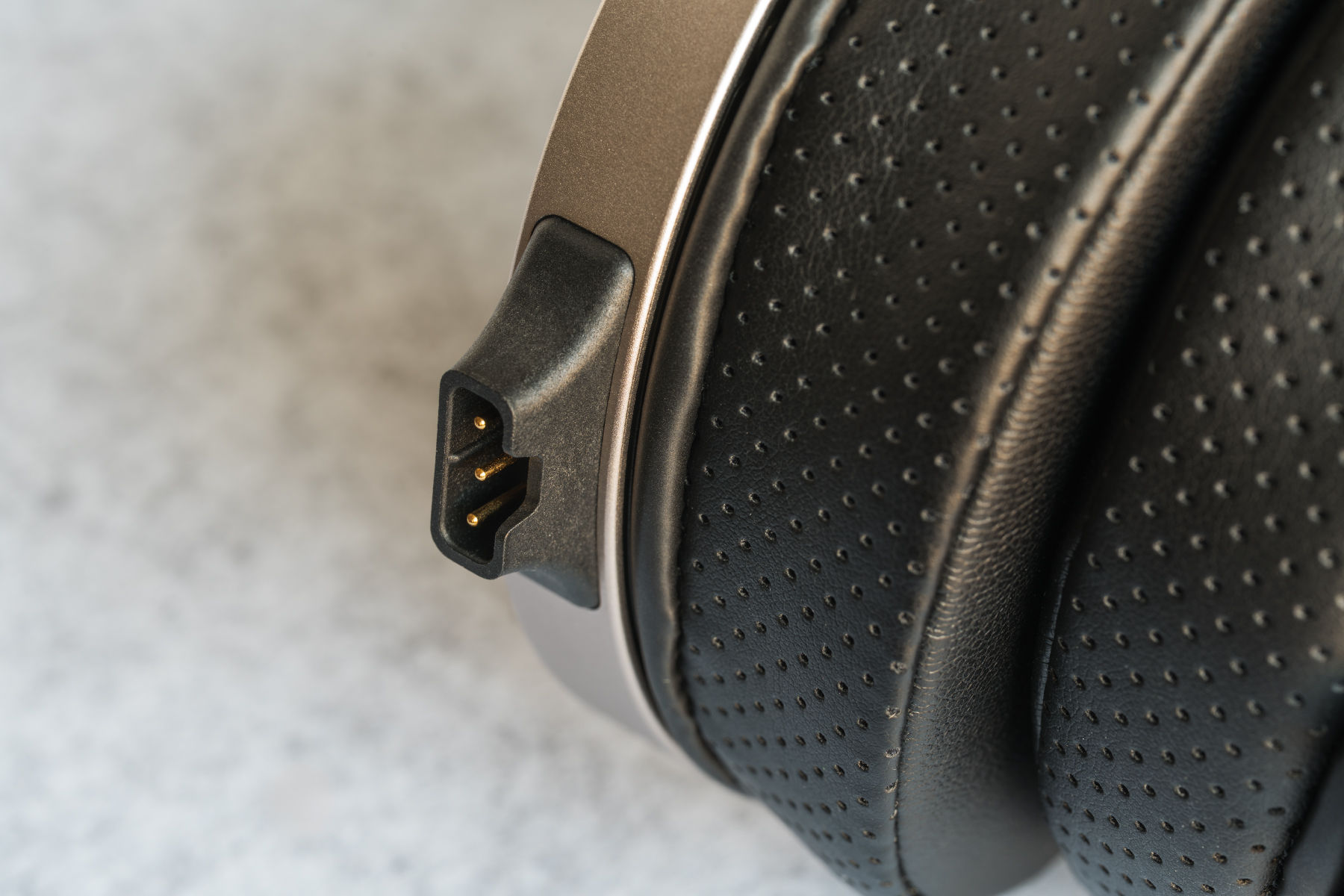
The cable connects to the headphones via a pair of clearly marked 3-pin connectors.
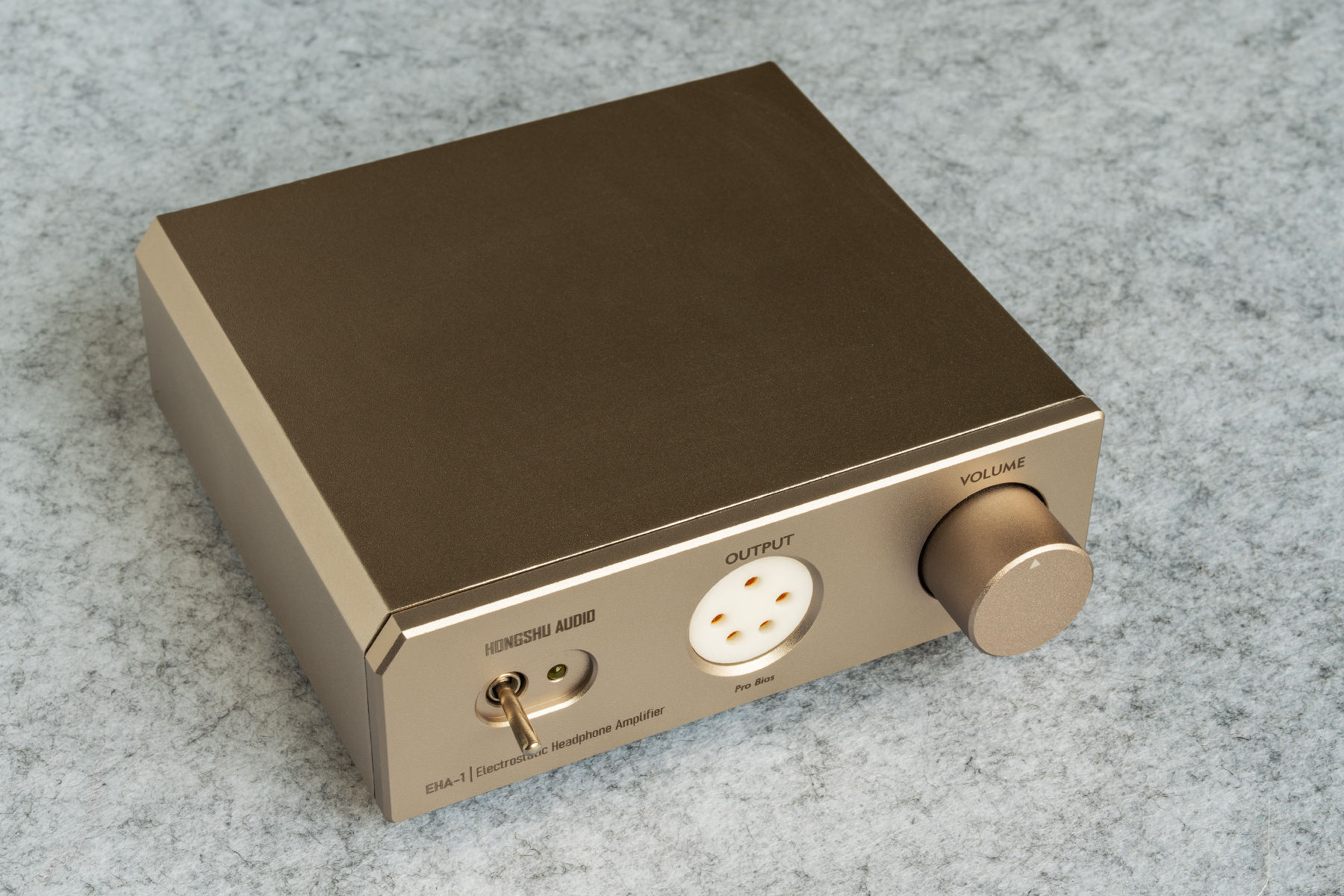
The EHA-1 amplifier, or energizer, converts the 12 V DC supplied by the external power adapter into the 580 V bias voltage required by the diaphragm (the standard 580V Pro Bias), while also providing the alternating voltage signal for the stators. It’s a remarkably compact unit, measuring just 12 × 11 × 4 cm.
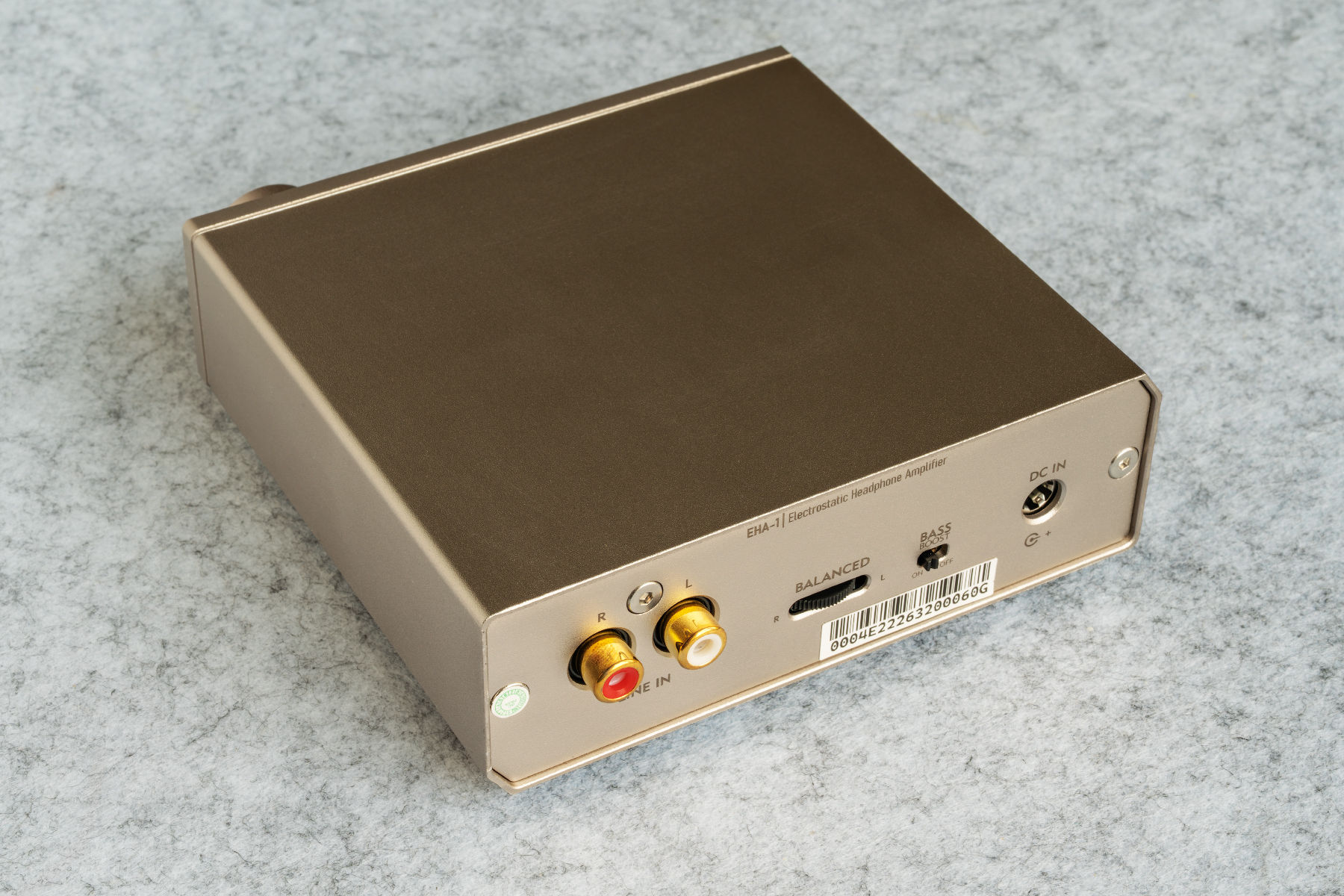
The front panel houses the power switch, a status LED, the headphone output connector, and the volume control. The rear panel is somewhat more unusual. In addition to the RCA inputs and the power socket, it features a channel balance control and a two-position switch for bass boost on/off.
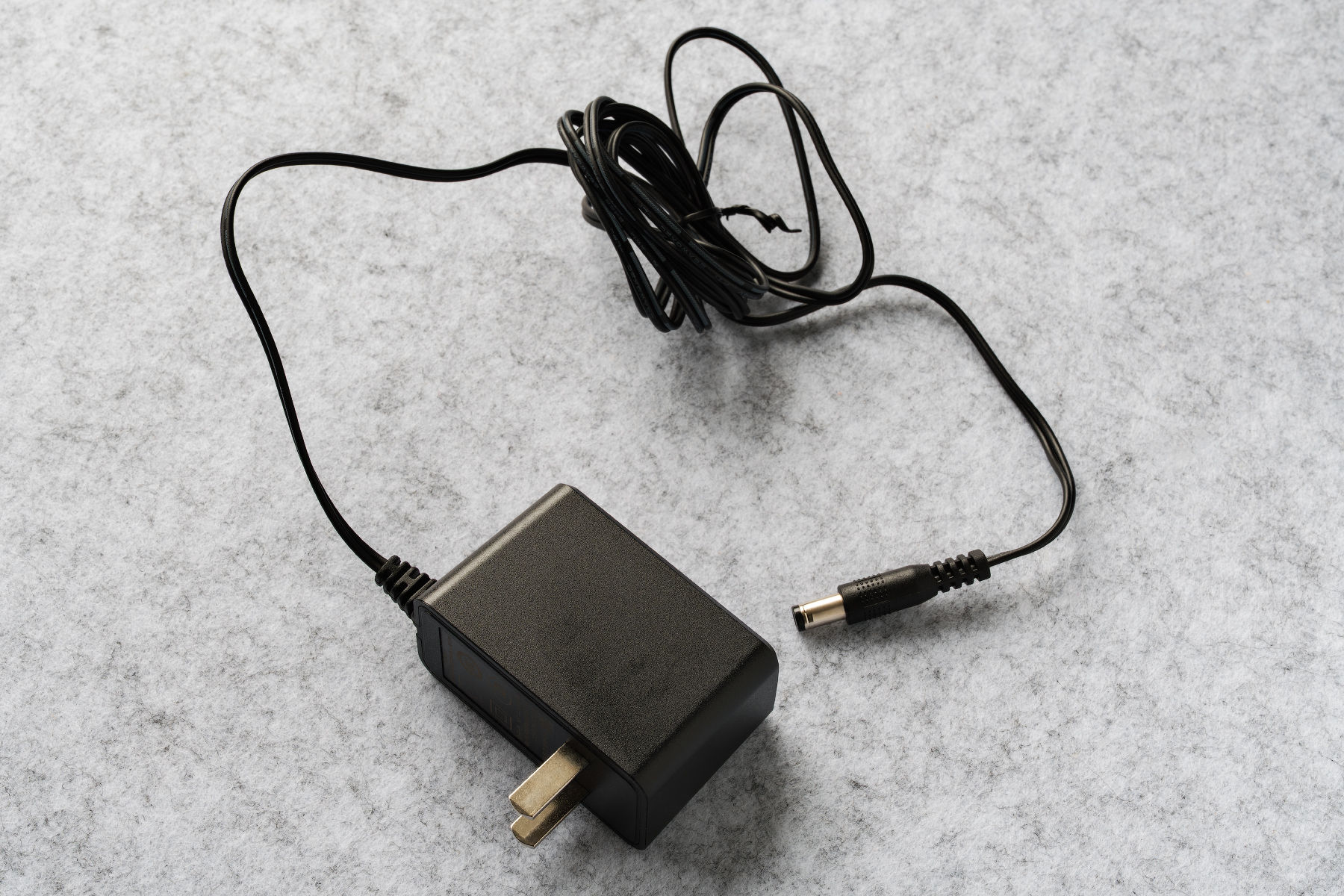
The power supply, incidentally, is a GQ12-120100-CC:
The headphones themselves weigh exactly 295 g without the cable but with the stock earpads installed. The earcups are made of metal and feature a fully open-back design. The 10 cm stators are protected by thin steel grilles, behind which the protective membranes can be seen.
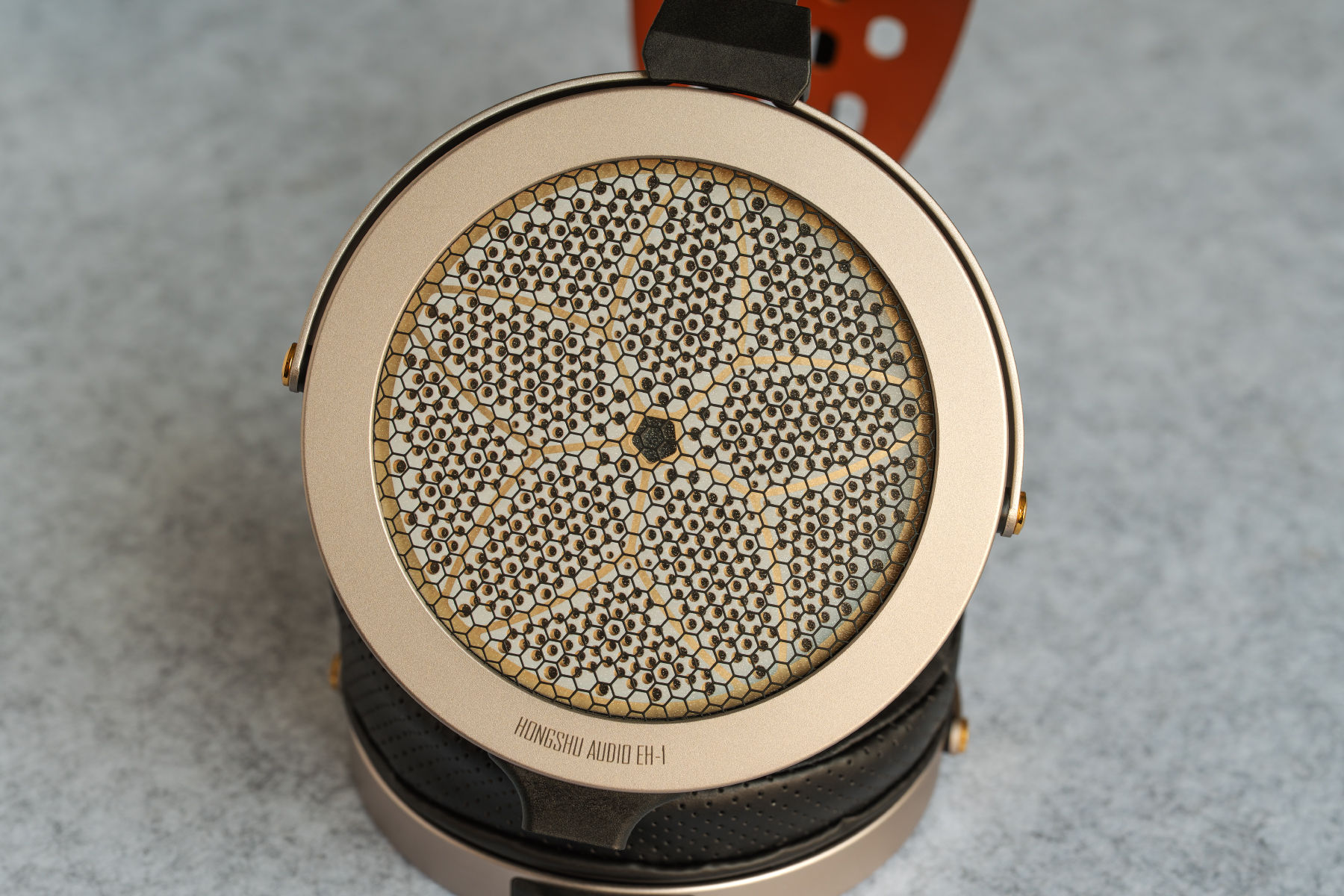
From up close, the stack of grilles, stators, and membranes looks something like this:

At the bottom of each earcup are the cable connectors, oriented straight downward.
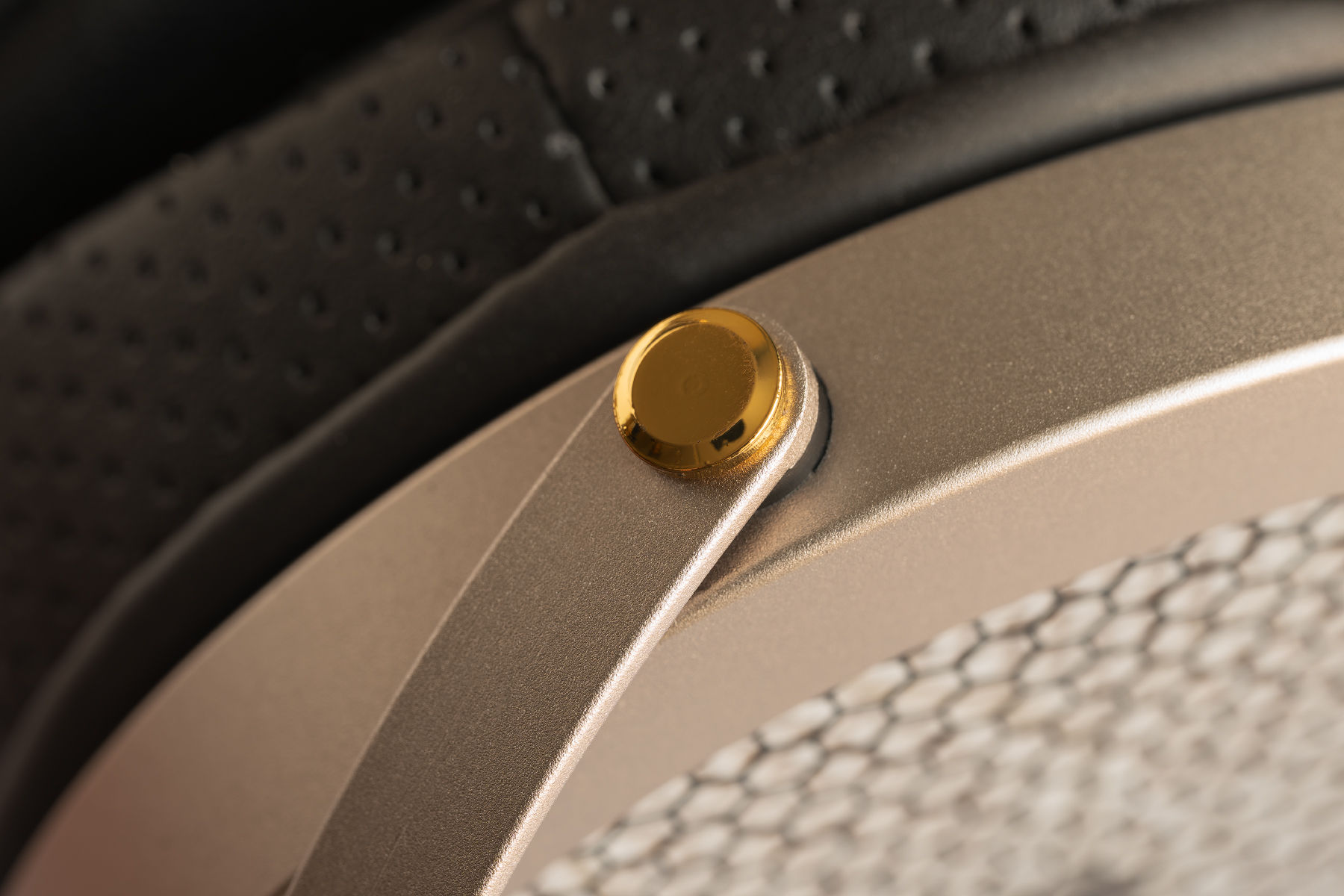
The earcups are attached to the headband via conventional yokes, allowing them to rotate on both the horizontal and vertical axes.
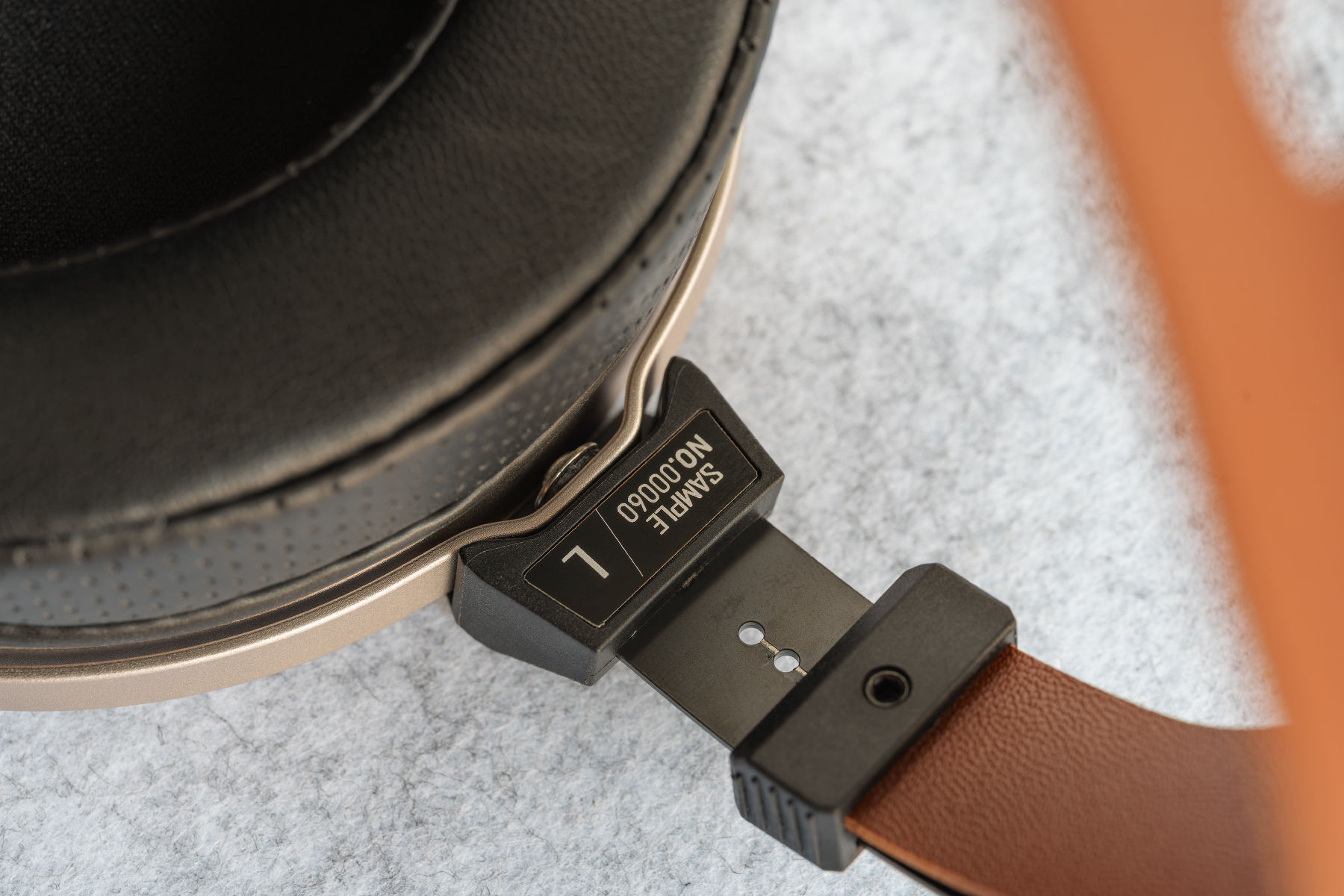
The headband width is adjusted in fixed incremental steps. The headband pad is lightweight and made of synthetic leather.
The earpads, designated SP-1V, are angled, perfectly round, and made of synthetic leather with a foam filling. They attach to the headphones via mounting lips. The internal opening measures 6.4 cm in diameter, while the pad thickness is 2.1 cm at the front and 3.1 cm at the rear.
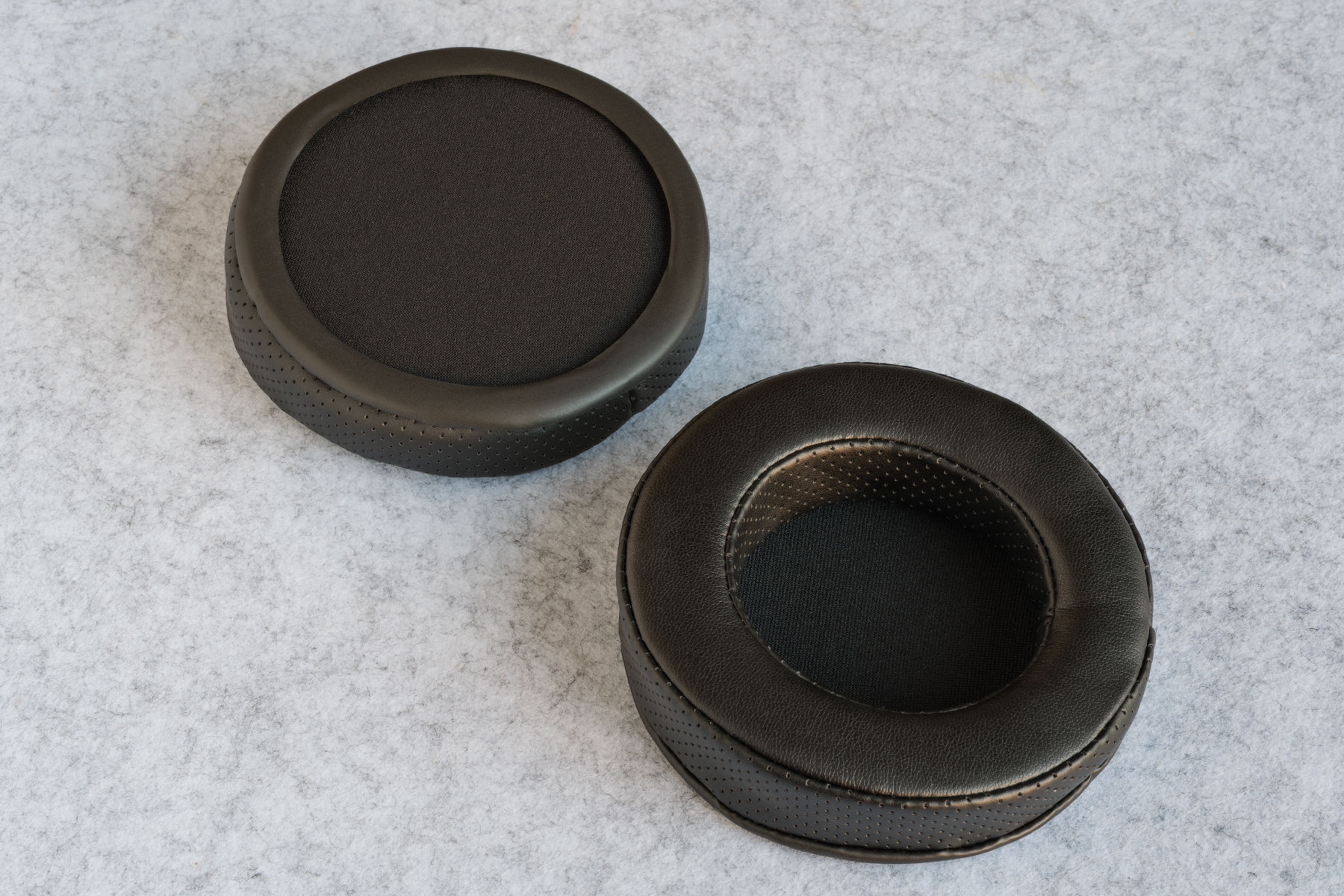
Removing the earpads reveals the inner sides of the electrostatic drivers, which are, however, completely identical to the outer sides.
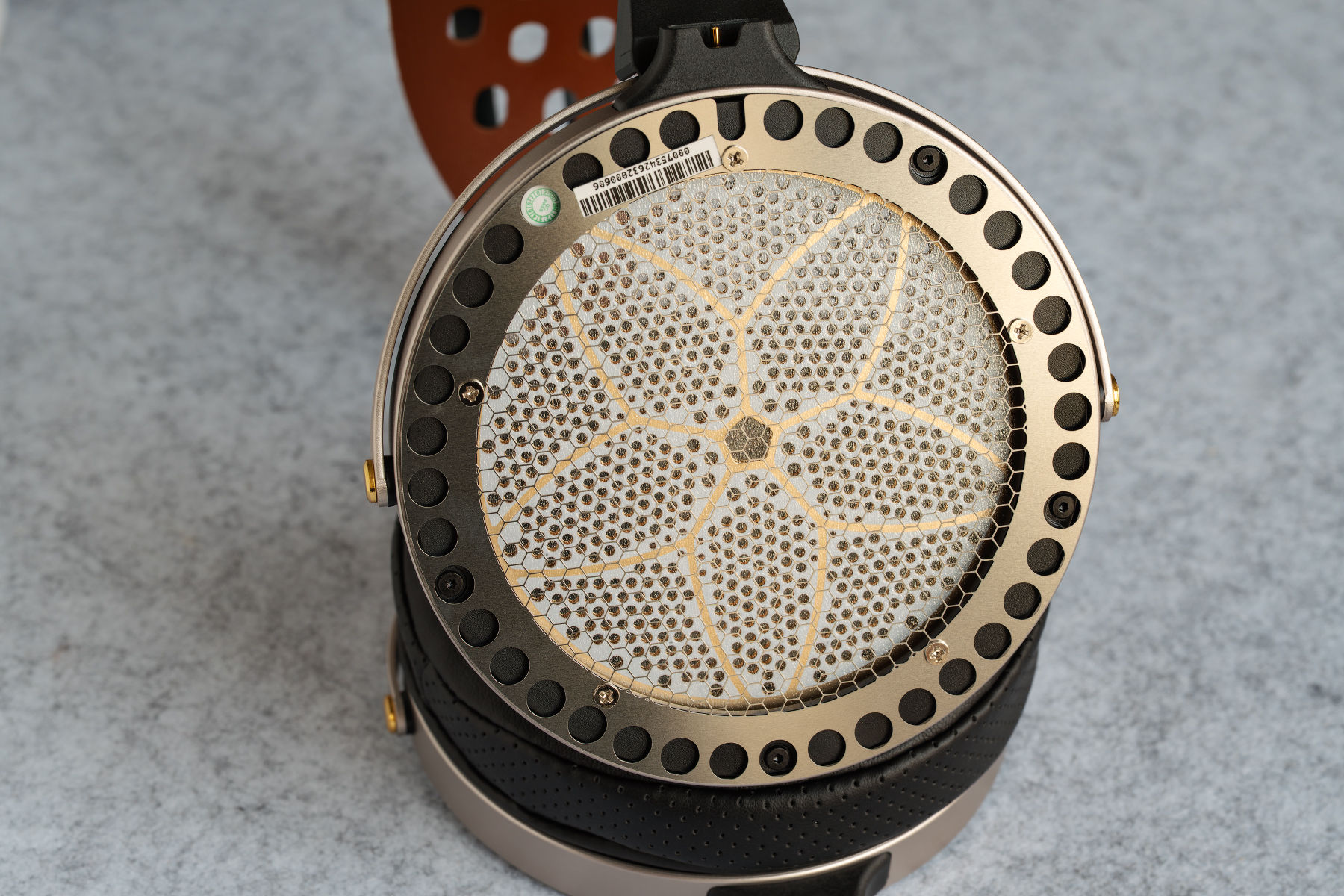
The only difference is the metal mounting ring used to attach the earpads. Its outer diameter, incidentally, is 10.3 cm.
Are the headphones comfortable to use? Yes, very much so. The clamping force is well judged, distributing part of the weight across the earpads and the sides of the head. The pads themselves are soft and conform to the shape of the head after about 30 seconds of wear. The headphones are lightweight, the headband strap is wide, and the weight distribution is even. Spending six to eight hours in the EH-1 is easy.
One thing worth noting is just how open these headphones are. They leak sound in both directions at practically the same volume. If someone is listening to the EH-1 in the next room at 80-90 dB, it genuinely sounds as though a small pair of speakers is playing nearby.
What I didn’t particularly like is the headband adjustment mechanism. The sliders feel rather delicate and don’t hold their position very firmly, often clicking into the next adjustment step when you simply try to reposition the headphones on your head. The vertically downward-facing cable connectors are also a poor design choice. Lean your head to either side and the connector immediately runs into your shoulder.
Beyond that, I really don’t have much to criticize, and that’s a good thing. Overall, the EH-1 are quite comfortable.
The lasting impression of the build quality and materials is somewhat mixed. As far as I can tell, the manufacturer did everything possible to minimize both weight and cost. The headphones don’t feel like a DIY project at all; every part is neatly made and clearly manufactured rather than hand-built. At the same time, the EH-1 feel fragile. Consider this: the earpad mounting ring is only 0.43 mm thick, and bending it accidentally seems entirely possible. The same applies to the extremely thin protective grilles. Once the earpads are removed, the entire structure becomes noticeably resonant and prone to ringing. The few plastic components, along with the headband strap, don’t exactly inspire confidence in terms of perceived quality.
In the end, the EH-1 are assembled very neatly, and that deserves credit. Even so, the headphones come across as somewhat flimsy and inexpensive.
As for the amplifier, I don’t have any particular critique. The power switch clicks cheerfully, the volume knob turns smoothly. The placement of the bass switch and the channel balance control is not ideal, as it’s easy to brush against the rear-mounted balance wheel with your fingers. At the same time, I suspect most users will only experiment with those adjustments during the initial setup period, so no harm done; and there isn’t really any room for them on the front panel anyway.
The sound
Standard links:
- the description of my rig is here;
- the audiogram of my hearing is here;
- articles on measurement theory and the whole shebang are here;
- some fine points of over-ear headphone measurements are here.
Frequency response of the Hongshu Audio EH-1 with the stock earpads, measured with a perfect seal against the measurement rig and the bass switch set to OFF:
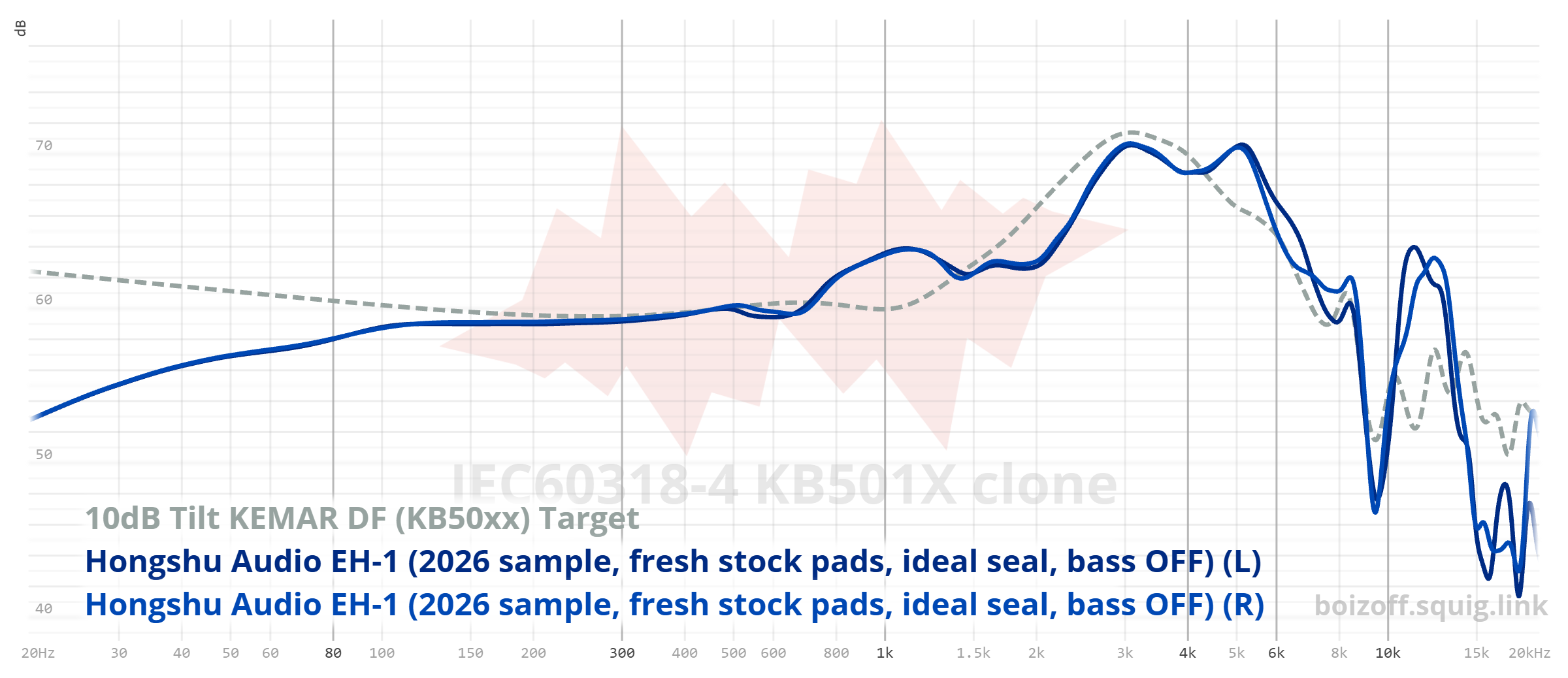
For now, let’s simply note the excellent channel matching, as well as the substantial roll-off in the low frequencies.
Frequency response of the Hongshu Audio EH-1 with the stock earpads under realistic-fit conditions (with an air gap between the pads and the measurement rig), bass switch set to OFF:
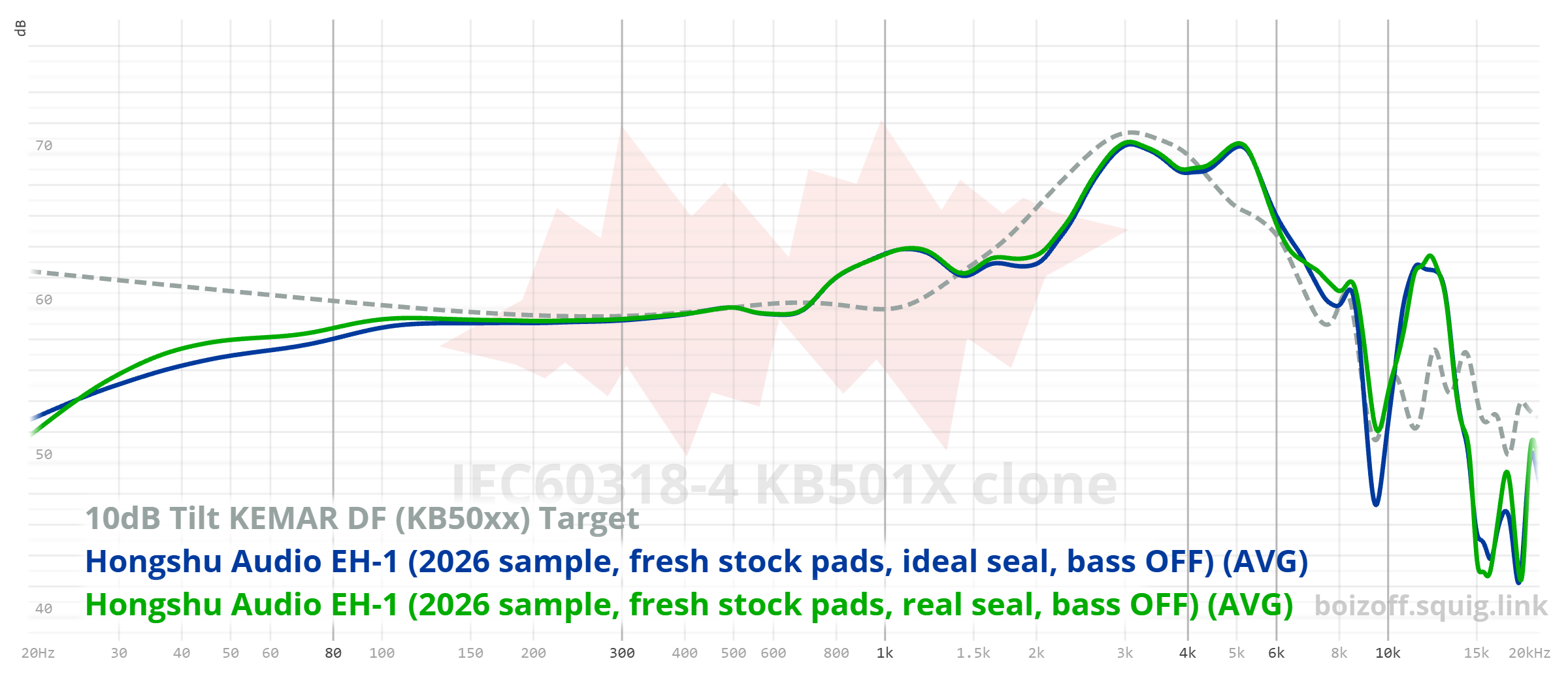
Here we can see the effect of the air gap. The headphones behave similarly to planar magnetic designs: bass response rises slightly, but the sub-bass roll-off becomes even more pronounced.
Comparison of the EH-1 frequency response with the bass switch set to OFF and ON under perfect-seal conditions:
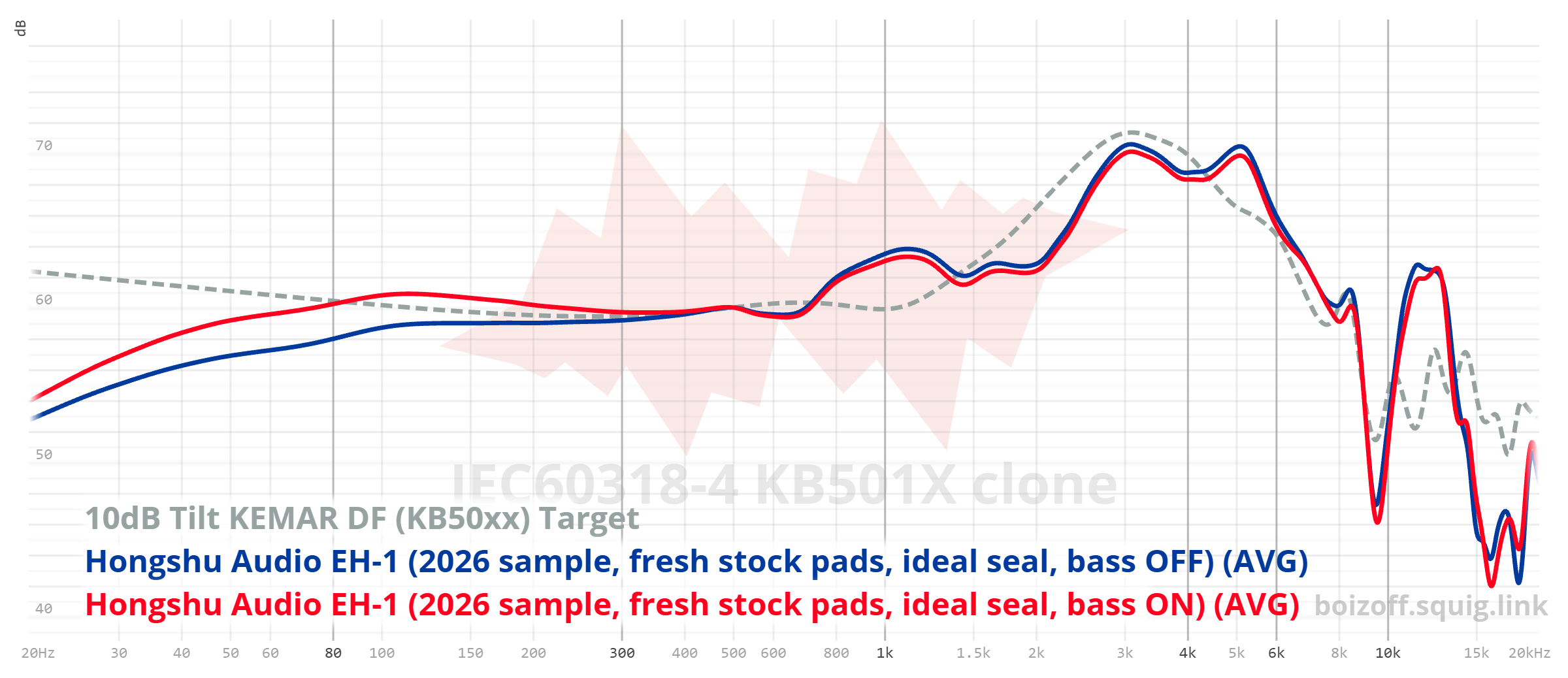
With the switch in the ON position, the bass boost behaves roughly like a bell-shaped filter centered at 67 Hz with a Q of 0.4 and a gain of 2.2 dB.
Comparison of the EH-1 frequency response with the bass switch set to OFF and ON under realistic-fit conditions:
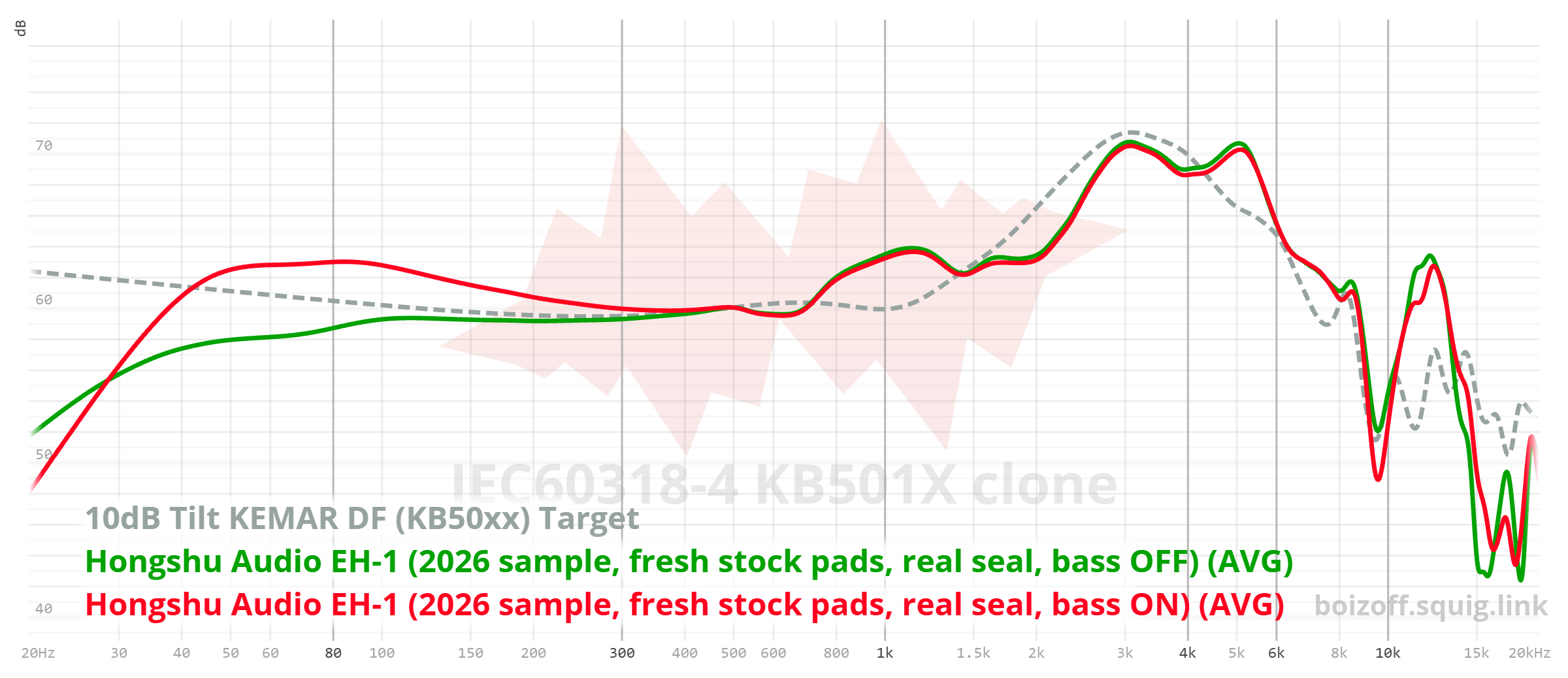
This is the graph I’ll be using as the primary basis for evaluating the sound of the EH-1. Several characteristics stand out:
- The tuning follows a DF-style target, with noticeable emphasis around 1 kHz and 5 kHz (+3 dB), as well as a distinct peak near 13 kHz.
- Regardless of the bass switch position, there is substantial roll-off in the deep bass. Even with a perfect seal, it’s still down by roughly 5-6 dB.
- With a realistic fit and the bass switch set to ON, the EH-1 deliver more low-frequency energy than the diffuse-field target, but the elevation begins rather early, at the midrange.
- With a realistic fit and the bass switch set to OFF, the EH-1 still fall noticeably short in terms of bass level.
Non-linear distortion measurements at 94 dB SPL, shown with the “Use harmonic frequency as ref” option disabled and enabled:
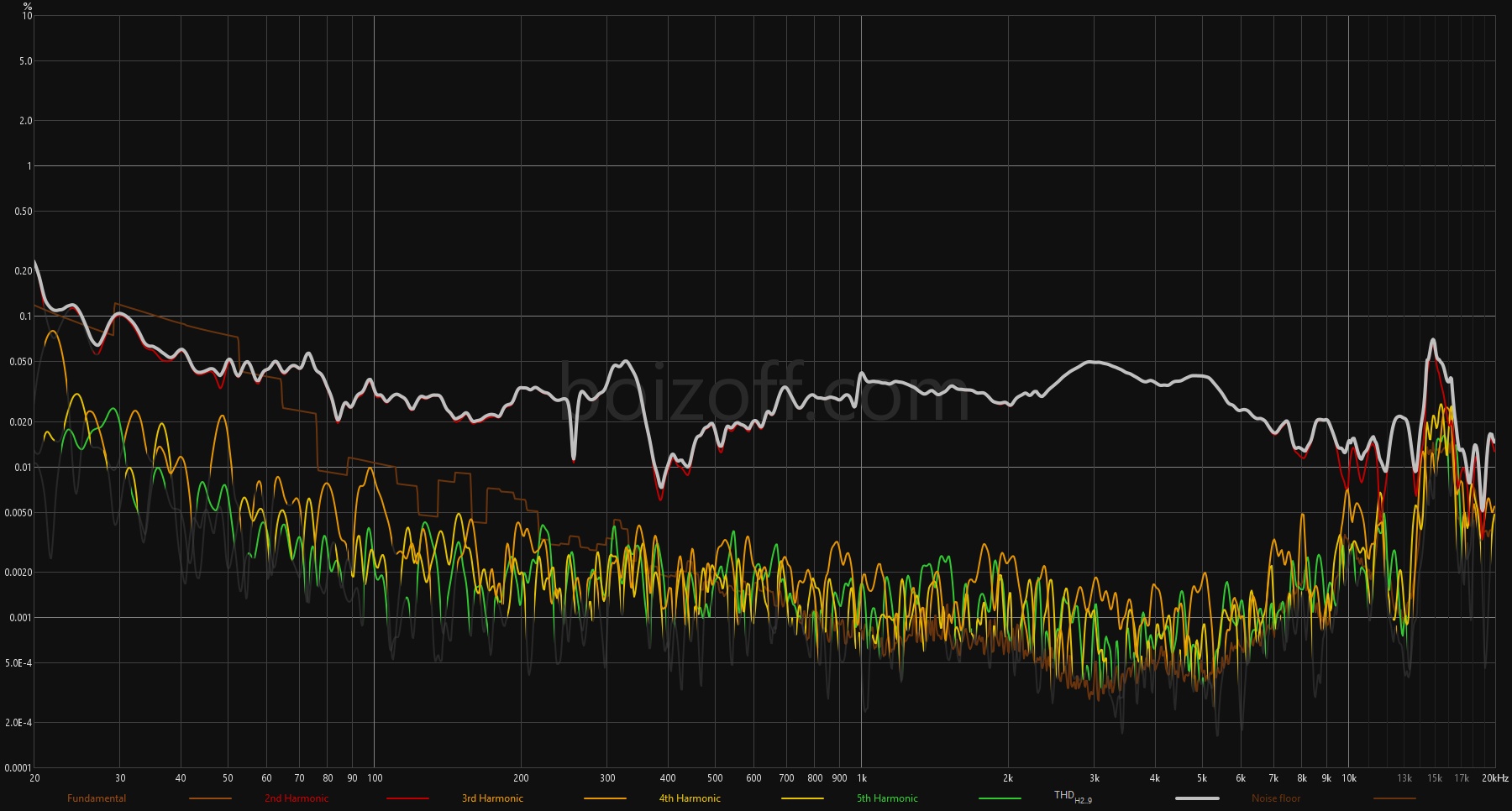
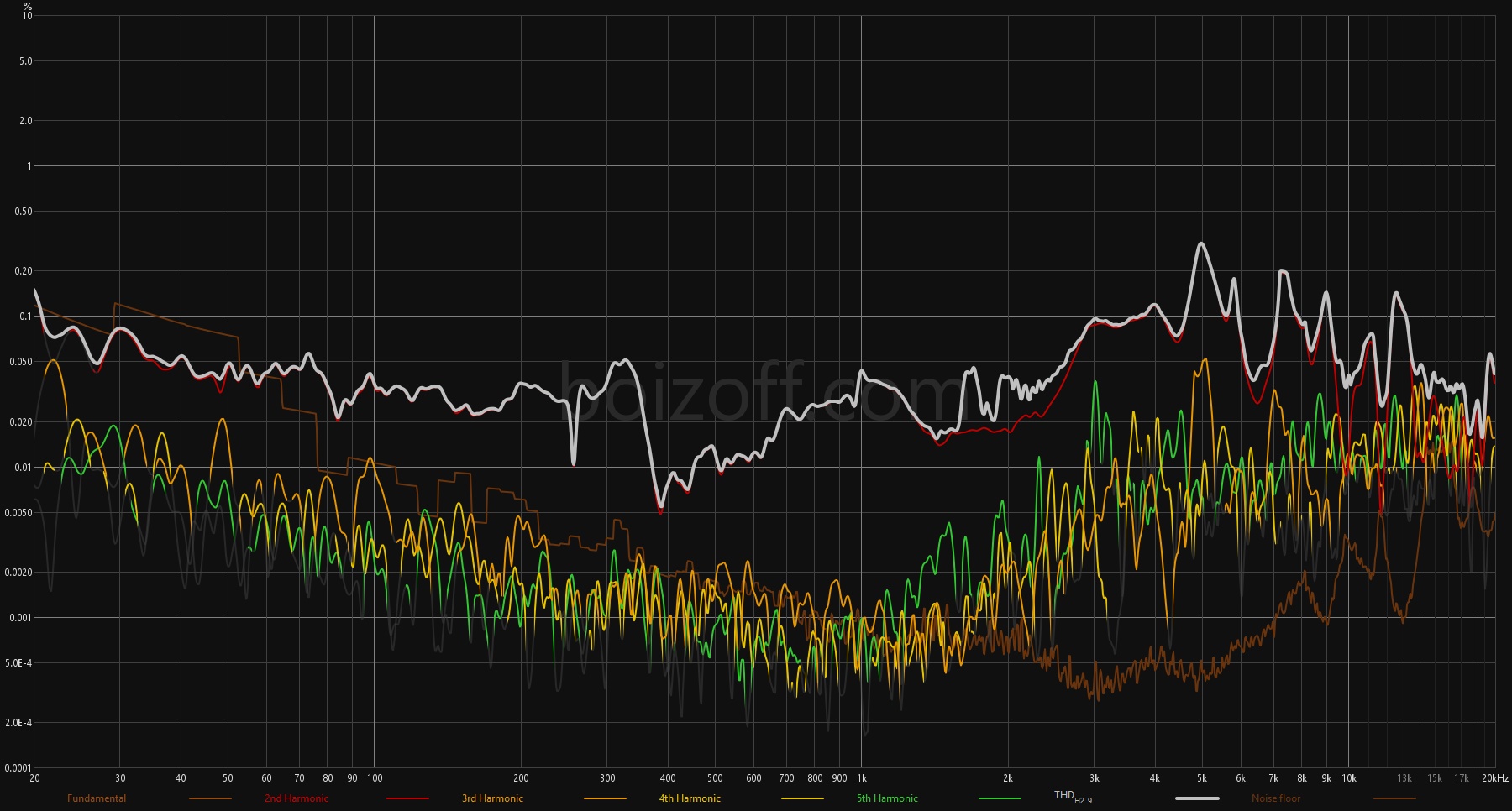
This may well be a record. I’ve never seen distortion levels this low from over-ear headphones before. The XK Audio Fluxion showed a similarly impressive result, but they still fall behind the EH-1 around the 5 kHz range. Technically, it’s 0.04% at 1 kHz.
Something rather unexpected happened during the 104 dB distortion measurements. As a reminder, the test consists of feeding the headphones a sine sweep that spans from 0 Hz up to half the sampling rate. In my case that’s 192 kHz sampling, meaning a sweep from 0 to 96,000 Hz. During the first run, I have to admit I was genuinely alarmed. When the sweep reached roughly 50 kHz, the headphones suddenly produced an awful grinding, crackling electrical noise. My first thought was, “Well, that’s it…” and I immediately started calculating how much I was going to owe Dmitry. Further testing showed that the headphones were perfectly fine and nothing had been damaged. It turns out that this is simply how the EH-1 behave at elevated playback levels, roughly 96 dB and above. If a signal at 45 kHz or higher is applied, the headphones produce a rather horrifying electrical crackling sound. Fortunately, this has no impact whatsoever on real-world use, since frequencies that high simply do not exist in music recordings.
To be on the safe side, I performed the measurement at 102 dB instead, using a single 1M sweep rather than the usual 4M8 mode.
Non-linear distortion measurements at 102 dB, shown with the “Use harmonic frequency as ref” option disabled and enabled:
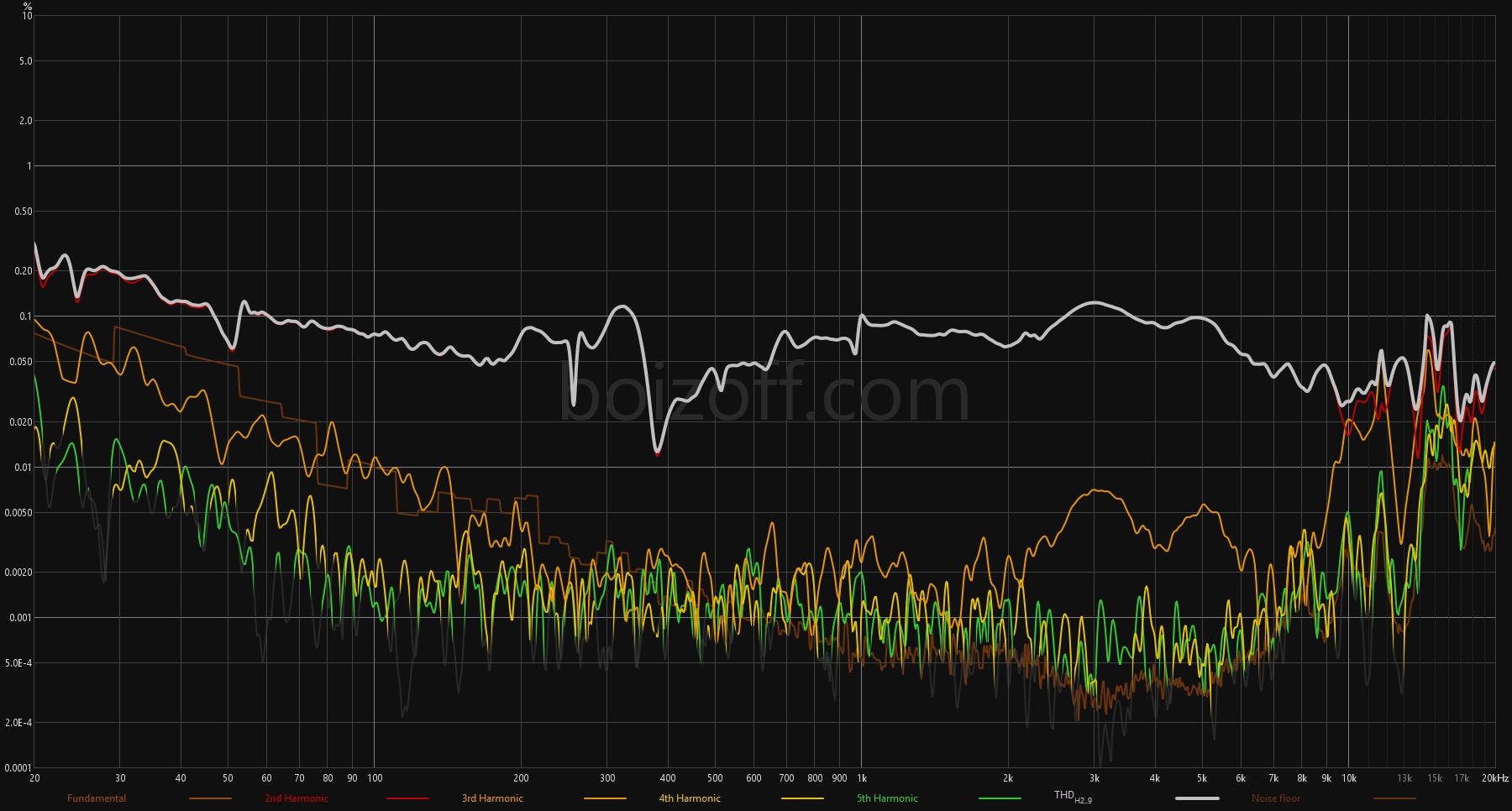
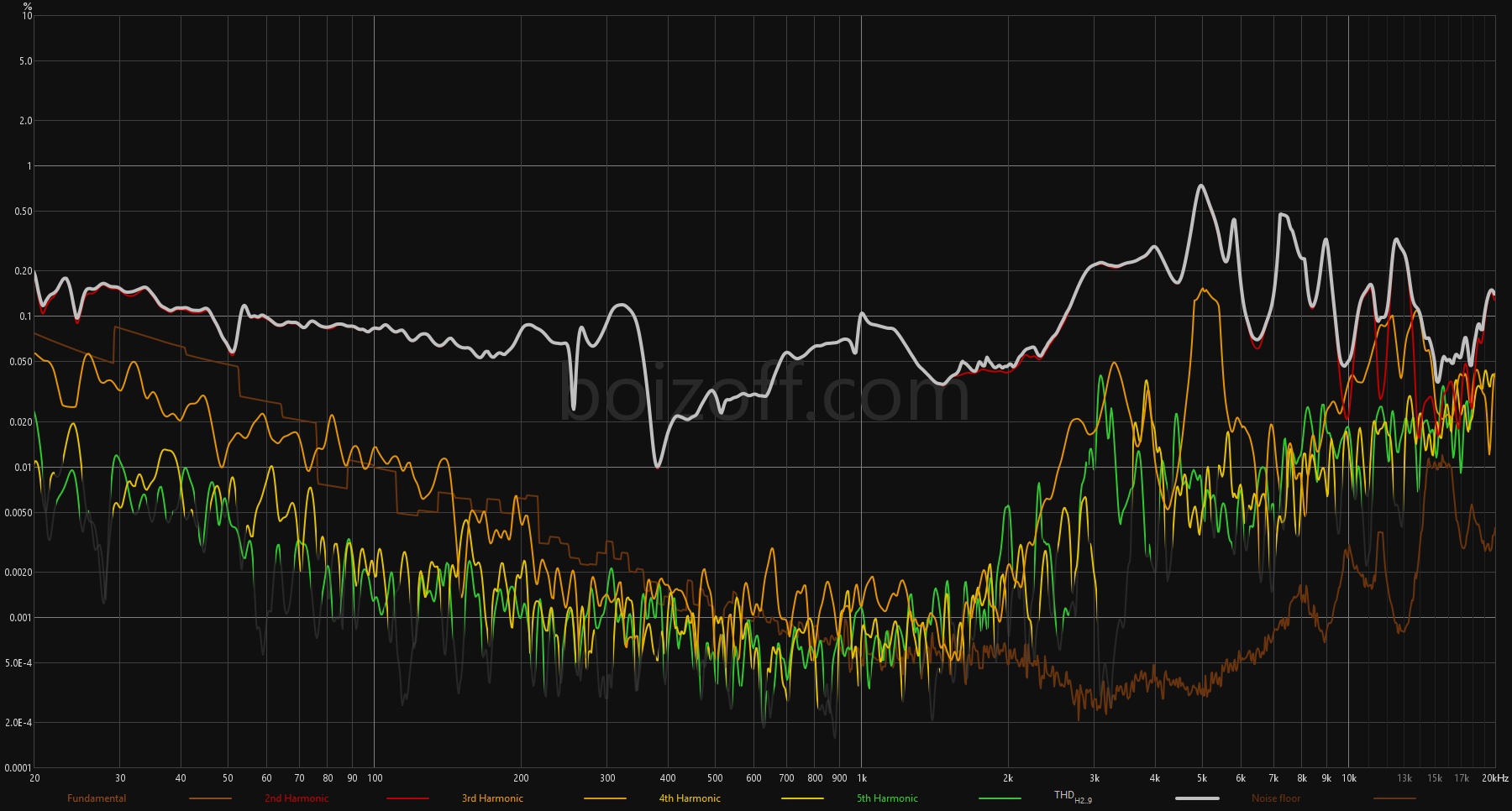
Again, the result falls firmly into the “I’ve never seen anything like this before” category. The peak distortion figure is just 0.7%.
Now let’s take a closer look at the unsmoothed frequency response curve, specifically the 20 Hz to 1 kHz region:
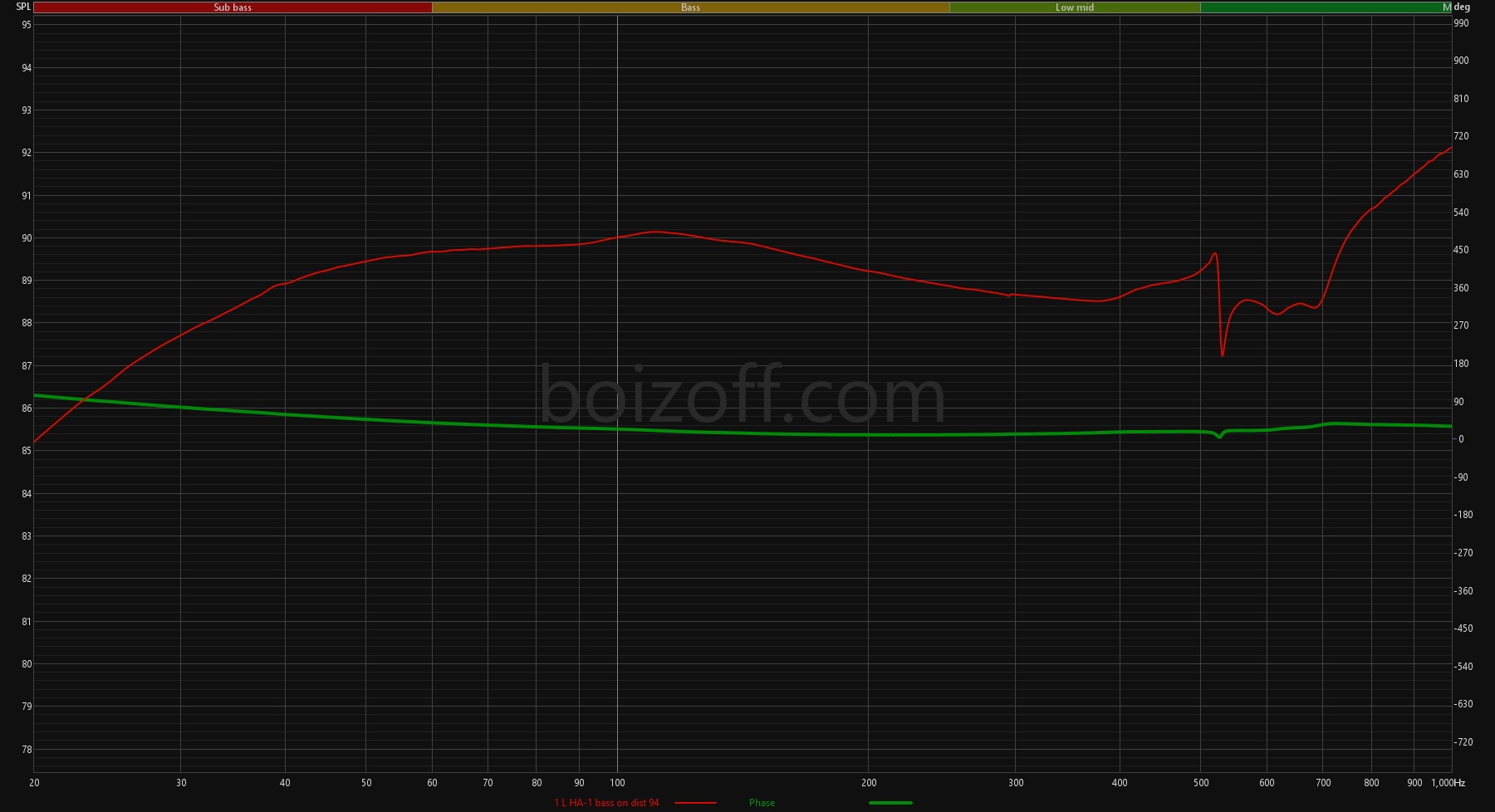
At exactly 531 Hz, we can see a peculiar, almost vertical step in the frequency response. This quirk is visible not only in my own measurements on squig.link, but also in measurements published by others (here, here, and here). You simply need to disable smoothing to reveal it. Let’s take a look at the phase response, group delay, and the spectrum:
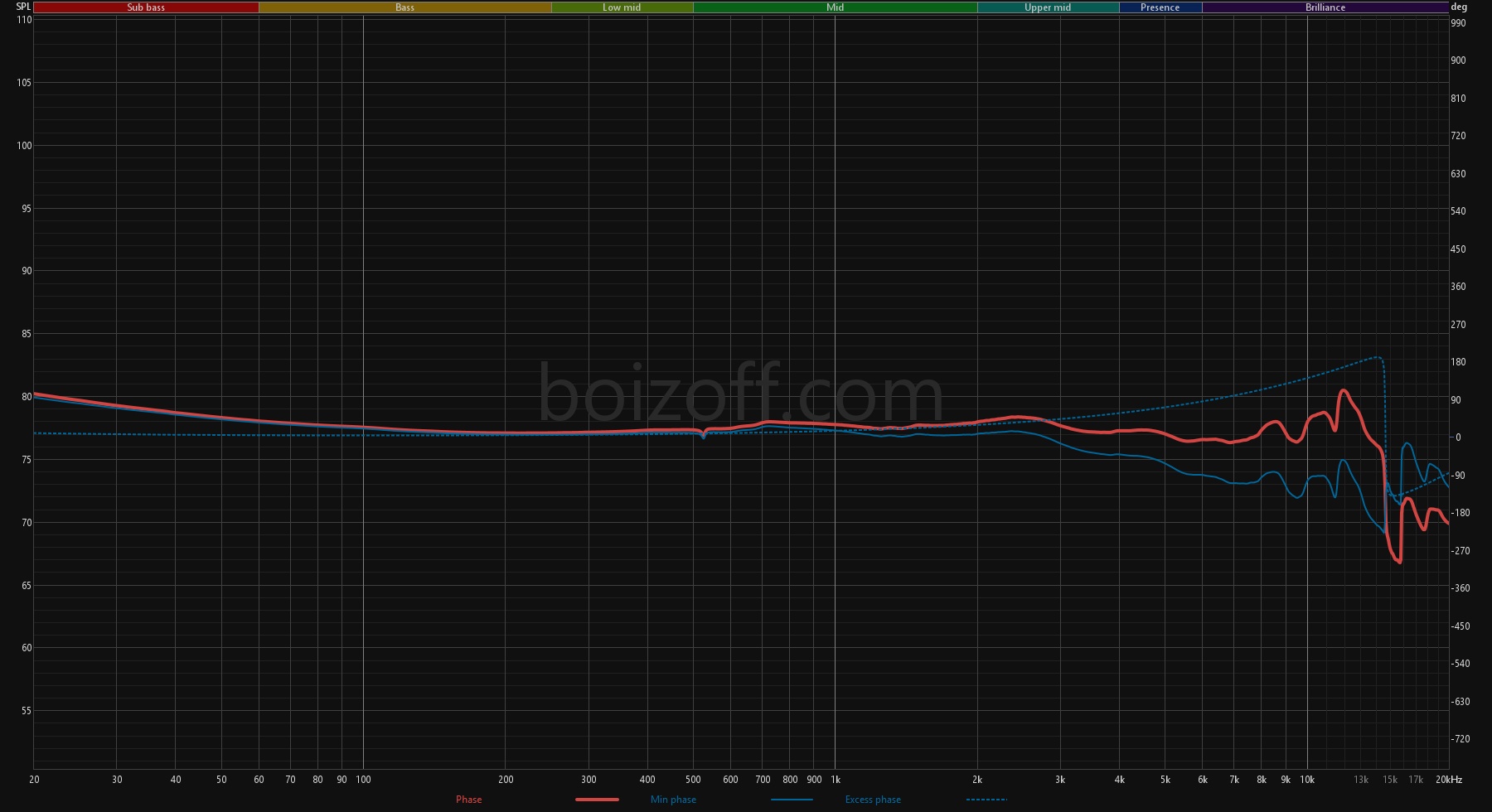
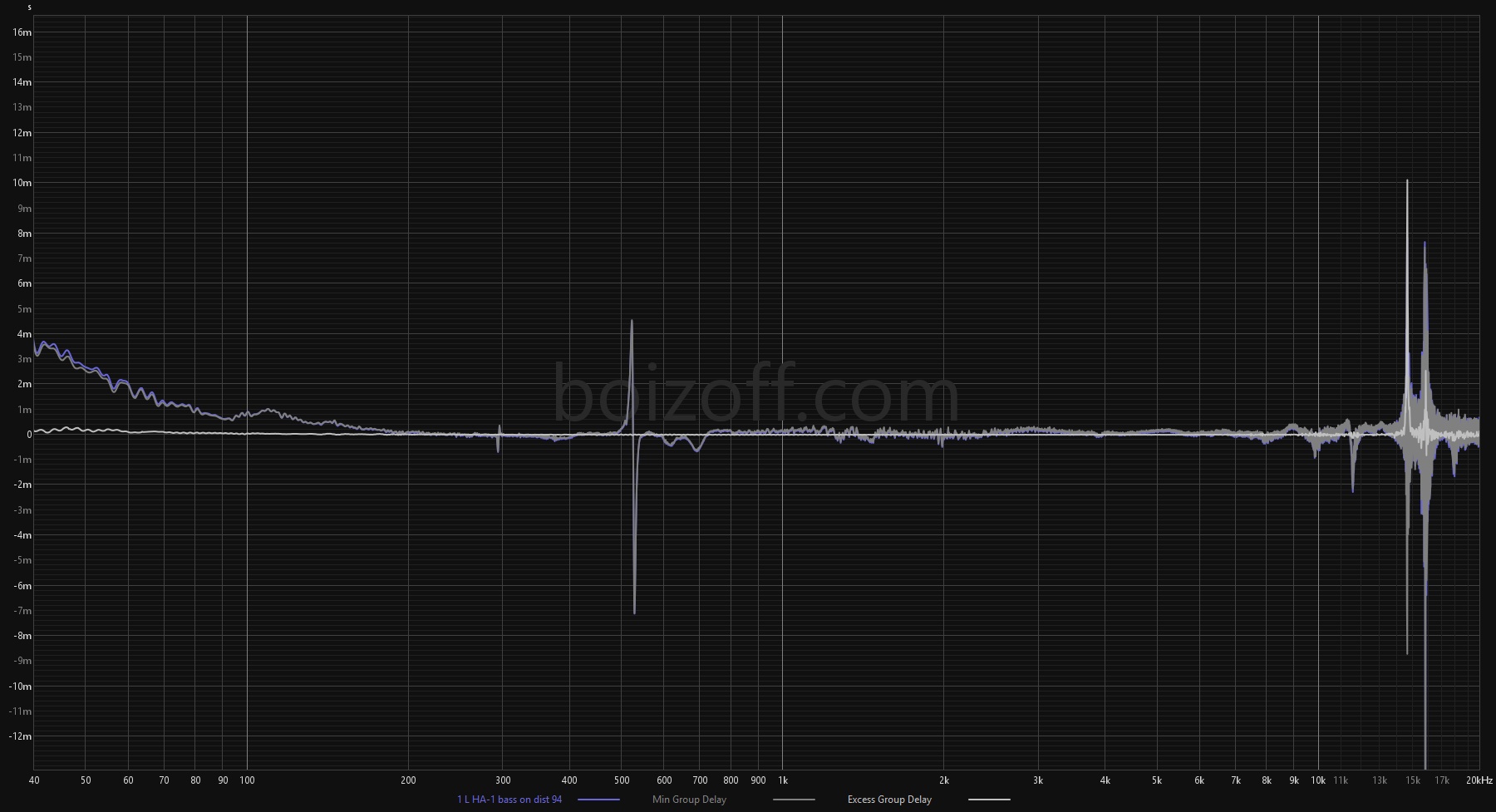
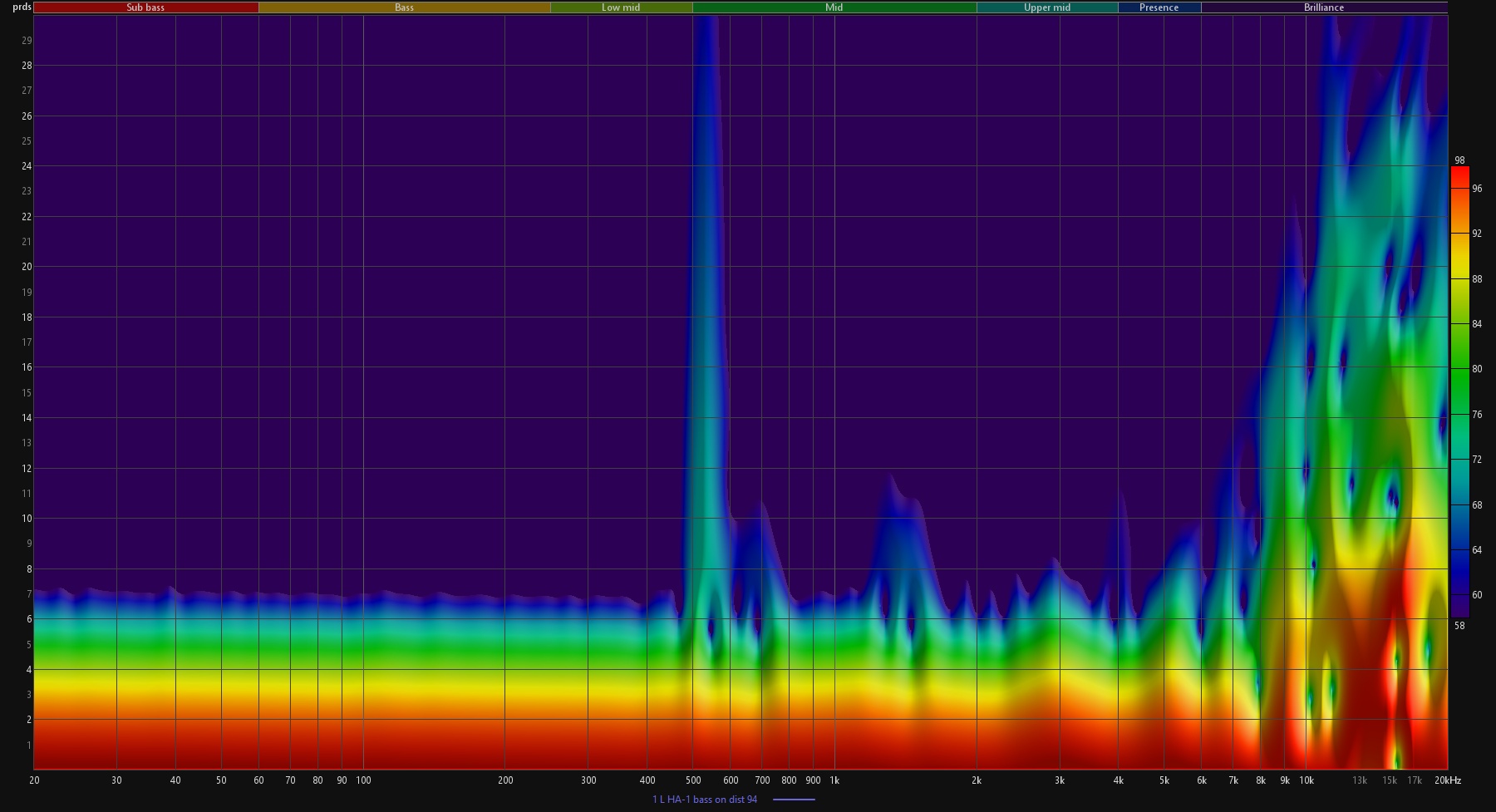
In other words, the measurements show a resonance at 531 Hz. It appears regardless of which earpads are installed, so it’s most likely related to the earcup structure itself or perhaps some ringing in the headband assembly. I tried to hear it using a sine sweep but never managed to do so. So, while the resonance is clearly visible in the measurements, I should emphasize that I personally cannot hear it.
Let’s move on to the sound. For listening tests, I used an ADI-2 DAC fs as the source. Incidentally, the manufacturer’s website features the very same pairing, with the only difference of them using the ADI-2 DAC Pro. I set the line output to 0 dB (+7 dBu) and adjusted the volume using the EHA-1’s volume knob. As a side note, a Shanling M0 Pro switched to line-out mode (you’ll need a 3.5 mm to 2 RCA cable) is also perfectly capable of driving the EH-1 through the EHA-1 to louder-than-enough levels.
Setting the bass switch to OFF results in a slight lack of low-end weight, while the ON position introduces a touch too much bass. Personally, I prefer the latter.
The EH-1 deliver a smooth, warm, and exceptionally comfortable sound. The defining trait of its tuning is the low end, which begins rising already in the lower midrange, combined with an extremely even and highly informative 3-8 kHz region that never comes across as aggressive. The slight emphasis around 5 kHz helps reveal subtle details in familiar recordings that might otherwise go unnoticed. The bass is slightly inflated and occasionally a bit boomy, depending on the track; the sub-bass is missing. The headphones can thump excessively, but they cannot produce that punchy or hard-hitting bass sound. In exchange, you get an extraordinarily detailed and refined treble response, a strong sense of air, and a very wide, precisely organized soundstage, aided by the elevation around 1 kHz. The overall sound is simply pleasant, even if it is not always entirely accurate. The EH-1 feel purpose-built for long listening sessions. Rather than drawing attention to flaws or fatiguing the listener, they aim to present the music in the most engaging way possible while preserving every available nuance.
Trying to define the types of music and listening scenarios where the EH-1 perform best, I’ve come to the following conclusions:
- Whether you’re listening emotionally for enjoyment or analytically for detail, the EH-1 work best with music that does not rely on clearly a separated sub-bass. Such material may not sound strictly “correct” through these headphones, but it will often sound enjoyable and highly engaging. Metal, hip-hop, and bass-heavy electronic/EDM genres are less convincing. On the other hand, live recordings, classical music, blues, jazz, hard rock, and trip-hop can be utterly mesmerizing.
- For competitive gaming, these are among the best, if not the very best, over-ear headphones I’ve ever heard.
Third-Party Earpads
The EH-1 respond exceptionally well to earpad rolling. Unfortunately, I didn’t have enough time to test these headphones with my entire collection of pads (I still need to add four models I’ve been using for the past year), but I did manage to measure and listen to a few combinations.
Frequency response of the EH-1 with XK Audio Fluxion pads, measured under realistic-fit conditions, with the bass switch set to OFF and ON:
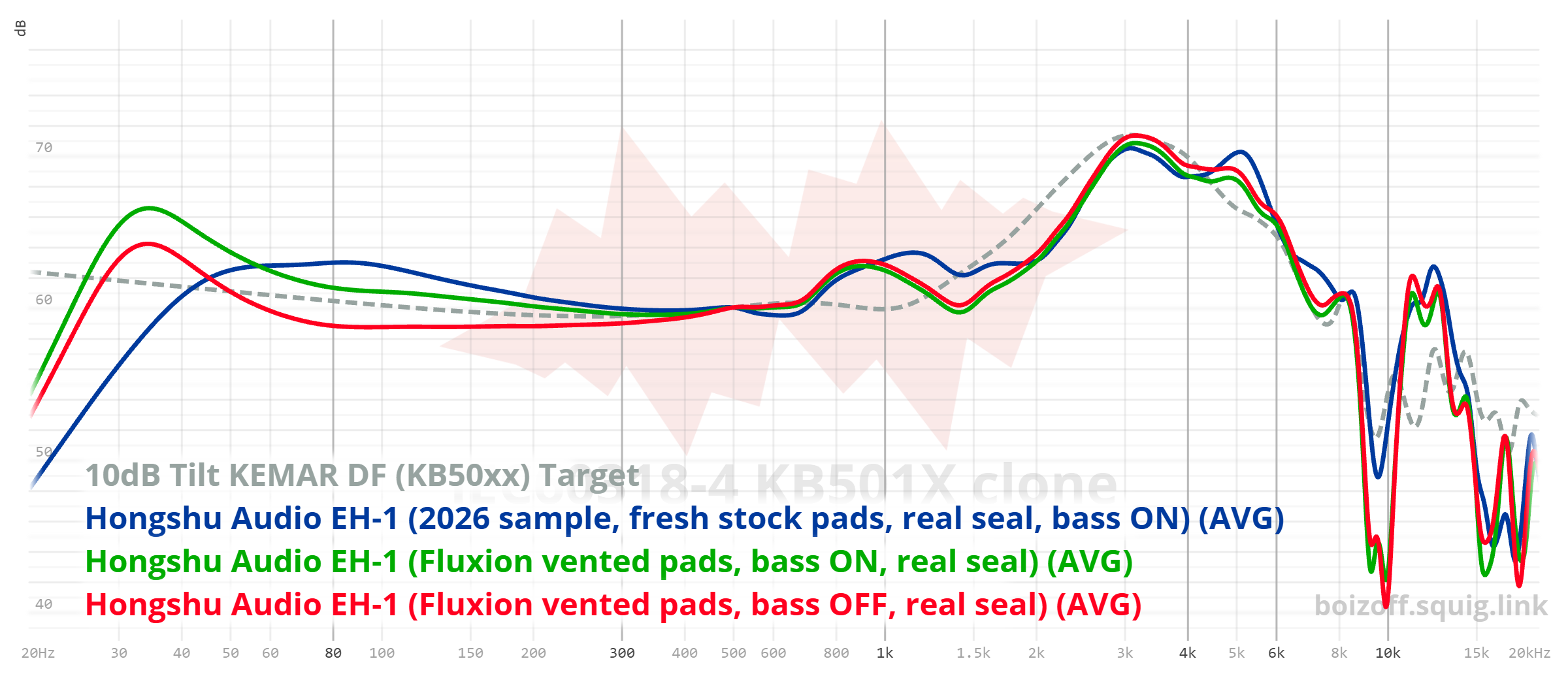
The stock Fluxion earpads, the ones with the rear tubes, leave the headphone’s character largely unchanged above 2 kHz, but address several shortcomings lower down in the frequency range. They reduce the emphasis around 1 kHz and add a substantial amount of well-separated sub-bass. In this configuration, I would actually prefer the bass switch set to OFF, as enabling it causes the low frequencies to become overly dominant on some tracks.
Frequency response of the EH-1 with angled semi-perforated sheepskin earpads (these ones), measured under realistic-fit conditions with the bass switch set to ON:
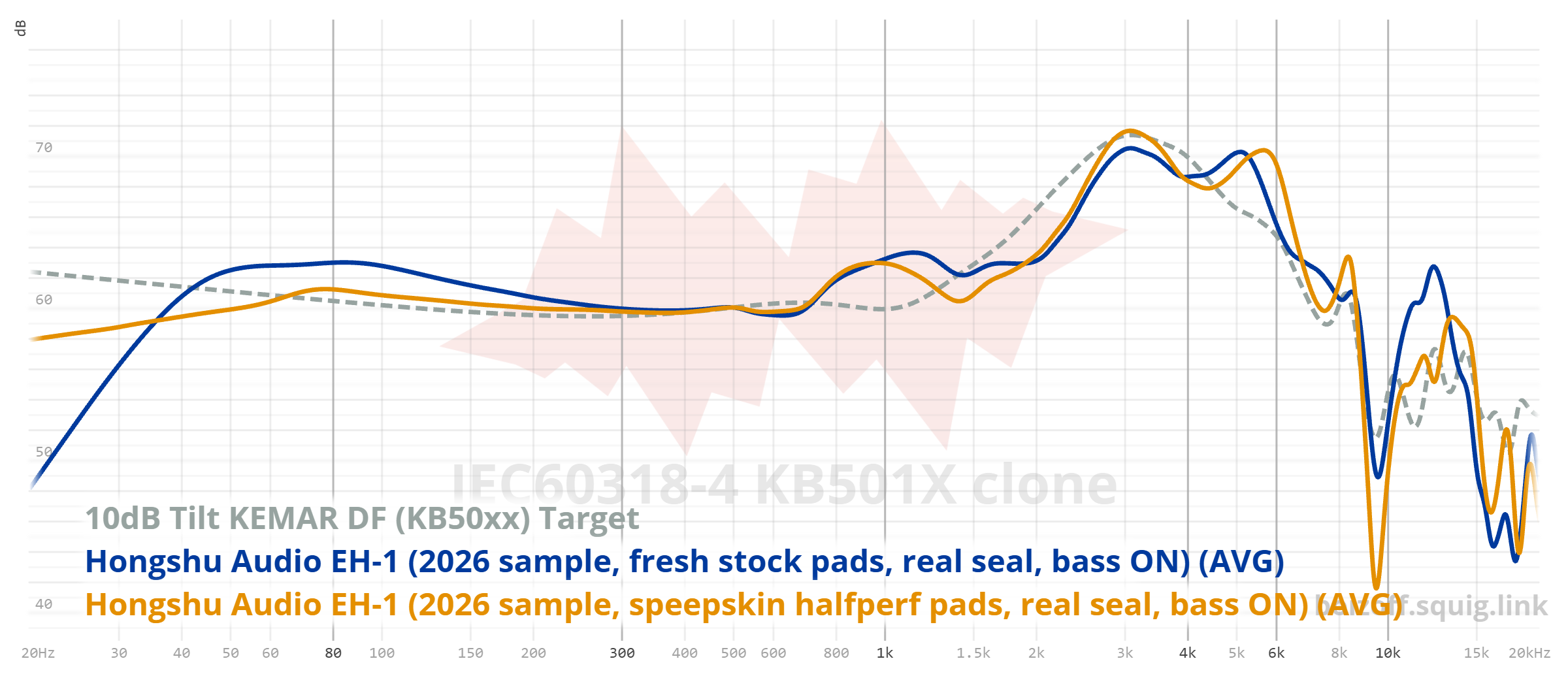
We get a bit more treble, but also the 12-13 kHz peak disappears entirely and the low frequencies closely match the diffuse-field target curve.
My impression is that with further experimentation, it would probably be possible to get the EH-1 remarkably close to a true DF-style tuning through earpad rolling alone.
Comparisons
Of similarly priced models, the only direct comparison I have on hand is the XK Audio Fluxion.
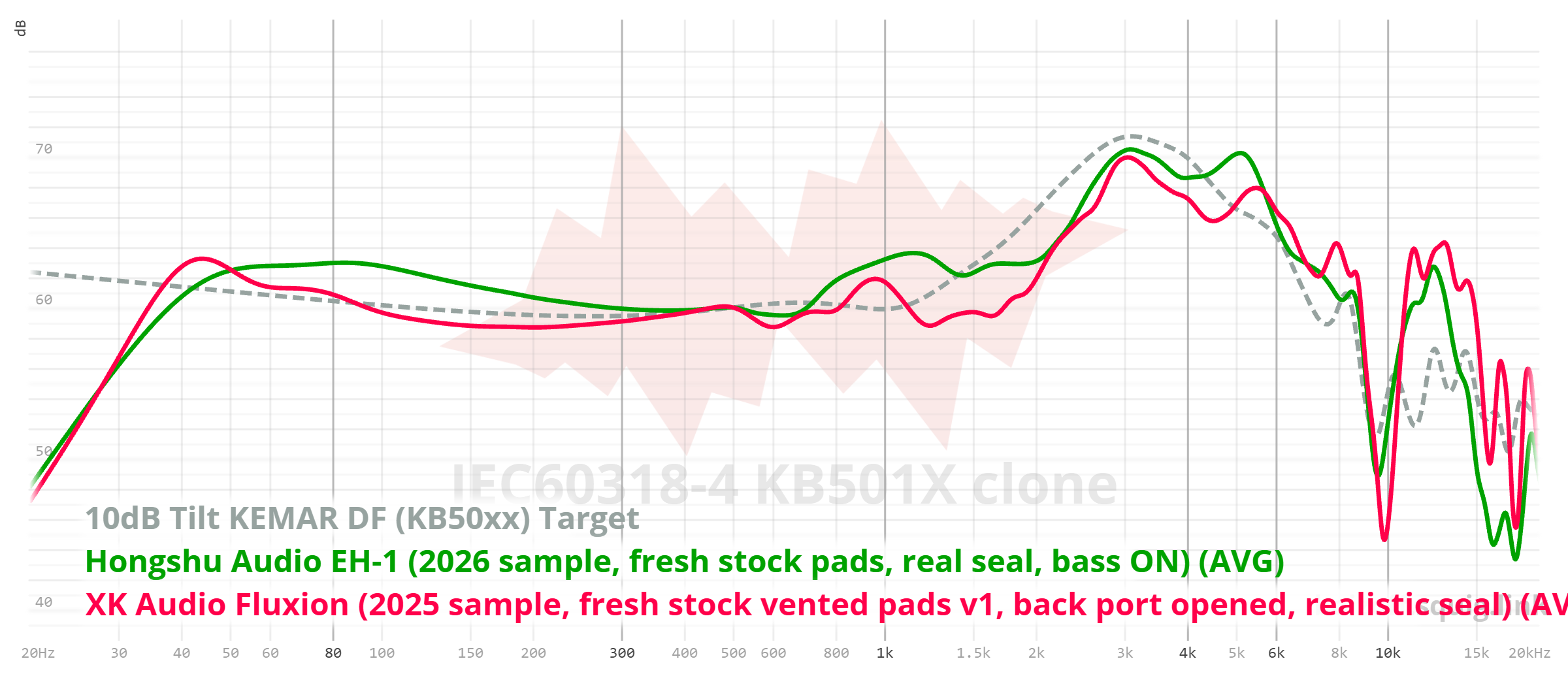
The Fluxion sound is more technically “correct”. At the same time, whether due to the lack of bass balancing out the treble or simply because of the way my head is, it actually comes across as sharper and less comfortable to listen to. In terms of comfort, I would consider the two models roughly equal. The EH-1 are also the better-built headphones, yet paradoxically they still feel more fragile. As for the sound, I personally lean toward the EH-1.
Speaking of headphones with a similar overall sounding, it would be impossible not to compare today’s review subject to the Sennheiser HD 490 Pro:
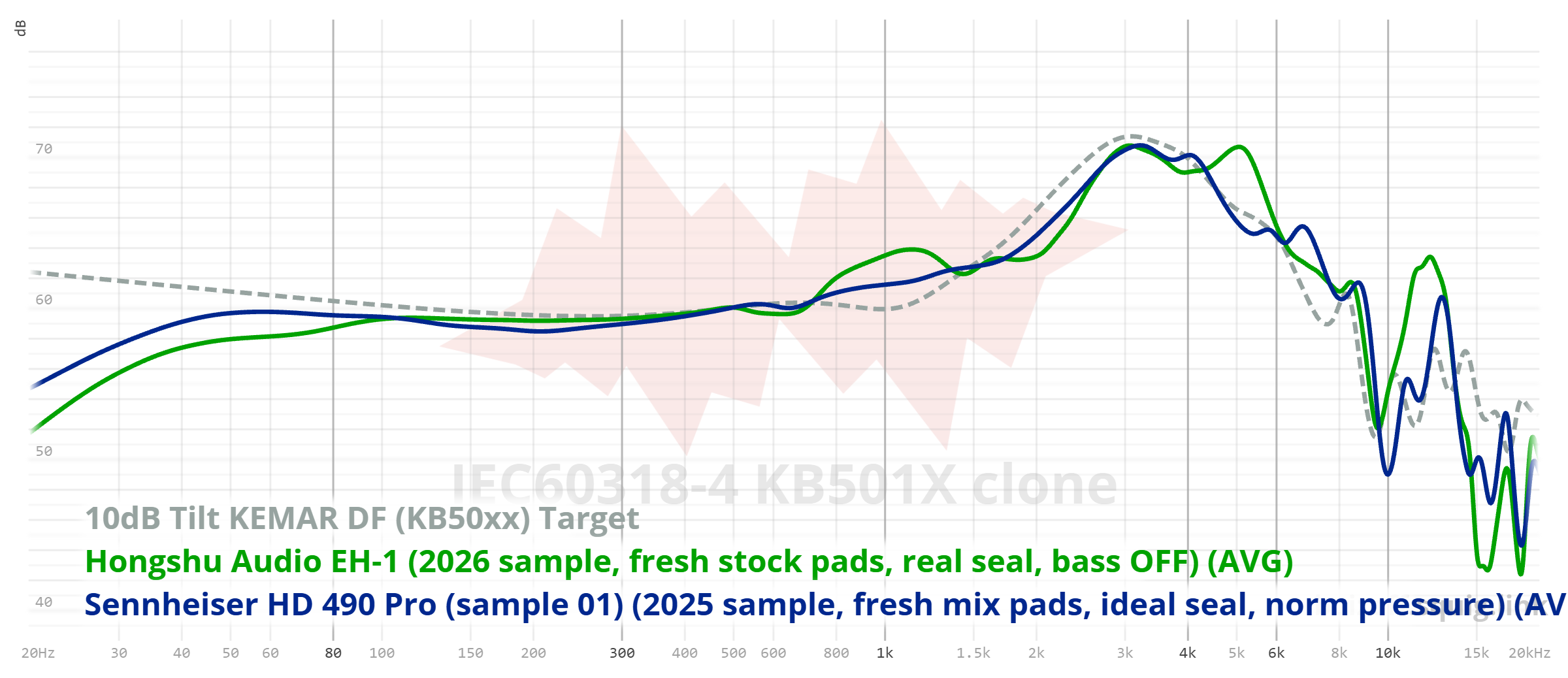
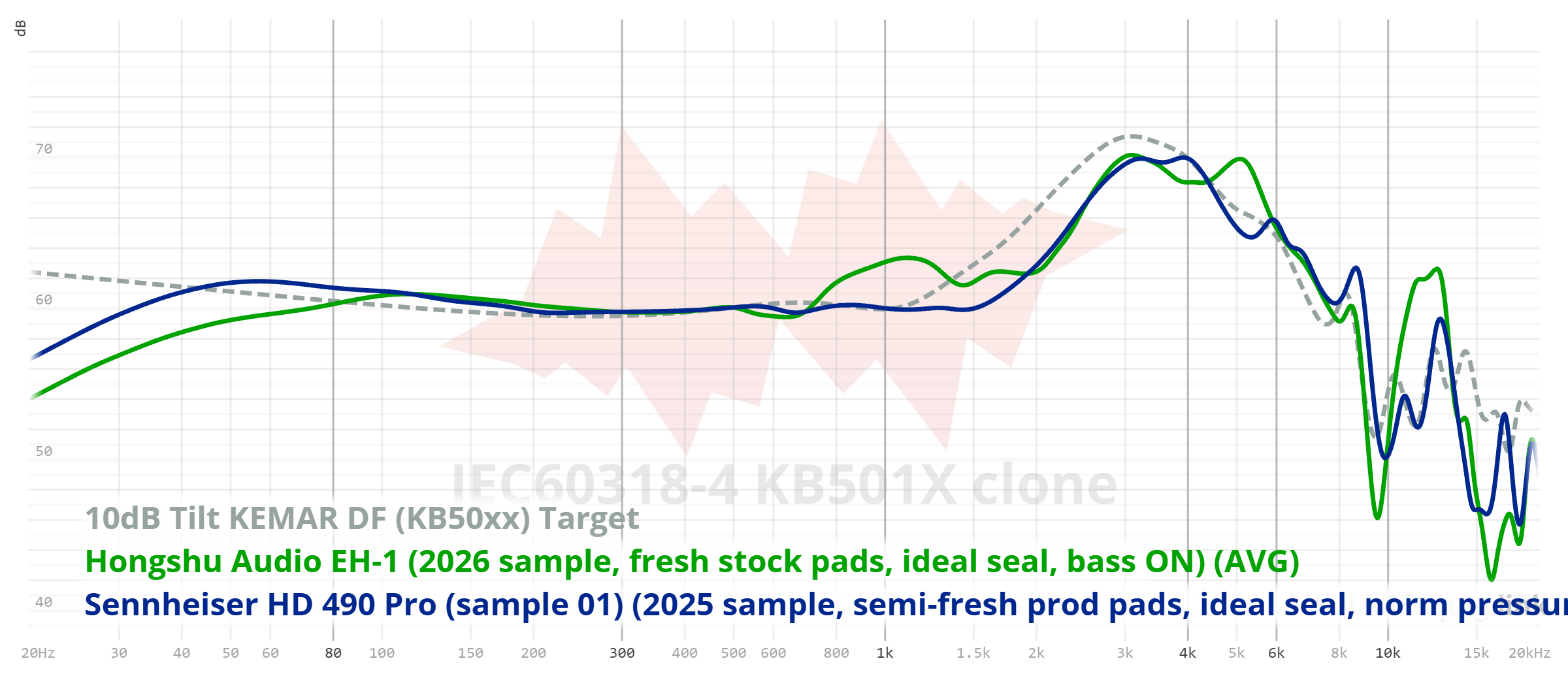
And this is where some of that electrostatic magic starts to fade a little. The HD 490 Pro sound slightly brighter in the 6-8 kHz region and present a somewhat narrower virtual soundstage. But the sub-bass of the Sennheiser is perceived as significantly more substantial and much faster, and the impact of bass transients is on an entirely different level. The overall tuning also feels more balanced and more correct, regardless of which set of earpads is installed. Then again, I’ve already sung the praises of the HD 490 Pro elsewhere. The EH-1, on the other hand, sound wider, and the positioning of sound sources within the virtual stage appears more obvious and easier to pinpoint.
Summary
I refuse to believe that “EH-1” stands for the rather mundane “Electrostatic Headphones” rather than being a cheeky ironic nod to the Sennheiser HE-1. Hongshu Audio spent four years refining their first and only model, and the result commands my genuine admiration.
The EH-1 sound wonderful, creating an instant “wow” moment from the very first seconds of listening.
That’s it – in a nutshell.
If you start digging deeper, there are questions regarding the build quality, material choices, and the thickness of the metal. The sound signature is spectacular but not particularly natural, and the sub-bass is practically non-existent with the stock earpads. At $650, if you are making an informed decision and choosing the sound rather than the technology and the elitist audiophile flair that electrostatics as a class are heavily coated in, then no, the EH-1 are not an obvious choice. However, if you’ve heard a lot of gear and are now looking for that “something special,” something out of the ordinary but without the million-dollar price tag, and you want it to be truly listenable for long sessions, then yes, I would call the EH-1 your very first option.
That said, the EH-1’s bank of objective pros is far from empty: the headphones are comfortable, distortions are at an all-time low among everything I’ve measured (which means EQ can be pushed to its limits), and pad rolling experiments are genuinely rewarding.
I want to sincerely congratulate Hongshu Audio. If your very first model turned out like this, what on earth are you going to show us with the second one?!
To buy or not to buy: in a nutshell, go for it.
P.S. Dear Hongshu Audio, I’ve already sent you an email (igor.boitsov@gmail.com), but I’ll ask here once more: please send me a sample unit. I’d like to finish the measurements with a wider range of earpads and collect at least a small amount of consistency data across multiple units.
Liked the review? Support the reviewer with a donation.
CloudTips | Boosty


